When Banks Are Taxed, Borrowers Can Pay Too
Recent Financial Times reporting on Jamie Dimon’s warning against higher UK bank taxes highlights a familiar policy dilemma. Governments view profitable banks as a source of revenue for public services and household support, while bank executives argue that additional taxation may discourage investment and employment. Dimon linked the UK’s business environment to JPMorgan’s planned London headquarters, illustrating how bank taxation can enter decisions about where financial institutions operate (Foy & Parker, 2026).
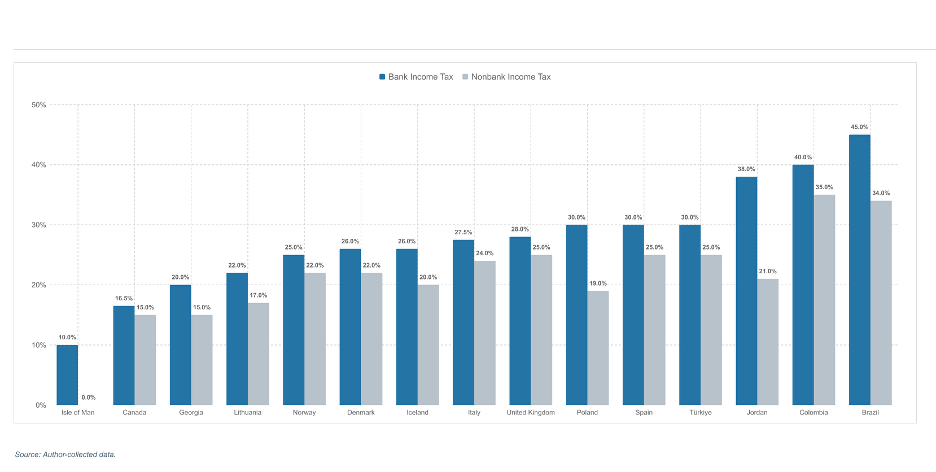
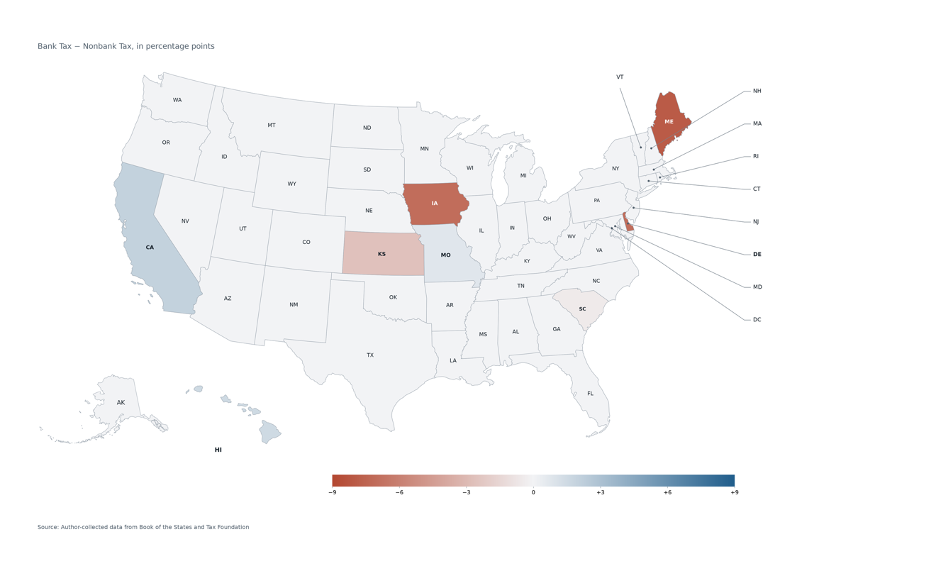
The debate takes place against a backdrop in which UK banks face a combined income-tax rate of 28%, 3 percentage points above the standard corporate rate of 25%.[[1]] Yet UK banks are not alone in being subject to higher income taxes than nonbank corporations. Figure 1 shows higher reported bank income-tax rates than ordinary nonbank rates in all 15 jurisdictions presented.[[2]] This pattern is evident in Northern Europe: Denmark taxes banks at 26%, compared with 22% for nonbanks; Iceland at 26% versus 20%; and Norway at 25% versus 22%. Higher bank rates also appear elsewhere in Europe, including the United Kingdom, Lithuania, Italy, Poland, and Spain. The pattern extends beyond Europe to countries such as Brazil, Colombia, and Jordan, indicating that higher taxation of banks is not confined to one region.[[3]] In other countries like the U.S., although banks and nonbank corporations face the same federal corporate income-tax rate, state-level rates can differ (Figure 2). Some states, like California, imposed higher income tax rates on banks than on nonbank corporations, while others, like Kansas, imposed lower rates.
Given the importance of bank income taxes, a related question arises: who, besides banks, bears the tax burden? Another voice belongs in this conversation: the business customer negotiating its next loan. A bank may write the cheque to the tax authority while asking borrowers, through higher lending charges, to help cover the cost. The tax bill has the bank’s name on it. The economic burden need not stay there.
Our research (Kang, Li and Lin, 2021) examines this process. We show that a bank, while legally responsible for paying income tax, can shift some of the burden to borrowers through higher loan spreads. Bank income taxes can affect loan pricing, and the response depends on market concentration and existing lending relationships. These features of credit markets help determine both the extent of tax pass-through and which borrowers are most exposed.
How a Bank Tax Reaches a Business
The economic mechanism is not automatic. A bank facing a higher tax burden may seek to preserve its after-tax return by charging more for newly arranged loans. Its ability to do so depends on how the tax affects lending returns and whether borrowers can obtain comparable financing elsewhere. A tax imposed on bank profits therefore needs to be understood alongside the market in which banks lend.
To examine this mechanism, our study follows changes in US state bank income-tax rates between 1994 and 2014. Because states changed their tax rates at different times, we can compare loan pricing before and after tax changes with pricing in states without such changes. Accounting for borrower characteristics, loan terms, and local economic conditions helps separate tax effects from changes in credit risk or the wider economy. We find that a one-percentage-point increase in the bank income-tax rate is associated with a 7.2–9.1-basis-point increase in loan spreads, measured as the charge above a benchmark interest rate plus annual fees. Our study also uses a calibration to estimate that around 24%–30% of banks’ tax burden is passed through to borrowers.
A Competing Offer Changes the Conversation
Borrowers’ alternatives constrain how much banks can adjust their prices. When several lenders can provide comparable credit, a borrower can respond to a higher spread by seeking another offer. Where alternatives are limited, moving to another lender may be costly or impractical. Loan demand is then less responsive to price, giving banks greater scope to pass on a tax increase.
Consistent with this mechanism, our study finds stronger pass-through in more concentrated banking markets. This does not establish that competition removes every tax-related increase in borrowing costs. It indicates that the same tax change can have different consequences depending on the competitive conditions borrowers face.
A Bank That Knows You Best
Established lending relationships can improve access to finance. Repeated interactions give a bank information about a borrower’s operations, prospects, and creditworthiness. That information can reduce uncertainty and support lending that would be more difficult for an unfamiliar bank to undertake.
The same information advantage can also make the relationship difficult to replace. A competing lender may need additional screening or require compensation for the uncertainty it faces. The borrower consequently cannot always obtain equivalent terms elsewhere, even when other banks are present. The relevant constraint is access to a credible substitute, rather than the number of potential lenders alone.
In our study, we find stronger tax pass-through among borrowers that borrowed more frequently from the same bank during the preceding five years. This result concerns sensitivity to tax changes, not whether relationship borrowers always pay higher rates. The benefits of an informed lender can coexist with greater dependence on that lender when prices are renegotiated.
What Does This Mean for Bank Tax Policy
Bank-tax policy should be assessed not only by the revenue it raises but also by who ultimately bears its cost. The broader lesson applies across jurisdictions: a tax legally paid by a bank may be partly passed on to borrowers through higher loan prices. Governments should therefore consider borrowers’ financing alternatives and switching costs when evaluating a proposal, particularly where competition is limited and firms depend heavily on established lenders.
This perspective has practical implications for policy design and evaluation. Before introducing a tax, policymakers should assess its potential effects on the cost and availability of business credit. After implementation, monitoring new and renewed loans could help identify whether borrowers with fewer alternatives bear a greater share of the burden. Borrower choice is therefore relevant to tax policy, although the research does not establish that any particular competition reform would eliminate pass-through.
These implications must remain within the limits of the evidence. Estimates from historical US corporate lending should not be applied unchanged to other countries or credit products. The study examines pricing when loans are arranged, not automatic changes to existing contracts. Income taxes, profit surcharges, and balance-sheet levies also require separate analysis because their bases and incentives differ.
For business leaders, the lesson is to assess credible financing alternatives before a loan renewal. An established banking relationship remains valuable, but the ability to obtain comparable financing elsewhere may strengthen a borrower’s negotiating position.
Pass-through does not, by itself, make bank taxes undesirable or justify exempting banks from taxation. It identifies a potential cost to weigh against revenue needs and distributional objectives. The policy question is therefore not simply how much banks should pay, but how the burden is shared—and whether the benefits financed by the tax justify those costs.
References
Foy, S., & Parker, G. (2026, August 16). Jamie Dimon warns UK chancellor against higher bank taxes. Financial Times.
Kang, Y., Li, O. Z., & Lin, Y. (2021). Tax incidence in loan pricing. Journal of Accounting and Economics, 72(1), Article 101418.
[[1]] Those banks also pay a separate bank levy on their UK balance sheets, known as a financial stability contribution, which further increases the burden imposed on banks.
[[2]] Source: Author-collected data. Country-specific references are as follows: Isle of Man—PwC’s corporate income tax rates overview, corporate income tax summary, and Pillar Two developments; Canada—the Canada Revenue Agency’s corporation tax rates and additional tax on banks and life insurers; Georgia—PwC’s corporate income tax rates overview and Georgia corporate income tax summary, and the Tax Code of Georgia; Lithuania—VMI’s corporate income tax rate guidance and consolidated Corporate Income Tax Law; Norway—the Tax Administration’s 2026 tax rates and financial activities tax guidance; Denmark—SKAT’s guidance on the ordinary corporate tax rate, financial-company tax factor, and covered institutions; Iceland—the Income Tax Act and government guidance on the financial activities tax; Italy—government guidance on IRES and IRAP, parliamentary materials on the bank IRES surcharge, and the parliamentary dossier on 2026 bank IRAP changes; United Kingdom—HMRC’s corporation tax rates and 2026 banking-sector tax statistics background information; Poland—the tax authority’s corporate and bank income tax guidance and the 2025 legislative amendment; Spain—AEAT’s corporate and bank tax rates and the legislation establishing the bank margin tax; Türkiye—the Revenue Administration’s corporate tax guidance and 2026 corporate tax return guide; Jordan—PwC’s corporate income tax rates overview and corporate income tax and national contribution summary; Colombia—DIAN’s consolidated Tax Statute, the Constitutional Court’s Judgment C-079/26, and DIAN’s Form 110 instructions; and Brazil—Receita Federal’s IRPJ guidance, the CSLL law, and the law governing CSLL nondeductibility.
[[3]] These headline comparisons should nevertheless be interpreted with caution because eligibility rules differ and the estimated rates are based on the highest applicable tax bracket.