The Global Minimum Tax for U.S. Companies: Early Evidence from Annual Reports
Pillar Two, the OECD’s global minimum tax, is one of the most coordinated changes to cross-border taxation in decades. In October 2021, 136 countries and jurisdictions agreed to a plan that sets a 15% floor on the tax rate that large multinationals, those with annual revenue of at least €750 million, pay on the profits they earn in each country where they operate. The rules are built to work together: when one country does not collect the tax on a company’s low-taxed profits, another can. The European Union and the United Kingdom began applying the rules in 2024, and Singapore and Hong Kong followed in 2025.
However, U.S. companies pay the tax only abroad, because the United States has not adopted Pillar Two. U.S. companies pay Pillar Two taxes in the countries that have adopted the rules, mostly through those countries’ domestic minimum taxes. This study examines and reports what large U.S. companies disclose about Pillar Two in their annual reports for 2025. My focus on 2025 is somewhat data-driven. I also pulled the data for 2024, but found that amount of tax related to Pillar Two reported by U.S. companies was only about 1% of the 2025 total. More on this later. The goal of this study is to provide initial, descriptive evidence on the effect of Pillar Two taxes on U.S. multinationals by examining how those very companies discuss it in their own annual reports.
Long story short: a small majority of large U.S. companies say nothing about Pillar Two in their annual reports. Of those that do discuss Pillar Two taxes, most give no number and usually say the tax is not material. Only a few give a number, and only about 4% of sample companies report that they recorded any Pillar Two tax expense for the year. Together, U.S. companies report $10.8 billion, and one company, Micron, accounts for about 84% of it. Almost all of the money goes to Singapore, which collects 95% of the reported tax. For the companies that pay it, the tax is meaningful, about a tenth of total income tax expense for the median payer, but across all large U.S. companies it is still small.
The data
To build a sample, I start with every 2025 annual report filed with the SEC by a company with revenue of at least $850 million, roughly the €750 million threshold in the rules.[1] I remove foreign companies that file Form 20-F or 40-F, companies that file Form 10-K but are incorporated outside the United States, and companies controlled by a foreign parent. After those removals, 1,583 large U.S. companies remain in the sample.[2]
To find and read the disclosures, I used textual analysis and natural language processing carried out by an AI agent (Anthropic’s Claude). The agent searched each report for 72 phrases that companies use for Pillar Two,[3] read every passage the search returned, classified what each report says about the tax, and extracted each Pillar Two tax amount and the country the filing tied it to. At the end of this exercise, the data show that, of the 1,583 sample companies, 713 discuss Pillar Two somewhere in the report.
Background on Pillar Two
Pillar Two is an OECD initiative for a 15% minimum corporate tax rate on large multinationals, and its stated objective is to reduce the incentive to shift profits to low-tax or no-tax countries. The OECD publishes only guidelines, so each country must adopt the rules into its own law. More than 50 countries have done so, many with effect for years beginning in 2024 or 2025, and others are still drafting.[4]
The United States did not pass Pillar Two legislation, and therefore U.S. companies owe no Pillar Two tax at home. However, the tax reaches U.S. companies through their subsidiaries. The rules are designed so that the minimum tax is collected somewhere within the group, starting with a country’s own minimum tax on the profits of subsidiaries inside its borders. A U.S. company with subsidiaries in a country that has adopted such a tax therefore pays when its profits in that country were taxed at an effective rate below 15%. Most EU member states and the United Kingdom enacted the rules with effect from 2024, and Singapore and Hong Kong applied theirs to companies starting in 2025.[5]
What do U.S. companies say about Pillar Two?
Most say nothing about Pillar Two. Just over half of the 1,583 companies do not discuss Pillar Two at all (Figure 1 below). Recall that these companies all have revenue of at least $850 million and are precisely the companies that could be subject to Pillar Two taxes. Among the 713 companies that do discuss Pillar Two taxes, the most common message is reassurance: more than half of them say that the tax had no material effect on the year or that they expect no material effect in the future. Most of the remaining companies mention Pillar Two only in boilerplate risk factor language, say that they are monitoring developments, or state that they are within the scope of the rules without saying how large the effect might be, and a small number say that they rely on one of the safe harbors in the rules. Only 119 companies, or about 8% of all large U.S. companies, state a specific amount of Pillar Two tax, and only 62 of them report Pillar Two tax expense greater than zero for the year. In the rest of this paper, I call these 62 companies “payers.”
Much of the silence comes from companies with little foreign activity. Among the 457 companies with no foreign income or tax in their data, almost all say nothing about Pillar Two. Among the 1,126 companies whose financial data show foreign income or foreign tax, about 40% say nothing about Pillar Two, and the vast majority of the payers belong to this group.
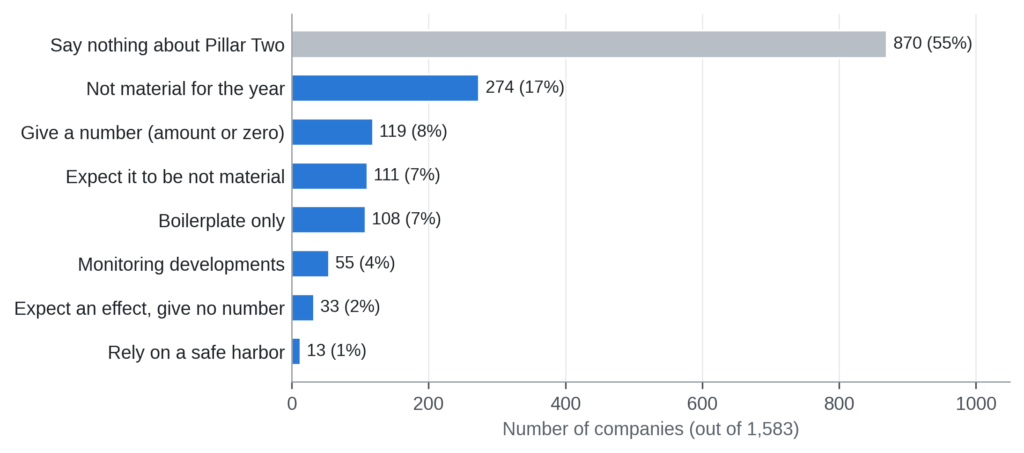
U.S. accounting rules permit this silence about Pillar Two. International accounting standards require companies to report their Pillar Two current tax as a separate amount, but U.S. GAAP has no such requirement, so U.S. companies disclose the tax mainly when they judge the amount to be material.[6] A silent report therefore does not mean a zero tax bill, and the totals reported below are a floor rather than a complete count.
Earnings calls tell the same story from the other side. Martin Jacob, Kaitlyn Kroeger, Jaron Wilde, and Ryan Wilson find in a recent working paper that only about 5% to 6% of affected U.S. multinationals discussed the global minimum tax on their earnings calls in 2024 and 2025, and that most of those that did described a negative effect; Kroeger recently summarized that evidence on this site. Their findings are consistent with mine: a company raises the tax on an earnings call mainly when the tax is material to it, and the annual reports examined here show that for most large U.S. companies it is not, since nearly half discuss Pillar Two and more than half of those say that it is not material.[7]
Some companies did warn investors a year ahead that the tax was coming. Micron’s previous annual report said Singapore’s rules “will apply to us starting in 2026,” meaning the year covered here, and that it expected its tax rate “to be in the mid to high-teens percentage range.” Its effective tax rate then rose from 11.6% to 14.8%. Mastercard’s 2024 report said the rules would “primarily offset” the benefit of its Singapore incentive in 2025, and Mastercard reported $233 million for 2025.[8]
How much do U.S. companies disclose paying in Pillar Two taxes?
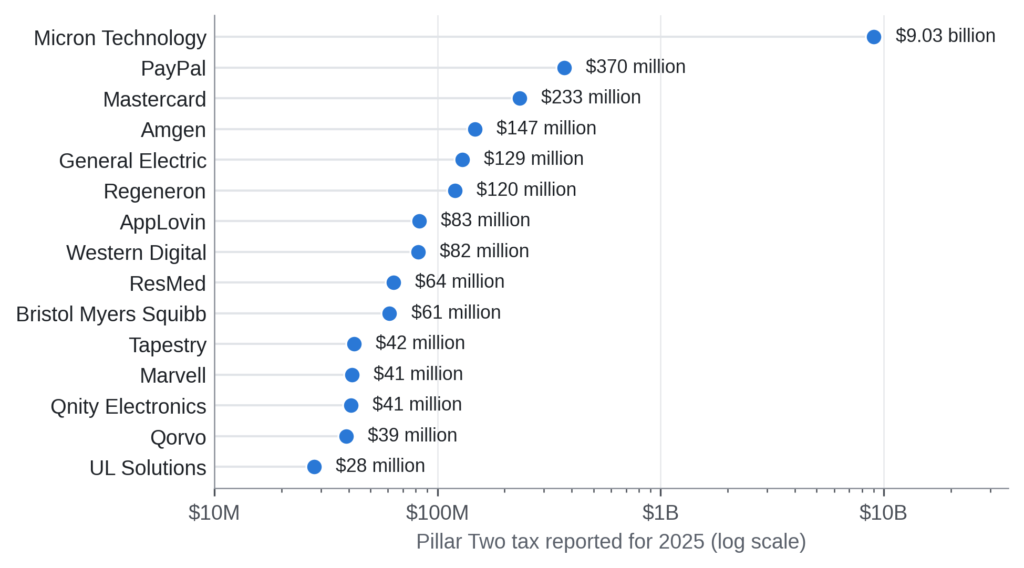
U.S. companies report $10.8 billion of Pillar Two tax for 2025 (Figure 2). However, one company dominates the sample: Micron Technology reports $9.03 billion in Pillar Two tax, which makes up about 84% of the total. The other 61 companies that disclose Pillar Two tax expense add up to $1.78 billion between them.[9] After Micron, the amounts fall off quickly, from $370 million for PayPal down to $28 million for UL Solutions. These 15 largest disclosed amounts account for 97% of the $10.8 billion in Pillar Two tax expense disclosed by the sample companies for 2025.
Where do U.S. companies disclose paying Pillar Two taxes?
As noted above, the disclosed Pillar Two tax is concentrated in just a handful of companies. But it is also highly concentrated into a single country: Singapore. Figure 3 shows that 95% of the Pillar Two tax that U.S. companies report is tied to Singapore. Even without Micron, Singapore collects 70% of the tax that the other companies report. Other than Singapore, the amounts are small and scattered across many countries. Ireland, with $172 million from six companies, and Thailand, with $91 million that comes mostly from Western Digital, come next, and no other country reaches $40 million.
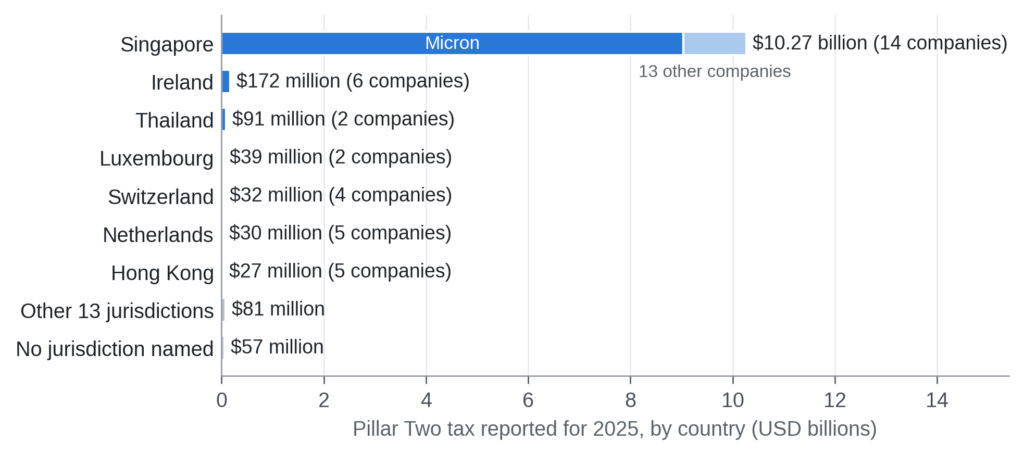
So why does Singapore dominate the sample? The answer is the tax incentives that Singapore grants to large multinationals, which reduce the tax on a company’s Singapore profits to an effective rate below 15%, even though Singapore’s statutory rate is 17%. As a result, Pillar Two requires a “top-up” of the tax on those profits to the 15% minimum.[5] Micron is the clearest case of this pattern. Its tax incentive arrangements in Singapore cut its tax by $11.22 billion in the year; however, the Pillar Two top-up tax took back $9.03 billion, which left Micron a net benefit of about $2.2 billion from its incentives.[10] Mastercard and General Electric describe the same offset of their Singapore incentives in their own filings. Singapore’s rules applied for the first time in 2025, so this is also the first year the 15% floor could bind there.
In the European Union and the United Kingdom, the floor mostly does not bind for U.S. companies because statutory rates in most of Europe are above 15%. The exception is Ireland with its 12.5% statutory rate, which likely explains why it shows up as the second-largest country in the data, at $172 million. The rest of the EU and the U.K. add about $111 million in total. The same fact explains the dearth of Pillar Two taxes that U.S. companies disclosed for 2024, when the EU and U.K. rules were in force but Singapore’s was not, and U.S. companies reported just $139 million.[11]
How heavy is the tax for the companies that pay it?
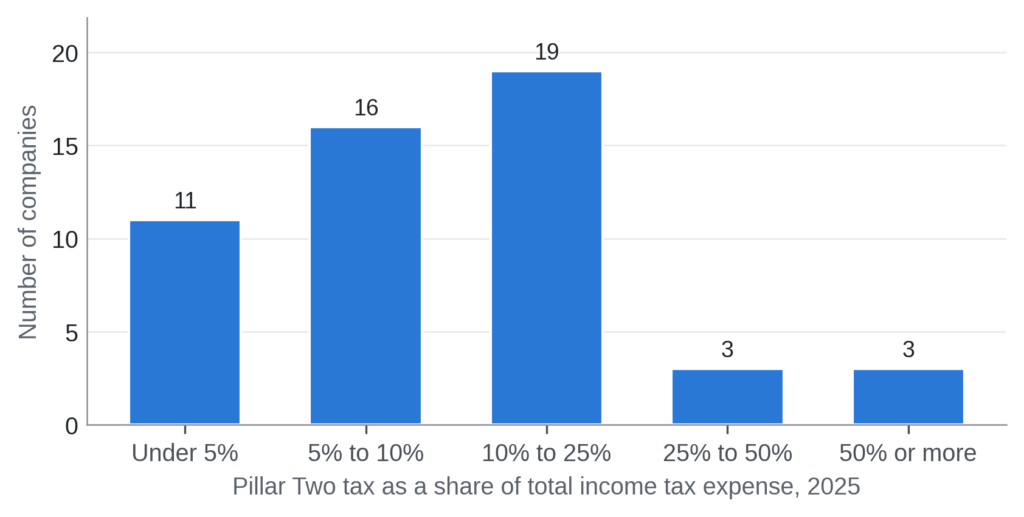
The tax is meaningful for the companies that pay it. For the median payer, the Pillar Two tax equals about 10% of total income tax expense (Figure 4). For three companies, Qorvo, Micron, and Advanced Energy, the Pillar Two tax exceeds half of total income tax expense, and for three more, Bumble, PayPal, and Victoria’s Secret, the tax falls between a quarter and a half.[12]
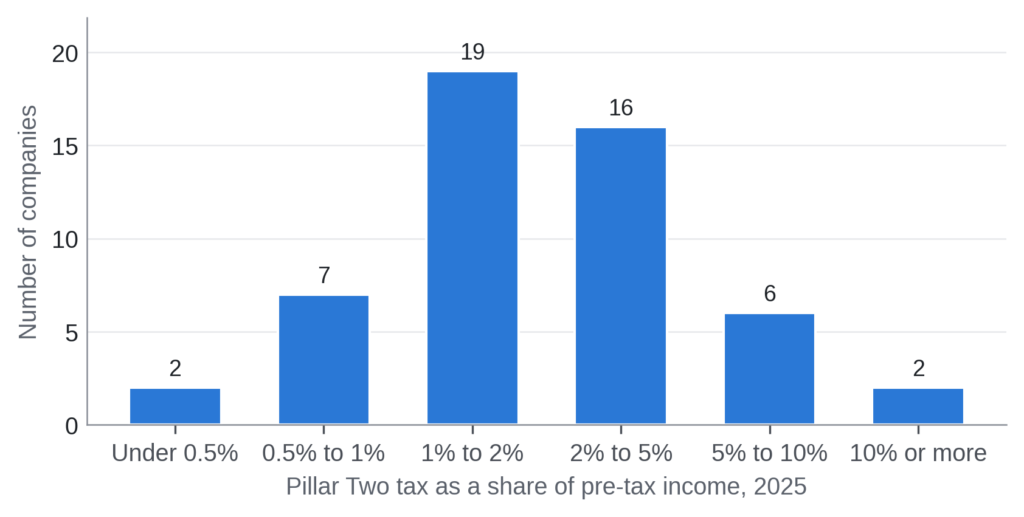
Measured against profit, the tax is smaller but still visible (Figure 5). For the median payer, the Pillar Two tax equals about 2% of pre-tax income. Of note, Micron’s Pillar Two charge equals 9.1% of its pre-tax income and 61% of its total income tax expense.
Across all large U.S. companies, however, the tax is still small: the reported tax equals 0.36% of the combined pre-tax income of the companies with positive pre-tax income, and the share falls to 0.06% without Micron.
In summary
This study asked a simple question: now that the global minimum tax is in force in much of the world, what do large U.S. companies say about it in their annual reports, and how much do they disclose paying? To answer it, I examined the 2025 annual reports of 1,583 U.S. companies with revenue of at least $850 million, the size at which the Pillar Two rules can apply, filed with the SEC through October 2026. I used textual analysis and an AI agent to evaluate these reports. I set the search terms and the rules the agent followed and reviewed its output, and the agent read every passage that mentioned Pillar Two, classified what each report said about the tax, and extracted any amount of Pillar Two tax expense that the report disclosed along with the country to which the filing tied it. I also examined 2024 reports, the first year in which the European and U.K. rules applied, as a point of comparison.
The findings are as follows. First, a small majority of large U.S. companies say nothing about Pillar Two in their annual reports, and most of the companies that do discuss it give no number and say that the tax is not material. Second, only about 4% of the sample (62 companies that I call “payers”) disclose Pillar Two tax expense greater than zero for 2025. Third, these payers together report $10.8 billion, but one company, Micron Technology, accounts for about 84% of that total, and the largest amounts from just 15 payers account for 97% of it. Fourth, the tax is just as concentrated by country: 95% of the disclosed tax is tied to Singapore, and even without Micron, Singapore accounts for 70% of what the other payers report. Singapore dominates not because its statutory rate is low, but because its tax incentives reduce the effective rate on many U.S. companies’ Singapore profits to well below 15%, which Pillar Two then tops up. In Europe, on the other hand, where statutory rates are mostly above 15%, the rules collected little from U.S. companies, with Ireland and its 12.5% rate the main exception. Finally, for the companies that pay the Pillar Two tax, it is meaningful, amounting to about 10% of total income tax expense and about 2% of pre-tax income for the median payer. Across all large U.S. companies, the total Pillar Two tax burden remains fairly small.
Two punchlines follow from these results. First, the global minimum tax has reached U.S. companies even though the United States never adopted it, but so far it is largely one company’s tax paid to one country: Micron’s top-up tax in Singapore. Second, for most large U.S. companies, Pillar Two is, for now, a disclosure topic rather than a tax bill, since a small majority say nothing about it and most of the rest say that it is not material.
A note on sources
Unless noted otherwise, all figures come from the AI-assisted reading, described in note 3, of 2025 annual reports (Form 10-K) filed on the SEC’s EDGAR system through October 2026.
Use of AI
I drafted this paper with the assistance of Claude, an AI model developed by Anthropic. The data come from an original collection of Pillar Two disclosures in Form 10-K filings that I designed and directed. Claude ran the filing searches, read every passage they returned, classified the reports, extracted and cross-checked the amounts in separate passes, resolved disagreements under written rules, prepared the figures, and helped draft and edit the text. I set the search terms and the rules, reviewed and edited the output, and am responsible for any errors.
Notes
[1] I use $850 million because it is the revenue threshold for U.S. country-by-country reporting, which the Treasury regulations set as the approximate dollar equivalent of the €750 million threshold in the OECD rules. Pillar Two applies the same €750 million test, so companies below the cutoff are unlikely to owe the tax. Two companies below the cutoff did report small amounts, which I leave out. I apply the test to each company’s 2025 revenue as tagged in its XBRL financial data (for nine companies whose 2025 revenue was not tagged, to the prior year’s revenue), rather than to the two-of-the-last-four-years test in the rules.
[2] The definitions are as follows. U.S.-parented means a Form 10-K filer incorporated in a U.S. state or the District of Columbia. I exclude two filers that foreign groups control, MiniMed and Children’s Place. Fiscal 2025 means the fiscal year that began in calendar 2025. A year that begins in the last week of December counts toward the next year. Revenue comes from each company’s XBRL data. The search window runs through October 2026. The total of $10.8 billion ($10,796 million) nets one negative amount of $17 million. The 62 disclosed amounts greater than zero total $10,813 million.
[3] The agent searched EDGAR full-text search for Form 10-K, 20-F, and 40-F filings filed from January 2025 through October 2026 for 72 phrases: the core terms (“Pillar Two,” “top-up tax,” and “global minimum tax”), their variants and the names of the rules (such as “Pillar 2,” “GloBE,” and “qualified domestic minimum top-up tax”), and alternative phrasings of a global or 15% minimum tax. For the broad phrases, such as “minimum tax,” the agent read every hit and removed uses unrelated to Pillar Two, such as the U.S. corporate alternative minimum tax. The agent read each passage twice in independent passes, and a rules-based step settled the cases where the two readings disagreed. The full phrase list, regular expressions, and reconciliation rules are available from the author.
[4] This section follows Kristina Allan et al., “Pillar Two ASC 740 Financial Tax Accounting Considerations” (Baker Tilly, February 13, 2026), which also covers the three layers of the rules (the qualified domestic minimum top-up tax, the income inclusion rule, and the undertaxed profits rule), the Side-by-Side arrangement, and the accounting treatment under U.S. GAAP.
[5] Inland Revenue Authority of Singapore, Multinational Enterprise Top-up Tax and Domestic Top-up Tax, e-Tax Guide, 2nd ed. (January 7, 2026), para. 4.1; Hong Kong Inland Revenue Department, “Global Minimum Tax and Hong Kong Minimum Top-up Tax”; IRAS, “Corporate Income Tax Rate, Rebates and Tax Exemption Schemes” (the 17% headline rate). Mastercard’s 2025 Form 10-K says the Pillar 2 rules that took effect in Singapore in 2025 “largely offset” the reduction in its effective tax rate from its tax incentive, and General Electric’s 2025 Form 10-K says its Singapore incentive benefit “was reduced by $121 million of the global minimum tax under Pillar 2.”
[6] IAS 12, paragraph 88B, as amended in 2023, requires companies to disclose current tax expense related to Pillar Two income taxes separately. U.S. GAAP has no corresponding requirement.
[7] Kaitlyn Kroeger, “The Global Minimum Tax Is Live. How Are U.S. Multinationals Responding?” Tax Policy Network, October 19, 2026; Martin Jacob et al., “How Do U.S. Multinationals Navigate the Global Minimum Tax?” (working paper, 2026).
[8] Micron Technology, Form 10-K for fiscal 2025 (filed October 3, 2025); Mastercard, Form 10-K for 2024.
[9] The agent took each disclosed amount as the company reported it in its 10-K and translated it to U.S. dollars at IRS yearly average exchange rates where needed. General Electric ties $121 million of its $129 million to Singapore and names no country for the other $8 million. These amounts are tax expense, not necessarily cash paid during the year. Micron’s long-term income taxes payable, for example, rose from $648 million to $9.82 billion, an increase the company relates to the implementation of Pillar Two, and Micron reports only $481 million of cash paid for income taxes in Singapore for the year.
[10] Micron Technology, Form 10-K for fiscal 2026 (filed October 9, 2026). Micron’s fiscal 2026 began on August 29, 2025, so this study counts it in 2025 (note 2).
[11] Fiscal 2024 covers fiscal years that began in 2024, the first year of the EU and U.K. rules. The 20 companies are 1.2% of the 1,693 large U.S. companies with a fiscal 2024 report.
[12] Pre-tax income and total income tax expense come from each company’s XBRL data or, where that is missing, from the filing. Of the 62 payers among the 1,583 companies, 52 have positive total income tax expense, and the total-tax ratios use those 52. The pre-tax income ratios use the 52 payers with positive pre-tax income, which is not quite the same group. The aggregate ratio at the end of the section uses the 1,242 companies with positive pre-tax income. Another 66 companies lack pre-tax income data.