Caught in the Crossfire: What Foreign Tariffs Did to American Bourbon and Whiskey Prices at Home
At the Irish Open on September 13, 2026, President Trump announced that he plans to lift the 10 percent U.S. tariff on Irish whiskey, saying “everybody’s been bugging me” about it, including Ireland’s prime minister and Open champion Shane Lowry. This came just a few months after the President relented on his efforts to tax imported Scotch following a royal visit to the White House.
Whiskey has become a running theme in the Trump administration’s trade fights going all the way back to 2018, when the administration’s first set of tariffs ended a long stretch of mostly tariff-free trade of spirits. American whiskey quickly became a focal point of the trade war back then, and that has continued into 2026. Why whiskey, one might ask? And what happens in the U.S. whiskey market when this distinctly American product suddenly loses a large share of export sales and revenue? Our recent paper in The Accounting Review provides evidence on these questions.
Why whiskey?
Kentucky bourbon and Tennessee whiskey are uniquely American products. A 1964 congressional resolution calls bourbon a “distinctive product of the United States,” and Tennessee state law defines how Tennessee whiskey must be made. Kentucky and Tennessee make more than 86 percent of the American whiskey sold in the U.S., and Kentucky alone makes 95 percent of the world’s bourbon.
But what do the original 2018 tariffs placed on U.S. bourbon and whiskey have to do with the U.S. trade war? Well, mostly politics. In 2018, the U.S. placed tariffs on steel and aluminum. China, Mexico, and the European Union retaliated with tariffs on American whiskey ranging from 10 to 25 percent. Why is this political? These tariffs served as a strategic punch to Kentucky, represented by Senator Mitch McConnell, the Republican Senate Majority Leader at the time.
Traditionally, the intent of tariffs is to protect a domestic industry from foreign competition. That has been the argument for many of the tariffs the U.S. placed on products coming from China: cheap imports are hurting American manufacturers, so we can level the playing field by taxing those imports at a rate high enough to make American producers competitive. However, the tariffs on American whiskey had a different goal. They were foreign retaliation for a different type of tariff (those on steel and aluminum), and they were levied on a product that had nothing to do with the original dispute. Rather, they were aimed at an important politician, with the goal of causing economic pain in his home state.
The whiskey industry is important to this region of the U.S., well beyond producer financial performance and consumer prices. The Kentucky Distillers’ Association estimates that distilling supports 23,100 jobs, $1.63 billion in wages, and $9 billion in economic output each year in Kentucky. In Tennessee, whiskey tourism is estimated to have a $3.45 billion economic impact. The impacts also run down the supply chain, as bourbon and whiskey producers purchase grain from farmers and items like glass, barrels, and corks from suppliers. Shortly after the tariffs were put in place, the Distilled Spirits Council of the United States reported that distillers lost export orders, paused hiring, and cut grain purchases. Brown-Forman, owner of Jack Daniel’s, soon estimated a negative financial impact of $125 million for 2018 alone.
The setting
In this case, what happens at home when liquor producers lose that much export revenue? Do whiskey makers raise prices to make up for it, or cut prices to move product and increase consumption? This presents an especially tricky question for whiskey producers because most whiskey products need to age for about four years in a barrel, which makes forecasting demand years in advance particularly important. If export demand drops suddenly, the barrels are already full.
In our study, we use Nielsen scanner data covering roughly 8,700 stores and 2,500 products. We compare U.S. whiskey with imported whiskey (such as Jameson, Crown Royal, and Glenfiddich) before and after the tariffs began in mid-2018. Importantly, the timing allows for a clean analysis because the U.S. did not retaliate with tariffs on imported whiskey until October 2019, so no U.S. import tariffs overlap with our window.
What happened at the store?
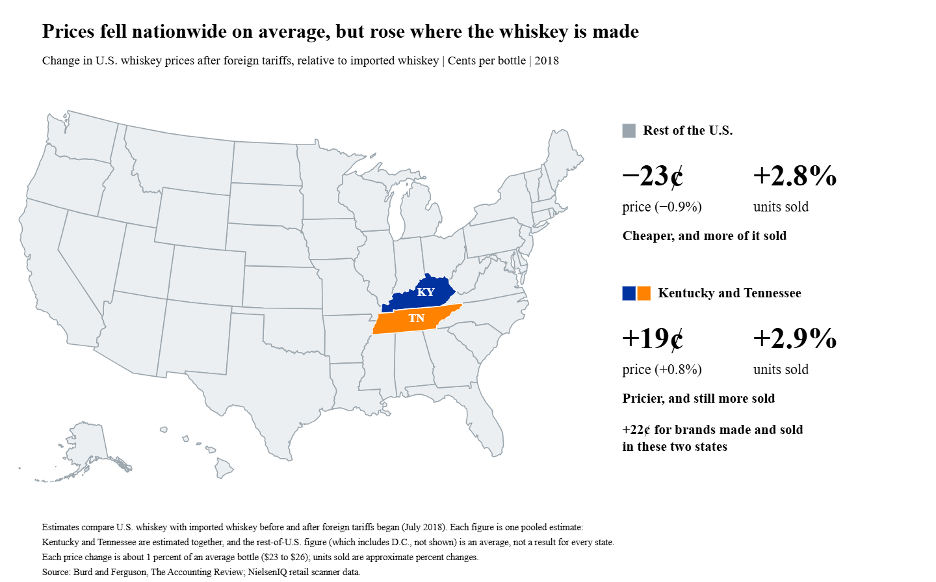
Across most of the country, U.S. whiskey got cheaper relative to imported whiskey, and people bought more of it, with volume increasing by about 3 percent. Prices fell most in states where whiskey drinking is not extremely popular, which is where you would expect shoppers to be the most price sensitive. In this sense, if you are a U.S. whiskey drinker, these foreign tariffs were beneficial to your purchasing habits. However, this result is more nuanced than it seems and depends on where you live.
Kentucky and Tennessee went the other way. There, U.S. whiskey increased in price, and unit sales still rose by about 3 percent (somewhere, an introductory economics professor is quietly weeping). As we investigated this result further, we found that this increase in sales came specifically from Tennessee whiskey sold in Tennessee and Kentucky bourbon sold in Kentucky.
Why do consumers in home production states pay more?
Producers need to make gains where they can, and they appear to have found them in the whiskey production states. This is a basic elasticity argument. Where buyers are loyal and domestic support exists in the face of political tension, a higher price might not reduce demand.
Our results suggest that demand in Kentucky and Tennessee is about as price insensitive as it comes. Nobody is heading to Nashville for the weekend to drink Jameson. They are drinking Jack Daniel’s, and if it costs more per bottle, so be it. The Kentucky bourbon trail works the same way: because tourists come for the local product and experience, they are inelastic in their demand.
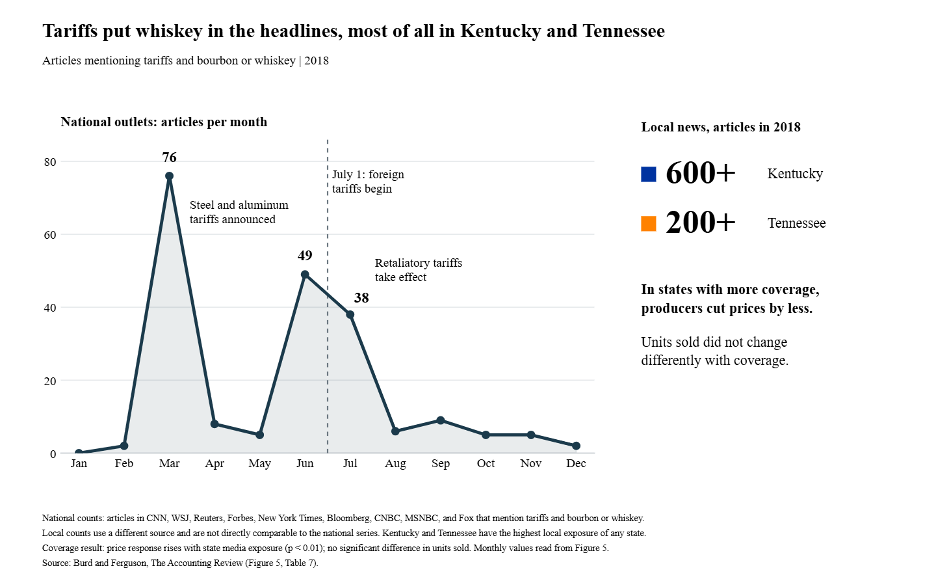
National and local media also covered the tariffs heavily, with spikes in national media around the announcement and implementation of the tariffs, and more than 600 articles in Kentucky and more than 200 in Tennessee in 2018. This attention likely helped strengthen local loyalty and drive support.
What about other states?
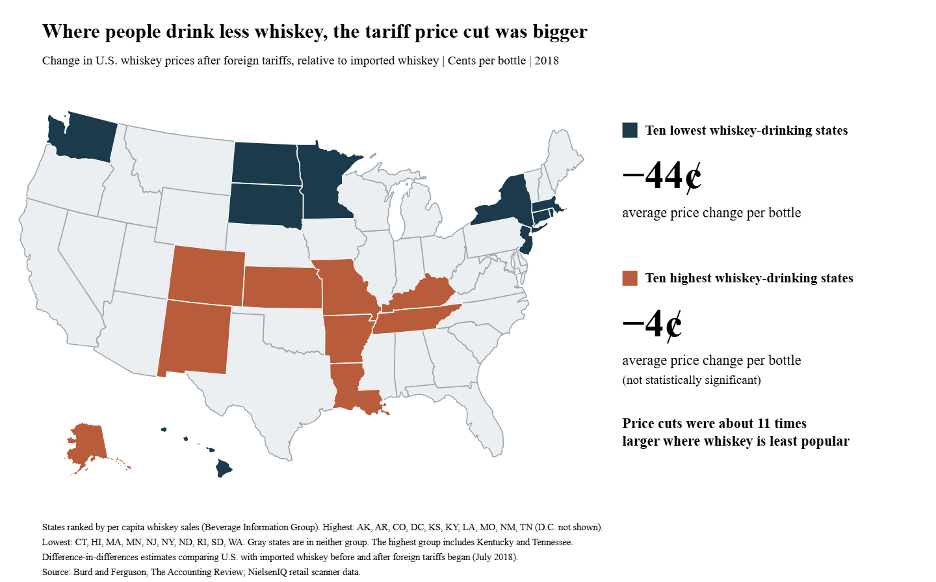
Beyond Kentucky and Tennessee, we also find evidence that in states where whiskey drinking is less popular, price cuts were about 11 times the magnitude compared to states in which it is popular. In places where whiskey drinking is more popular, we did not find evidence of price cuts, indicating that producers take advantage of not only home bias, but the strength of the whiskey-drinking market itself.
What does this mean for the trade situation today?
Since Canadian provinces pulled U.S. alcohol off store shelves in 2025, U.S. spirits exports to Canada have fallen 70 percent, according to an industry coalition. Those are bans, not tariffs, and a ban takes sales to zero. Effective September 29, 2026, the U.S. has put its own ban on Canadian spirits and wine, which will certainly impact U.S. retailers, bars, and consumers alike. This is unfortunate for Crown Royal and Fireball drinkers, as the supply may literally (and figuratively) dry up.
Takeaway
Two things from our study and the current situation stand out. First, a foreign tariff on a U.S. product does not stay abroad. It reaches back to U.S. consumers through the pricing choices of the producers it affects. Most shoppers in our data saw lower whiskey prices. Shoppers where whiskey is made paid more and bought more. Second, as policymakers weigh the next round of liquor tariffs, in either direction, the useful question is who is most exposed and how easily they can switch. Even if politics picks the target, incidence decides who pays.
AI disclosure: AI was used to copyedit this piece and create figures based on data from Burd and Ferguson (2026). We take full responsibility for the contents.
Academic references:
Burd, C. S., & Ferguson, V. (2026). Domestic product market impacts of politically motivated foreign tariffs. The Accounting Review. Forthcoming. https://doi.org/10.2308/TAR-2024-0708
Non-academic references:
Brown-Forman. 2019. Annual Report 2019. Louisville, KY: Brown-Forman. https://www.brown-forman.com/
CNN. “Trump just banned Canadian booze – but there’s a big catch” September 29, 2026
Distilled Spirits Council of the United States. “Distilled Spirits Council says China’s 25 percent tariffs on U.S. whiskeys could put brakes on export success story”, July 6, 2018
Distilled Spirits Council of the United States. “Spirits Canada Analysis: Removal of U.S. Spirits from Canadian Stores in Retaliation to U.S. Trade Dispute Resulted in Sharp Sales Decline of U.S. Products and Total Spirit Sales”, July 22, 2025
Reuters. “Trump says he is removing US tariffs on Irish whiskey”, September 13, 2026