Financial Innovation and the Tax Treatment of Gains and Losses
Recent reporting on AQR Capital Management illustrates a long-standing tension between financial innovation and the tax rules governing economic gains and losses.
An investor who turns $100 million into $300 million has certainly earned a significant profit. Yet one of the more remarkable figures in recent articles on AQR Capital Management concerns an investment that could do precisely that while also generating more than $580 million in tax losses.[1] The estimate, drawn from marketing materials for one of AQR’s “tax-aware” investment strategies, assumes a 10-year investment period and illustrates the potential to accumulate tax losses amounting to several times the original investment. Although the figures are hypothetical in nature, they raise an obvious question. How can an investment generate substantial profits and substantial tax losses at the same time?
The apparent contradiction reflects an important and long-standing feature of the U.S. tax system. Economic income and taxable income are not necessarily equal as tax law typically does not continuously measure changes in an investor’s overall wealth. Instead, tax law generally recognizes gains and losses when investments are sold or otherwise disposed of, although some financial instruments are subject to different timing rules. The resulting tax liability also depends on the character of those gains and losses, which can differ according to the type of investment, circumstances of the transaction, and taxpayer involved. The ability to recognize losses while deferring gains helps explain the apparent contradiction. Financial instruments can raise additional questions when economically similar or offsetting positions are governed by different rules for recognizing and characterizing gains and losses.
Consider a simple portfolio containing two stocks purchased for $50 each. After one year, the first stock has appreciated to $65 while the second has declined to $40. The portfolio is now worth $105, leaving the investor with an economic profit of $5. Suppose the investor sells the declining stock but retains the appreciated stock. The sale generally produces a realized capital loss of $10, even though the investor’s overall wealth has increased. Meanwhile, the $15 gain on the appreciated stock generally remains untaxed because the investor continues to hold it.
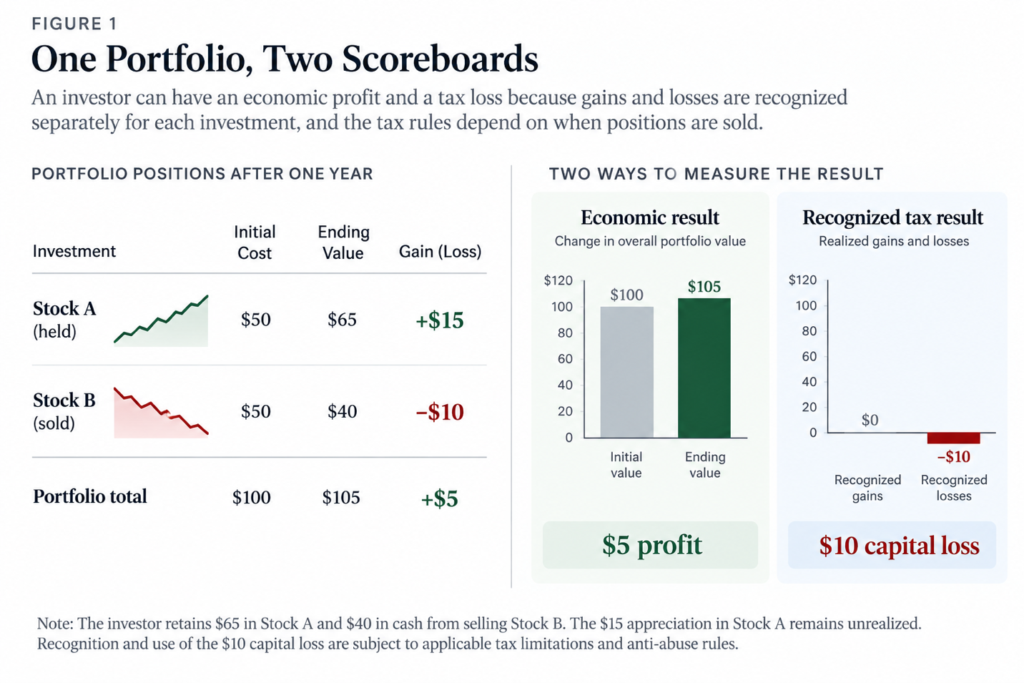
The difference between the two results is not an accounting illusion. The investor genuinely lost money on one stock while earning even more on the other. Selling the losing position allows the investor to recognize its loss for tax purposes, potentially offsetting gains from other investments, while postponing recognition of the appreciated position.[2] Although the deferred gain generally becomes taxable upon a subsequent sale, the timing difference can be valuable. Taxes paid in the future are less burdensome than equivalent taxes paid today, particularly when the investor can continue earning returns on money that otherwise would have been remitted to the government.
Tax-aware investment strategies can extend this familiar practice well beyond a portfolio containing two stocks. Through combinations of long and short positions, leverage, and frequent trading, investors can generate significant realized losses while continuing to pursue positive investment returns. By reinvesting the proceeds from sales and repeating the process over several years, investors can accumulate realized losses that exceed the original investment many times over without suffering a comparable decline in wealth. The accumulated losses may be valuable to an investor with taxable capital gains from other investments, although their use remains subject to important restrictions. A realized loss is not necessarily an immediately deductible loss, and neither amount should be confused with the actual taxes saved.
AQR has emphasized that its tax-aware long-short strategies are designed primarily to generate pretax investment returns, with realized losses arising largely as a byproduct of active trading.[3] According to research published by AQR, the primary incremental tax benefit relative to comparable investment strategies that disregard taxes comes from delaying the realization of gains, particularly short-term gains, rather than realizing additional losses. Active trading can naturally generate winning and losing positions, but tax-aware managers can be more reluctant to close profitable positions when doing so would trigger heavy taxes. The resulting combination of realized losses and deferred gains helps explain how a growing portfolio can accumulate significant tax benefits over time.
Financial Derivatives, Risk Management, and Tax Planning
Financial derivatives make the relationship between economic outcomes and tax consequences rather complicated. Options, futures, forwards, and swaps allow investors and businesses to obtain exposure to changes in stock prices, interest rates, exchange rates, and other variables without necessarily owning the underlying assets. For example, a firm concerned about rising interest rates might enter a swap that effectively converts variable-rate debt into fixed-rate debt, while an investor seeking exposure to a particular stock might use options or a forward contract instead of purchasing shares outright. Although these contracts differ considerably, their economic consequences can be remarkably similar.
The tax rules governing these instruments are far less uniform than their economic characteristics might suggest. A gain recognized when a forward contract settles may be taxed differently from a gain arising on a comparable futures contract. Payments under a swap can receive different treatment depending on whether they arise periodically over the contract’s life or upon its termination. Choices involving the type of instrument, the structure of its payments, and the timing of its disposition can thus influence the amount of income recognized during a particular period, when that income becomes taxable, and whether it receives ordinary or capital treatment.
Importantly, derivatives also serve legitimate economic purposes that have little to do with tax planning. An airline facing uncertainty about fuel prices may use derivatives to stabilize its operating costs, while a manufacturer purchasing materials overseas may hedge currency risk to protect expected profit margins.[4] Successful hedging can also reduce taxable income volatility, potentially lowering expected taxes when tax losses cannot be used immediately or marginal tax rates vary with income. In these circumstances, tax benefits may arise from managing business risk, whether or not tax considerations also influence the choice of instrument.
My research on derivatives and corporate tax avoidance distinguishes these incidental tax benefits from those arising through transactional choices.[5] Derivatives can be useful for tax planning because taxpayers may achieve similar economic outcomes through contractual arrangements that receive different tax treatment. Some of these choices are expressly contemplated by existing rules, while the treatment of others depends on applicable statutory restrictions, regulatory provisions, and judicial doctrines. Tax savings alone do not establish a transaction’s economic purpose or whether its treatment is consistent with applicable law.
In a 2015 study published in the Journal of Accounting and Economics, I estimated the tax effects of derivatives usage among public U.S. corporations.[6] Firms initiating derivatives programs subsequently experienced materially lower cash effective tax rates than comparable firms that did not use derivatives, with the difference amounting to approximately 4.4 percentage points over a three-year period. Additional analyses suggested that conventional risk management benefits could not fully explain the observed tax savings. The evidence does not identify the specific transactions responsible for those savings or suggest that the firms engaged in improper behavior. Nevertheless, it illustrates why the tax consequences of financial instruments deserve attention beyond their traditional role in reducing business risk.
The distinction between risk management and tax-aware structuring is not necessarily a distinction between two different groups of taxpayers. A firm may undertake a derivative transaction to manage an identifiable economic risk while also selecting a permissible contractual structure that reduces taxes. Likewise, an investment strategy can pursue profitable market opportunities while incorporating tax considerations into trading decisions. Transactions undertaken with substantial tax objectives can still involve genuine financial contracts with real economic risks and cash flows. Depending on the applicable rules and the question at issue, evaluating their tax consequences may require examining both the individual instruments and their interactions, alongside their contractual terms, economic effects, and the taxpayer’s objectives.
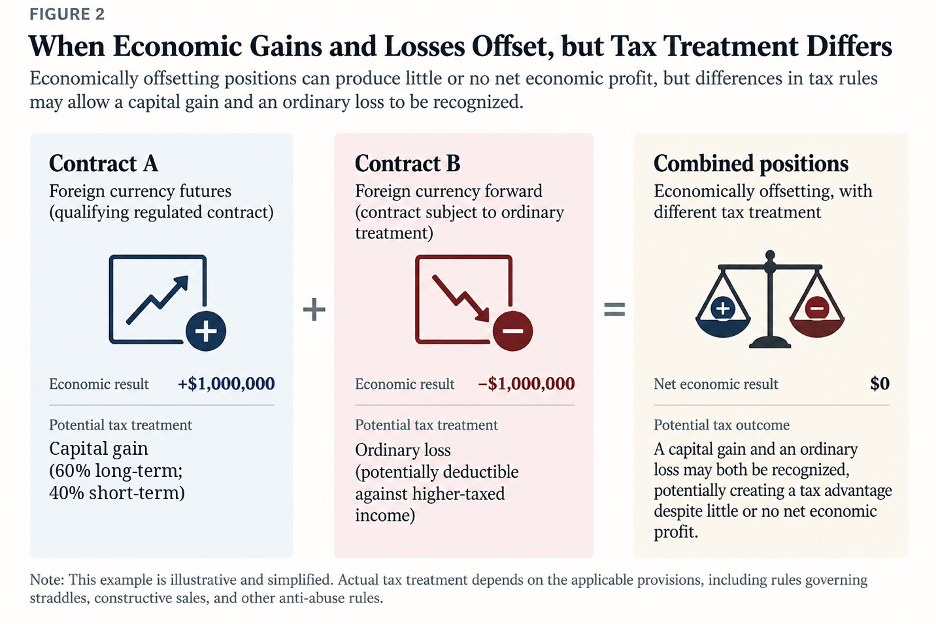
Differences in tax treatment can create opportunities for tax savings even when financial positions offset one another economically. Consider an investor holding two contracts that largely neutralize one another’s exposure to a particular financial risk. One contract produces a $1 million gain while the other produces a $1 million loss, leaving little or no net economic return. If the gain is eligible, at least in part, for preferential capital gains rates while the loss is deductible against ordinary income, the investor could obtain a valuable tax advantage despite earning nothing from the combined positions. The treatment of actual transactions depends on the applicable character rules, elections, limitations, and facts. The example illustrates how the character of gains and losses can affect after-tax outcomes even when positions substantially offset one another economically.
Questions Raised by Recent IRS Guidance
On September 28, 2026, the IRS issued Notice 2026-62 addressing specific concerns about the taxation of financial instruments.[7] The Notice recognizes the conventional practice of selling declining investments to realize capital losses while retaining appreciated investments. It separately describes arrangements involving economically offsetting positions, elections, and contract terminations that Treasury and the IRS believe may produce favorable tax consequences through differences in the character or timing of gains and losses. The Notice does not identify AQR or attribute those arrangements to its strategies. The concerns identified in the Notice do not, by themselves, establish that any particular transaction is inconsistent with existing law.
One example involves offsetting positions in foreign currency forward and futures contracts. Under the relevant rules, certain currency forwards generally generate ordinary gains and losses, while qualifying regulated futures contracts receive capital treatment. Although the positions can be structured to offset one another economically, the differences in tax character create opportunities to recognize capital gains alongside ordinary losses. The IRS describes strategies that use the identification of offsetting positions and the sequence of contract terminations to obtain favorable tax results. The Notice’s concern centers on the tax consequences of the combined arrangement, rather than the mere fact that an individual contract produces a genuine gain or loss.
Certain foreign currency contracts may qualify for an election allowing capital rather than ordinary treatment. Treasury and the IRS describe situations in which investment funds appear to make the election after learning whether specific trades generated gains, thereby obtaining capital treatment for profitable positions while retaining ordinary treatment for losses. According to Treasury and the IRS, the election was intended to provide consistent treatment for comparable financial transactions, not necessarily to allow taxpayers to choose whichever classification is advantageous after the economic outcome becomes known. The IRS also identifies strategies involving swaps, where terminating profitable contracts while holding losing contracts until their scheduled payment or expiration dates may allow similar payments to receive different tax treatment.
The debate is clearer when two questions are considered separately. The first question concerns how much tax deferral the realization-based system should permit when investors recognize losses while postponing gains. Much of that treatment follows from long-standing rules, and disagreement about its desirability is fundamentally a question about the design of the tax base and the distribution of tax burdens. The second question concerns how existing provisions determine the tax character of gains and losses arising from economically related financial instruments. Whether a particular arrangement receives its claimed treatment under current law is distinct from whether lawmakers should change the law.
Any regulatory response would need to distinguish uncertainty about the operation of existing rules from broader choices about tax policy. Guidance on elections, offsetting positions, and contract terminations could clarify when different timing or character results are permitted under current law, while accounting for differences in contractual obligations and economic exposure. Such guidance would also need to consider potential effects on established hedging and investment practices. Broader changes to the realization-based system, including the treatment of deferred gains, involve legislative questions that cannot be resolved solely through transaction-specific enforcement.
[1]https://www.bloomberg.com/features/2026-aqr-tax-loss-harvesting-billionaires
[2] https://www.irs.gov/forms-pubs/about-publication-550
[3]https://www.aqr.com/insights/research/tax-aware-investing/misconceptions-about-tax-aware-long-short-misleading-parallels-with-direct-indexing-part-ii
[4] See, for example: https://history.southwest.com/our-stories/the-southwest-jet-fuel-hedge-strategy/
[5]https://publications.aaahq.org/jata/article-abstract/37/1/37/9090/Financial-Derivatives-in-Corporate-Tax-Avoidance-A?redirectedFrom=fulltext
[6] https://www.sciencedirect.com/science/article/pii/S016541011400072X?via%3Dihub
[7] https://www.irs.gov/pub/irs-drop/n-26-62.pdf