Tax and the Final Frontier
With the successful IPO of SpaceX on June 12, 2026 (stardate -357211.03), it is time that academics and policymakers begin considering the final frontier of tax: space.
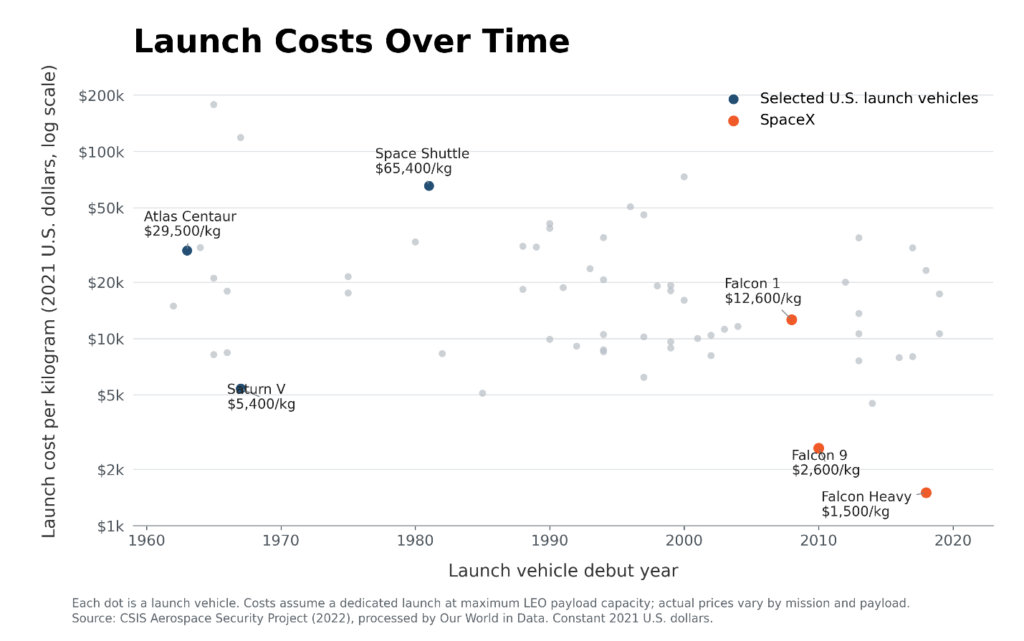
On IPO day, SpaceX traded at a $2 trillion valuation with annual revenue of only $20 billion.[1] The stratospheric valuation was motivated by extraordinary expectations for future profits backed by SpaceX’s real innovations. For example, the Falcon Heavy rocket reduced the cost of carrying mass to low Earth orbit by over 95 percent relative to the Space Shuttle (Figure 1).[2]
In addition to lowering launch costs, SpaceX operates Starlink, the world’s largest satellite network, and has proposed launching solar-powered orbital data centers as early as 2028.[3] The orbital data center business plan is speculative but could revolutionize the nascent AI industry. The tax implications are worth considering now.
Current tax law is preoccupied with geography. Both people and businesses are taxed at least partially based on where they reside, and even assets are subject to different rules based on location. Orbital data centers (and other near-future space enterprises) will challenge the geographic nature of tax law by creating economic activity that occurs entirely outside the bounds of sovereign states.
Can Earth states claim economic value in space?
States have legitimate reasons to tax economic activity when they supply inputs that precipitate said activity. Space enterprises depend on (Earth-based) state-supplied laws, educated workers, research, capital markets, infrastructure, national security, and diplomacy. Therefore, states on Earth do have a legitimate claim to tax the profits of space commerce if they continue to supply services crucial to the flow of said commerce.
An efficient space tax regime will need to go beyond geography to tie space revenue to the Earth countries that facilitate space commerce. While the country in which a space business is registered provides a foundation for taxation, many countries will play host to the engineers, research, launches, and customers that will make these businesses possible.
Where is space income earned?
Imagine a U.S. corporation that owns orbital data centers manufactured in other countries, launched from Texas, controlled in California, and used by customers worldwide. The AI models were developed on Earth, but the computing happens outside Earth, and the data is distributed worldwide. Where is the resulting income earned?
U.S. law already provides a partial answer. Section 863 provides that income from “space or ocean activity” earned by a U.S. person is generally U.S.-source, while income earned by a foreign person is generally foreign-source.[4] The regulations then quickly complicate matters. A U.S. person’s space income is foreign-source to the extent that it is attributable to functions performed, resources employed, or risks assumed in foreign countries. A controlled foreign corporation’s space income is generally U.S.-source, subject to the same carveout.[5] The taxpayer’s identity therefore sets the starting point, but Earth-based economic activity may change the result.
The type of income also matters. The regulations treat data transmission as communications activity. International communications income earned by a U.S. person is generally divided equally between U.S. and foreign sources. However, computation in orbit may fall under the space-activity rules. An orbital data center could therefore require separate tax treatment for income from transmission, storage, model access, and processing.[6]
Corporate residence could provide a method for determining where space profits are earned. But incorporation is partly elective, and space commerce could be particularly vulnerable to registration games that reduce tax liability. The country named on a corporate charter may have contributed less to orbital profits than the countries supplying the engineers, research, launch infrastructure, capital, customers, and courts that make space businesses viable.
Another problem is that OECD Model treaties allow taxation of foreign businesses only when they have reached permanent establishment. However, the OECD also holds that the digital footprint of a satellite is not a permanent establishment.[7] Under that approach, an orbital data center would not create a permanent establishment merely by serving customers in a country. Offices and ground stations might do so, and personnel might create an agent or service permanent establishment under a particular treaty. Still, the core productive asset could remain outside every treaty territory.
Who gets to tax space income?
Once several countries establish a claim to space income, corporate tax strategy will partially determine what each country can tax. A corporation could complicate taxes by separating satellites, AI models, employees, and ground control infrastructure into separate affiliates and charging transfer prices for internal transactions. The arm’s-length principle asks if unrelated parties would have charged the same price in comparable circumstances.[8] Like many innovative industries, there may be no comparable transactions for orbital computing. Novelty will not only allow taxpayers opportunities for creative transfer pricing but also the risk of multiple tax authorities imposing double taxation.
But physical presence need not be a precondition for tax nexus. In South Dakota v. Wayfair, the U.S. Supreme Court determined that physical presence was unnecessary for digital businesses to establish nexus in U.S. states.[9] An orbital provider could theoretically incur collection obligations anywhere it is used. Countries may likewise seek income-tax rights based on users, sales, or locally exploited data. That approach prevents income that escapes taxation entirely, but customer location will remain difficult to determine.
Should space businesses receive tax subsidies?
Another policy question is not simply whether orbital businesses should pay tax. It is also whether the tax system should subsidize them. Space infrastructure may generate knowledge and technologies with applications far beyond the original venture. Moreover, earthbound data centers are controversial because of their impact on the environment and local electricity prices. Orbital data centers could limit these externalities by harnessing abundant solar power to reduce emissions while also lowering demand on local grids. However, if policymakers decide orbital infrastructure creates enough spillover benefits to merit support, existing tax rules are not yet designed to subsidize it.
Depreciation is a major tool of tax subsidy, but current law does not clearly explain how it would apply to orbital data centers. Section 168 generally requires straight-line depreciation under ADS for tangible property used predominantly outside the United States, but it provides exceptions for certain satellites and spacecraft.[10] So it is unclear whether an orbital data center would qualify for immediate expensing or instead be limited to straight-line recovery. Policymakers should address that question explicitly as space commerce expands. If the goal is to encourage orbital computing, the law should allow immediate expensing. If not, it should make clear that straight-line depreciation applies.
Current law also leaves orbital research in an awkward position. U.S. tax law generally allows deductions and credits for domestic research expenditures, but these rules depend on where the research is conducted.[11] That works well on Earth but becomes complicated when U.S.-based engineers direct experiments that are carried out by equipment in space. As space commerce expands, Congress should address that boundary explicitly. If the goal is to encourage orbital innovation, it should treat qualifying U.S.-directed orbital research as domestic research or create a targeted credit for orbital technologies.
Where is current tax law unprepared for space?
Tax law is least prepared for space where long-standing labels and definitions determine everything. Space is a new area for commerce and will create economic transactions and relationships that will not fit neatly into examples from the Earth-bound economy. Tax policymakers must be willing to create new types of laws for a novel industry.
Space law also fails to provide a comprehensive tax solution. The Outer Space Treaty bars space annexation by sovereign nations, yet space objects and their inhabitants are subject to the laws of their state of registry.[12] Registration could therefore become a tax connecting factor, much like a ship’s flag. However, used alone, taxation by registration could lead to tax havens being used as flags of convenience for space commerce.
Tax treaties divide taxing rights between states, but orbital business will be connected to many countries at once. Because space is not a treaty resident, it cannot negotiate with other tax authorities or grant tax credits to space businesses. The result could be either a tax vacuum where income escapes taxation, or a tax conflict where several countries claim the same profit. Ultimately, a multilateral agreement will be required to coordinate taxing space businesses and prevent them from escaping taxation through complex planning or registering in tax havens that provide none of the inputs making space commerce possible.
Space commerce will take the tax system far beyond geography if economic activity beyond Earth is to be taxed at all. Orbital data centers will be connected, economically and legally, to many countries even if they physically exist in none of them. If policymakers want to levy taxes on space activity, they will need to create novel means of dividing revenue to match novel means of commerce.
[1] SpaceX surges past $2 trillion in Nasdaq debut, closes in on Amazon | Reuters
[2] Cost of space launches to low Earth orbit, Cost for Space Launch to Low Earth Orbit- Aerospace Security Project
[3] https://www.sec.gov/Archives/edgar/data/1181412/000162828026040874/spacexukfwp.htm?
[4] 26 USC 863: Special rules for determining source
[5] eCFR :: 26 CFR 1.863-8 — Source of income derived from space and ocean activity under section 863(d).
[6] eCFR :: 26 CFR 1.863-9 — Source of income derived from communications activity under section 863(a), (d), and (e).
[7] Model Tax Convention on Income and on Capital: Condensed Version 2017 (EN)
[8] Transfer pricing | Internal Revenue Service
[9] 17-494 South Dakota v. Wayfair, Inc. (06/21/2018)
[10] 26 USC 168: Accelerated cost recovery system
[11] Section 174A generally allows current deductions for domestic research expenditures, and section 41 provides a credit for qualifying research, but both regimes turn in part on where the research is conducted.
26 USC 174A: Domestic research or experimental expenditures