
Don’t Ask Tax Policy to Do Competition Policy’s Job
Often, tax reforms come with many promises. Raise corporate taxes and inequality will fall. Crack down on corporate tax avoidance and markets will become more competitive. Introduce a global minimum tax and dominant firms will finally lose their grip on the economy. Politically, these promises are irresistible. A single policy suddenly appears capable of solving several economic problems at once.
The evidence is, however, less enthusiastic. Few examples illustrate this better than the campaign against corporate tax avoidance. For years, governments, the OECD, the International Monetary Fund and the European Commission have argued that multinational corporations gain an unfair competitive advantage by shifting profits to low-tax jurisdictions. Tightening anti-tax-avoidance rules, they contend, would not merely raise tax revenue. It would level the playing field, weaken dominant firms and reduce industry concentration. It is an appealing story.
Unfortunately, it is one that the data do not support when examining one of the largest changes in anti-tax avoidance rules available as shown by Gallemore, Jacob, Marangoni, and Peters (2026). Beginning in 2013, European countries introduced a sweeping package of anti-tax-avoidance rules following the OECD’s Base Erosion and Profit Shifting initiative. Seventeen countries tightened transfer-pricing rules, expanded controlled-foreign-company legislation, introduced country-by-country reporting and adopted a series of additional measures aimed squarely at multinational tax planning.
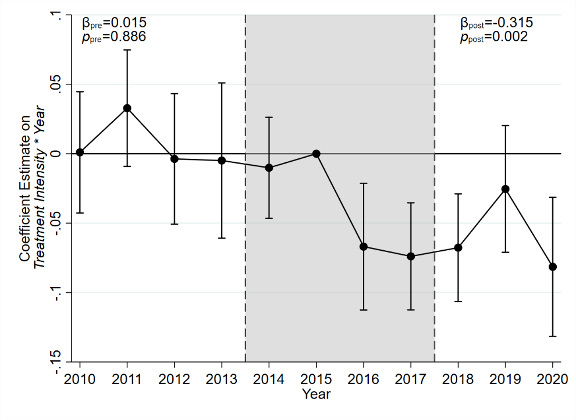
The reforms achieved their immediate objective. Corporate tax avoidance fell substantially as shown in Figure 1, which shows the impact of anti-tax avoidance rules on corporate tax avoidance.
Yet the promised transformation of market structure never happened. As shown in Figure 2, there find no meaningful reduction in industry concentration. Dominant firms remained dominant. Whether measured immediately after the reforms or five years later, industry concentration barely moved. The estimated effects are not merely statistically insignificant; they are economically trivial, well below the thresholds that U.S. and European competition authorities themselves consider meaningful.
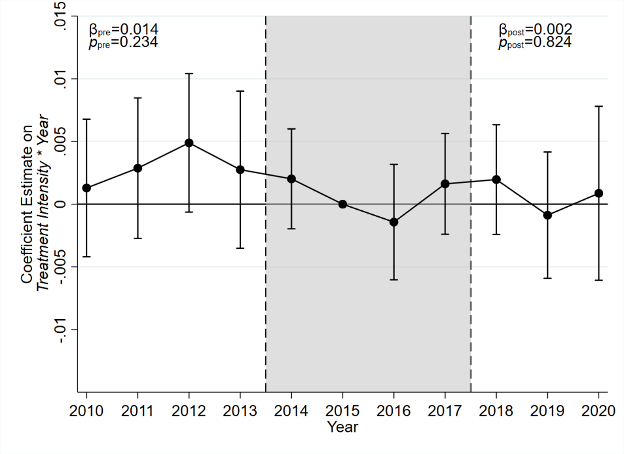
The evidence points to a simple conclusion: reducing tax avoidance does not, by itself, make markets substantially more competitive. Why not? Because policymakers confused one competitive advantage with every competitive advantage.
Taxes matter. But they are only one ingredient of business success. The firms that dominate industries usually do so because they possess superior technology, stronger brands, deeper customer relationships, larger distribution networks, or significant economies of scale. Increasing their tax bill does little to erode those advantages.
There is another reason. The political narrative assumes that industry leaders systematically avoid much more tax than everyone else. Sometimes they do. But often they do not. Smaller competitors also engage in tax planning, frequently attracting far less public or IRS attention than large multinationals. If both leaders and challengers lose similar tax advantages, the competitive gap hardly changes.
Ironically, the largest firms may even adapt more easily to new regulations. They can spread compliance costs across global operations, hire specialized tax experts and reorganize their structures when rules change. Smaller firms have fewer such options. Rules intended to weaken market leaders can therefore leave their relative position largely intact.
To be sure, there are exceptions. There are some modest reductions in concentration in the very few industries where two conditions hold simultaneously: dominant firms enjoyed particularly large tax advantages before the reforms, and multinational firms accounted for a substantial share of the industry. However, even there the effects remain small—roughly half the size that U.S. antitrust authorities would regard as economically meaningful. And, these are also not the industries with the big tech companies, which are often cited in policy discussions.
The broader lesson extends well beyond tax avoidance. Governments increasingly justify policies not only by what they directly accomplish but also by the additional benefits they are expected to deliver. Sometimes those promises are real. However, often they are simply plausible stories that survive because nobody asks whether they actually happened.
That is why empirical evaluation matters. Good intentions are not evidence, and appealing theories are not substitutes for measured outcomes. None of this argues against fighting corporate tax avoidance to raise revenues. Governments may reasonably conclude that companies should pay taxes where profits are earned. They may value the additional revenue. They may believe stricter enforcement improves the fairness and integrity of the tax system. Those are legitimate objectives. But reducing industry concentration appears not to be one of them.
If policymakers genuinely want more competitive markets, they already possess tools designed for that purpose: stronger antitrust enforcement and careful merger review. Those instruments directly target market power instead of hoping it changes as an indirect consequence of tax reform.
