California’s Billionaire Tax: Liquidity Issues and Questionable Fiscal Rationale
California’s Billionaire Tax: Liquidity Issues and Questionable Fiscal Rationale
California voters will soon decide whether to approve Proposition 40, a one-time five percent tax on the wealth of the state’s billionaires. Yet proponents continue to sidestep fundamental questions about its design and fiscal rationale. In this article, I respond to two arguments made recently by Rep. Ro Khanna, one of the tax’s most vocal supporters.
“A Few Founders”
First, Mr. Khanna downplays a central problem with the proposal: it taxes wealth, including unrealized gains, regardless of whether taxpayers have liquid assets available to pay the bill. He states that this is a problem for “a few founders” who have illiquid wealth, implying that the issue is immaterial because it affects so few.
Let’s examine this assertion. According to the Forbes Real-Time Billionaires list, billionaires residing in California held approximately $2.4 trillion in wealth as of October 4, 2026. I estimate that 68.4% of that wealth relates to public stock, leaving 31.6% from wealth in less liquid assets (see Figure 1).[1] In other words, nearly one-third of the wealth targeted by Proposition 40 is not in public stock, which can easily be sold to pay the tax.
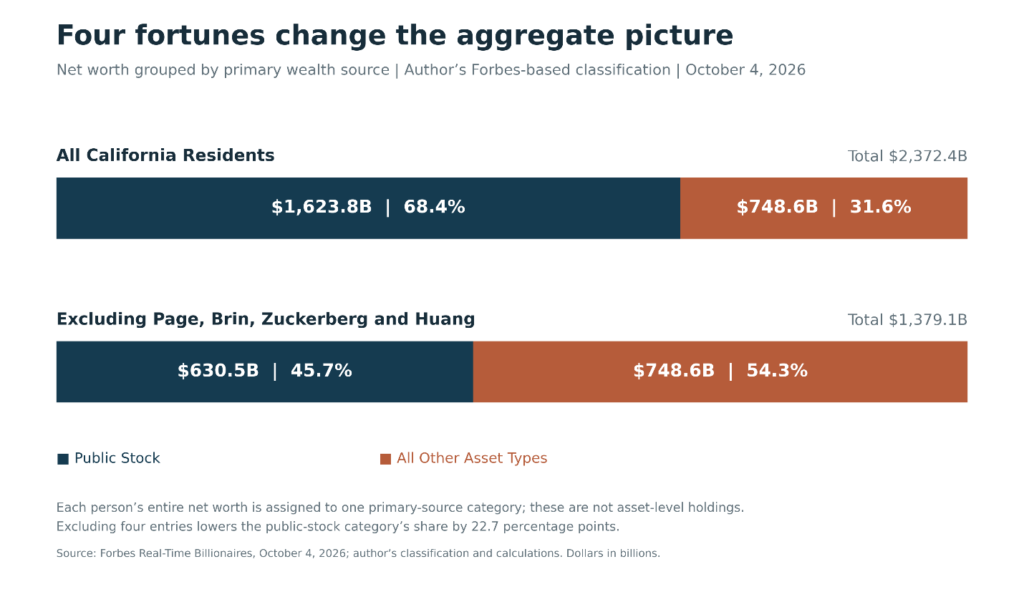
Furthermore, these aggregate figures are heavily influenced by the extraordinary fortunes of four individuals—Larry Page, Sergey Brin, Mark Zuckerberg, and Jensen Huang—whose wealth is primarily tied to the publicly traded companies they founded. Excluding those four, the public-stock category accounts for just 45.7% of the remaining wealth.[2]
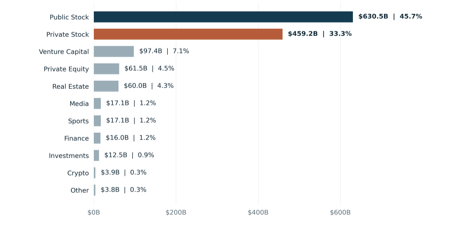
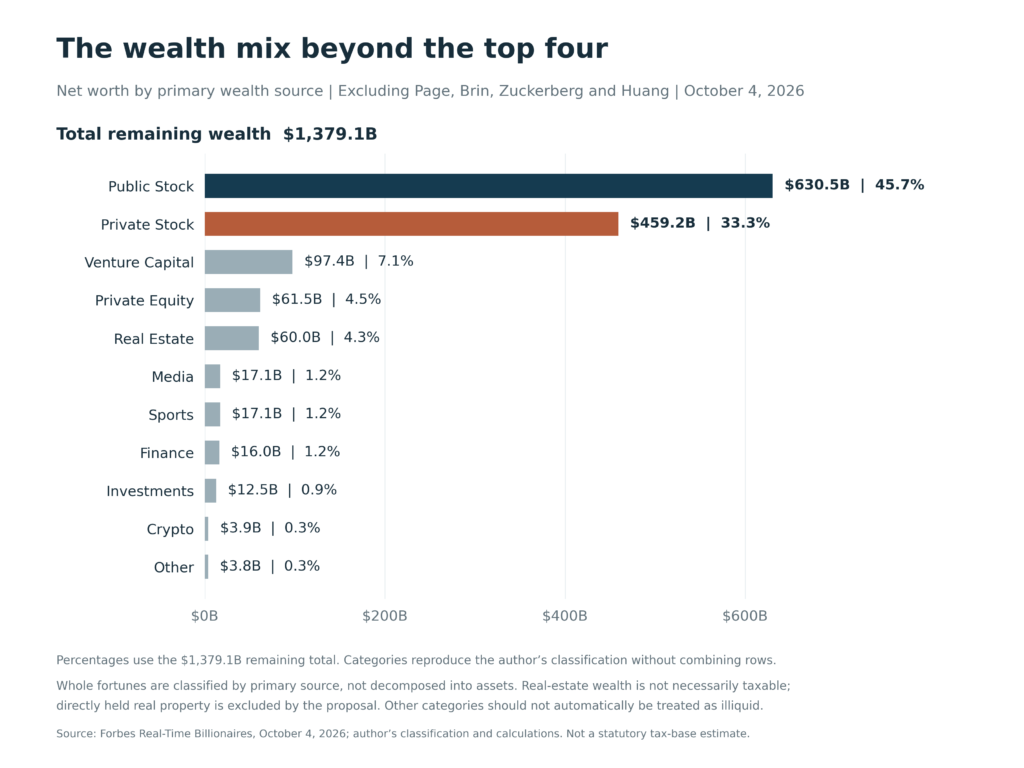
A closer look at the other categories of wealth reveals substantial exposure to typically illiquid assets (see Figure 2). Excluding the top four billionaires, private stock alone accounts for one-third (33.3%) of the remaining wealth. Venture capital (7.1%), private equity (4.5%), real estate (4.3%), and sports teams (1.2%) bring the combined share to roughly half. These classifications are imperfect and do not establish precisely how much cash each taxpayer can access. They do, however, show why liquidity deserves serious consideration.
The pattern is similar when counting people rather than dollars (see Figure 3). Excluding the top four billionaires, 62 of the remaining 252 California billionaires, or nearly one-quarter, derive their wealth primarily from private stock. Those whose wealth comes primarily from public stock account for fewer than half (47.6%). Thus, after excluding the top four billionaires, the public-stock category accounts for less than half of both wealth and individuals.
Clearly, the potential liquidity problem extends well beyond “a few founders.” Downplaying its scope allows Mr. Khanna and other supporters to sidestep a fundamental weakness in the proposal: similarly valued fortunes can impose sharply different payment burdens, and the proposed remedies introduce complications of their own.
The tax is conceptually flawed, in part, because it violates a fundamental principle of a good tax system: taxes should be equitable. Horizontal equity requires that taxpayers with similar ability to pay face similar burdens. Two taxpayers with the same appraised wealth could face the same tax bill but very different costs of paying it. One might sell a small portion of a liquid portfolio; another might need to negotiate a private share sale, accept unfavorable financing terms, or surrender part of a business. We should care about having an equitable tax system, no matter who faces a particular tax.
Proposition 40’s supporters have put forward at least three solutions: (1) a five-year installment plan, (2) an “Optional Deferral Account,” and (3) a nonrecourse government loan.
The installment option alleviates the immediate cash demand, but it does not eliminate the equity disparity. It allows five annual installments, with a nondeductible annual charge of 7.5% on the remaining unpaid balance. For a founder whose shares remain illiquid, installments spread the financing problem over time while adding to the nominal cost.
The Optional Deferral Account more directly addresses cash constraints by tying payments on illiquid assets to future distributions and other specified transactions. But eligibility is narrow and the tax grows with the assets, meaning that the effective tax rate can end up being well north of five percent of the original valuation.
Mr. Khanna has separately suggested that cash-poor founders pledge private stock as collateral for a ten-year, nonrecourse government loan to pay the tax. If the founder cannot repay, the state takes the shares. However, if the state takes the shares in satisfaction of the loan, the founder could recognize taxable gain to the extent the outstanding nonrecourse debt exceeds the shares’ adjusted tax basis, even if their market value has fallen sharply.
These mechanisms can relieve some immediate payment pressure, but each brings costs, conditions, or risks. Moreover, deferred payment raises questions about when the tax would generate the revenue needed to support its stated purpose, which I discuss next. Taken together, these complications help explain why, for more than a century, the income tax has generally taxed gains upon realization, largely avoiding these liquidity problems and the need for complicated remedies.
“The Immediate Impetus for the Billionaire Tax is the One Big Beautiful Bill Act”
Second, Mr. Khanna’s presents the billionaire tax as an urgent response to health-care funding cuts under the One Big Beautiful Bill Act (OB3). The cuts are substantial, but a closer look at the timing shows that the funding shortfall isn’t immediate and isn’t one-time
KFF’s analysis of CBO estimates puts the nationwide Medicaid spending reduction at approximately $911 billion over 2025–2034. Estimates from KFF and the Hoover Institution peg the hit to California over that 10-year period at $150 billion and $156 billion, respectively.
However, three important details contradict Mr. Khanna’s justification for the billionaire tax. One, the effects of this law are not immediate. California currently projects an increase in federal Medi-Cal funds in fiscal year 2026-27 compared to fiscal year 2025-26. Both KFF and the Hoover Institution estimate that the majority of the cuts won’t occur until 2030.
Two, the funding pressure is ongoing, while the proposed tax is one-time, as Martin Jacob has shown. OB3 changes the rules governing Medicaid eligibility and financing, reducing federal support in future years. An initial revenue cushion from Proposition 40 could help California adjust. But once that cushion is exhausted, the underlying funding problem remains.
Three, California’s fiscal problems predate OB3. The Legislative Analyst’s Office reports that the state adopted measures to close $125 billion in budget deficits over the preceding three years. California also enacted Medi-Cal reductions in June 2025, before OB3 became law that July. Federal cuts compound an existing structural problem, they did not create it.
Final Remarks and a Thought Experiment
Supporters of California’s billionaire tax have greatly understated the scope of the liquidity problem and fail to justify the fiscal rationale for the tax.
To conclude, consider a thought experiment. How should supporters’ case for Proposition 40 change if California’s fiscal outlook improves? Suppose the state receives enough additional revenue from existing taxes to cover a meaningful portion of the shortfall invoked to justify the levy, expected to raise approximately $100 billion. Would its supporters reconsider?
In normal times, this exercise would be purely hypothetical. But these are not normal times.
Anthropic is planning an IPO next month with a valuation of approximately $2 trillion. Even if no insiders sell their stock, much of that value may be taxed at or shortly after the IPO due to the increasing use of double-trigger equity compensation (it is widely believed, though not confirmed by the company, that Anthropic uses double-trigger restricted stock units). Sales by employees and investors could generate additional taxable gains. OpenAI is reportedly raising at a $1.4 trillion valuation, and is expected to go public next year. Together, the two IPOs could generate a windfall representing a meaningful share of the revenue expected from the billionaire tax. Do you think that California will trim or cancel the billionaire tax once the funding needs are less dire?
Consider a second possibility. Suppose Democrats regain control of Congress and the presidency and restore some or all of the federal Medicaid funding reduced by OB3. Would proponents then support returning unused tax proceeds to the billionaires who paid them?
[1] I classify each billionaire’s primary source of wealth using AI-assisted research and manual review, assigning the individual’s entire estimated fortune to one category. These figures therefore describe wealth grouped by its primary source, rather than actual portfolio allocations, liquidity, or taxable assets. For comparison, Boll, Saez, and Zucman (2026) report that assets other than public stock account for 35% of wealth at the end of 2025 in the full sample, implying a 60% share after excluding the top four billionaires; my corresponding estimates as of October 2026 are 31.6% and 54.3%.
[2] I use Forbes’s reported state of residence, although Larry Page and Sergey Brin have reportedly left California.