What Do People Want From the IRS?
Sahil Lavingia is not the person you would ordinarily expect to find building software for the Internal Revenue Service. He founded Gumroad, the online platform that lets creators sell products directly to customers, and spent years running and designing software businesses. In February 2026, he announced that he was no longer Gumroad’s CEO and that he had taken a job at the IRS. By then, he said, he had already shipped software there that had affected more than a million Americans.
On September 25, the IRS launched a new official mobile app, replacing IRS2Go and adding secure access to several Individual Online Account functions. Lavingia was one of the people working on the IRS’s new generation of digital products, and after the app launched he asked the people of X what they wanted. “What should the IRS ship next?”
Sahil has almost 400,000 followers. Almost 100,000 people saw the tweet. The tweet had more than 200 responses.
Governments and academics survey taxpayers all the time. Those surveys usually present respondents with a list of questions chosen by the researcher: How satisfied are you with the IRS? How burdensome is filing? Would you support this reform? Rate these services from one to five. Most of the time people filling out these surveys, at least if they are anything like me, believe the surveyors have no power to change anything. In this case, the guy asking had already done something.
The thread showed 255 responses. I collected 211 unique replies and went through them individually. I classified 167 as serious or usable requests, excluding obvious jokes, praise, political venting without a concrete proposal, etc. I then grouped different formulations of the same basic request together. A response could count in more than one category if it made more than one request.
The results looked like this:
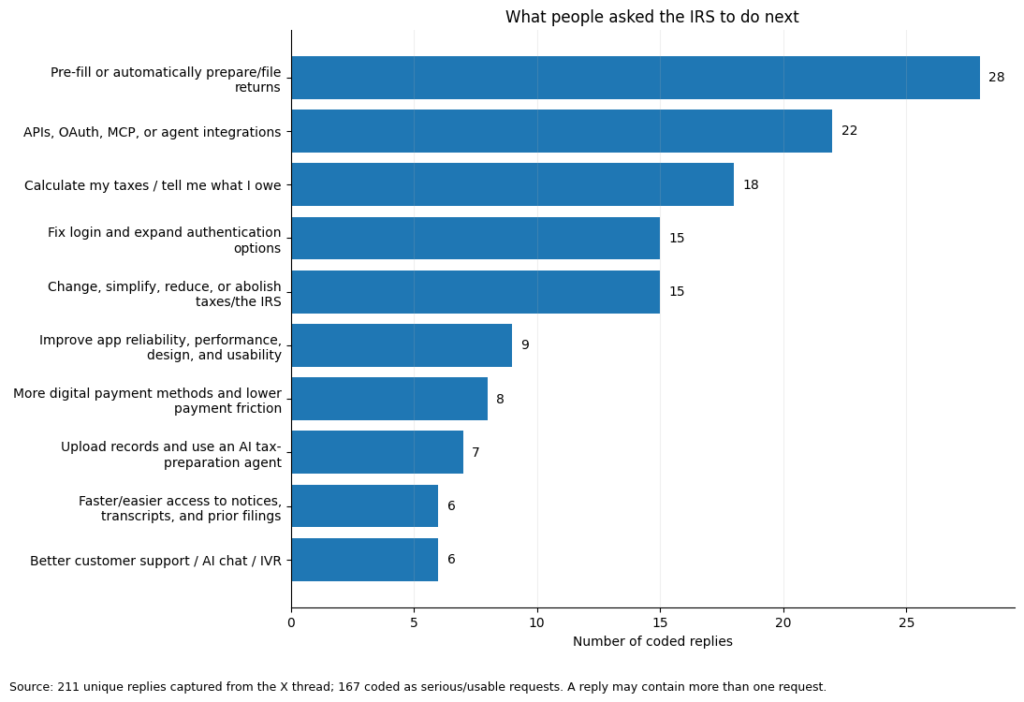
The most common request was, at least in my opinion, very expected. People want the IRS to prepare the tax return for them.
Twenty-eight responses asked, in one form or another, for the IRS to pre-fill, prepare or automatically file tax returns. Another 18 made a closely related request: just tell me what I owe. Seven more wanted to upload their records and have an IRS or AI agent prepare the return.
One respondent put it about as efficiently as possible: “Just tell us what we owe.”
Another wanted “prefilled tax returns that we review and approve.” Another said there should be “no need to file taxes for standard W-2” taxpayers because the government already has the information.
Other countries do pretty much exactly what these folks are asking for. Pre-filled returns are already routine across much of the world. Of course, its trickier here. The United States has a complicated tax code. Not everything the IRS needs to know is reported by a third party, and many taxpayers have business income, deductions, credits or transactions that the government cannot simply infer. Pre-filling would not eliminate filing for everyone, and it would require some things in the tax code to be simplified.
These are obviously not a random set of American taxpayers. These are users replying to a tech entrepreneur who works at the IRS. But, my guess is a random set of Americans would give the same answer.