What Do Tax Experts Think About California’s Billionaire Tax?
Six Nobel Prize-winning economists recently endorsed California’s Proposition 40, a ballot initiative that would impose a one-time tax on billionaires’ wealth. Their Nobel-recognized contributions concern subjects such as labor markets, information, economic development, and other broad questions in economics, rather than the practical design and administration of taxes. While some of these scholars have studied taxes, none focused entirely on taxes. But it does raise a natural question. What do economists who specialize in taxation think about the proposal? And what do scholars in other disciplines, such as law and accounting, think? To find out, I surveyed researchers belonging to a prominent professional organization devoted to tax research and public finance.[1] Its membership draws heavily from academic economists, accountants, and lawyers. Their answers provide a different perspective on the debate.
Proposition 40 was developed largely by legal academics. Three of its principal drafters, Brian Galle, David Gamage, and Darien Shanske, are tax-law professors. They worked with economist Emmanuel Saez of the University of California, Berkeley. Economist Gabriel Zucman has also been a prominent activist surrounding the measure and wealth taxation generally, publicly promoting wealth taxation and contributing with Saez and Jasper Boll to research estimating billionaire wealth and prospective revenues.
The measure would impose a one-time tax of up to 5 percent on covered net wealth for individuals whose covered assets exceed $1 billion, generally using California residence as of January 1, 2026. Payment would be due in 2027, with an option to pay over five years at additional cost. Covered property includes business interests and other financial and intangible assets, while real estate and certain retirement assets are generally excluded. Supporters estimate that the tax could generate approximately $100 billion in revenue. The amount ultimately collected depends on the size of the taxable base, valuation, compliance, litigation, and taxpayers’ responses.
Supporters argue that billionaire wealth has grown substantially and that taxing a portion of accumulated wealth would raise significant public revenue from taxpayers with considerable capacity to pay. They also see the proposal as a means of moderating economic inequality and the political influence associated with concentrated wealth. In the standard public-finance analysis, a genuinely unexpected, one-time tax on wealth already accumulated could create fewer distortions to past saving decisions than a tax that households anticipated when making those decisions. Supporters further argue that the retrospective residence date could limit the ability to avoid the levy by moving after the fact.
The objections concern both the revenue estimate and the operation of the tax. A state-level wealth tax may encourage wealthy residents to move, potentially eroding future income tax receipts even if a liability for the one-time levy has already accrued. Privately held businesses and other illiquid property are difficult to value and could generate costly disputes, liquidity problems, and avoidance opportunities. Other critics have raised concerns about accounting-based valuations, the difficulty of using one-time revenue for continuing expenditures, and valuation and liquidity problems for closely held assets.
One recent analysis suggests that the fiscal effect could even be negative. Joshua Rauh, Benjamin Jaros, Gregory Kearney, John Doran, and Matheus Cosso at Stanford’s Hoover Institution estimate that the levy would bring in substantially less than proponents project once departures and other reductions in the taxable base are considered. They further estimate that the present value of lost future state income tax revenues could exceed the wealth-tax collections. Their analysis finds a negative net fiscal effect under many plausible scenarios. These are model-based estimates that depend on assumptions about residence, litigation, taxpayer behavior, and discount rates, rather than observed outcomes of a tax that has not yet been imposed. Their estimates represent a substantial departure from the original, and substantially simpler, revenue estimates from proponents of the bill.
In order to see what scholars thought about the proposal, I surveyed researchers who specialize in taxation and public finance. The mailing list came from the directory of a prominent tax research organization. Its members include economists, accountants, lawyers, and other researchers, many of whom work at universities. I began with 503 contacts drawn from a somewhat dated directory (see footnote 1). Initial emails to these addresses generated 53 nondelivery notices. I located replacement email addresses for most of those failed emails, and ended up sending 486 apparently valid email addresses that did not bounce back. Note that the absence of a bounce does not guarantee that an email reached its intended recipient.
The questionnaire asked one substantive question. “If you had the chance, would you vote for Prop 40, imposing the tax?” Respondents chose either “Yes, I would vote for Prop 40 and impose the new tax” or “No, I would vote against Prop 40 and not impose the new tax.” As the organization whose membership directory I used has economists, lawyers, and accountants who study taxation, I also had survey participants identify as an economist, accountant, lawyer, or other respondent and could leave a comment. As of October 13, 2026, at 5.17 p.m. Eastern, I received 105 responses, equal to 21.6 percent of the cleaned invitation list. The poll was voluntary and completely anonymous. Because I did not collect identifying information or restrict responses to one per recipient, I cannot rule out that an individual answered more than once. Nor can I know whether respondents disproportionately held strong views. The results therefore describe the people who responded.
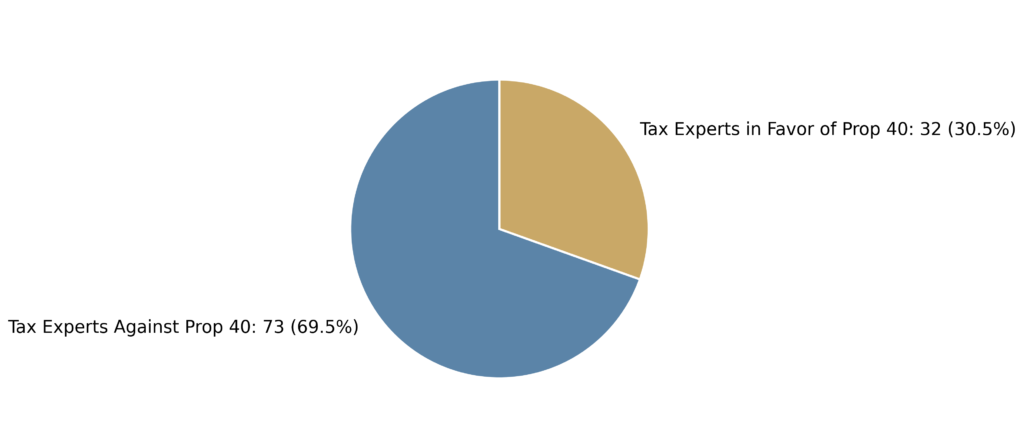
Of the 105 respondents, 73 (69.5 percent) would vote against Proposition 40 and 32 (30.5 percent) would vote in favor. Figure 1 reports the overall distribution. Approximately seven in ten respondents opposed the proposal.
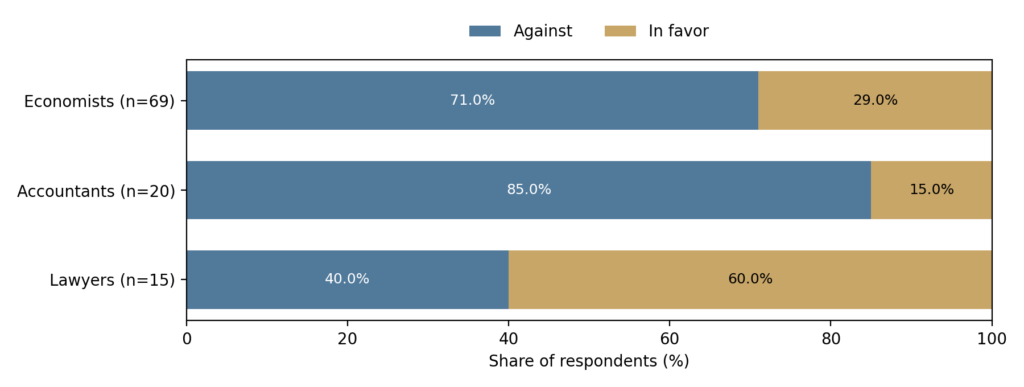
The respondents identified primarily as economists (69, or 65.7 percent), accountants (20, or 19.0 percent), and lawyers (15, or 14.3 percent). One respondent selected other (and noted they were a political scientist, they are omitted from Figure 2). These groups differed markedly. Among economists, 49 of 69 (71.0 percent) opposed the tax. Among accountants, 17 of 20 (85.0 percent) opposed it. Among lawyers, nine of 15 (60.0 percent) favored the measure, while six (40.0 percent) opposed it. Figure 2 reports the distribution by profession. In the combined economics and accounting groups, 66 of 89 (74.2 percent) opposed Proposition 40.
Summary of Open-Ended Comments
I also left an optional field for comments, thoughts, or opinions about Proposition 40. Thirty-eight respondents used it, including 25 economists, six accountants, six lawyers, and one other respondent. The comments help explain why someone might oppose this proposal while supporting higher taxation of wealthy individuals. The AI generated summaries that follow paraphrase the responses rather than quote individual respondents.
Economists
- Several opposed imposing a wealth tax at the state rather than federal level, citing migration, cross-border substitution, and the potential loss of future California income tax revenue.
- Others objected to asset valuation, avoidance, and the administrative burdens of taxing privately held or illiquid wealth.
- Multiple opponents said explicitly that they favored higher taxes on the wealthy, or would consider a federal wealth tax, but opposed this particular measure.
- The one-time design drew objections about using temporary revenue for ongoing programs. one respondent preferred a lower-rate recurring levy instead.
- Supporters emphasized the potential efficiency of a genuinely unexpected levy on wealth already accumulated, reducing concentrated wealth, and generating additional public revenue.
Accountants
- Respondents emphasized practical implementation, including the challenge of administering a state-level levy and enforcing it across mobile taxpayers and assets.
- Several pointed to valuation, liquidity, and compliance costs and questioned whether collections would justify those costs.
- Some favored different methods of taxing wealthy households or opposed this proposal without opposing wealth taxation in principle.
- Others raised objections to taxing wealth rather than realized income, including concerns about effective tax burdens, business certainty, and property rights.
Lawyers
- Supporters stressed equity and the social and political consequences of widening wealth inequality.
- Opponents worried that a nominally one-time tax could become a recurring levy with greater efficiency costs.
- Some warned of businesses leaving California. others described the proposal as short-term fiscal policy.
- One respondent selected opposition but described being on the fence, illustrating the limitations of a forced yes-or-no response.
The open-ended comments suggest that support for higher taxation of wealthy households and support for Proposition 40 are distinct questions. Some opponents objected to wealth taxation in general, but others objected to the state-level administration, one-time design, revenue implications, or choice of tax base. Conversely, some supporters acknowledged administrative or behavioral concerns but regarded the fiscal need or the distributional case as decisive.
Survey Integrity Checks
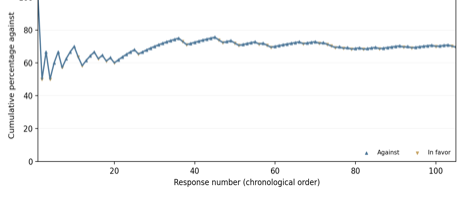
To protect respondents’ anonymity, I did not collect IP addresses or other identifying information. Consequently, it is possible that the same individual completed the survey more than once. To examine whether responses exhibited unusual clustering, I graphed the cumulative percentage voting against Proposition 40 in the order responses were received (Figure 3). The longest consecutive sequence of votes against the tax was 10 respondents. If responses were independent and randomly distributed with a 70 percent probability of voting against the tax, the probability of observing at least one sequence of 10 or more consecutive votes against the tax among 105 responses would be approximately 59.9 percent. The observed sequence is therefore not unusual under this model, although the exercise cannot rule out multiple responses from one individual.
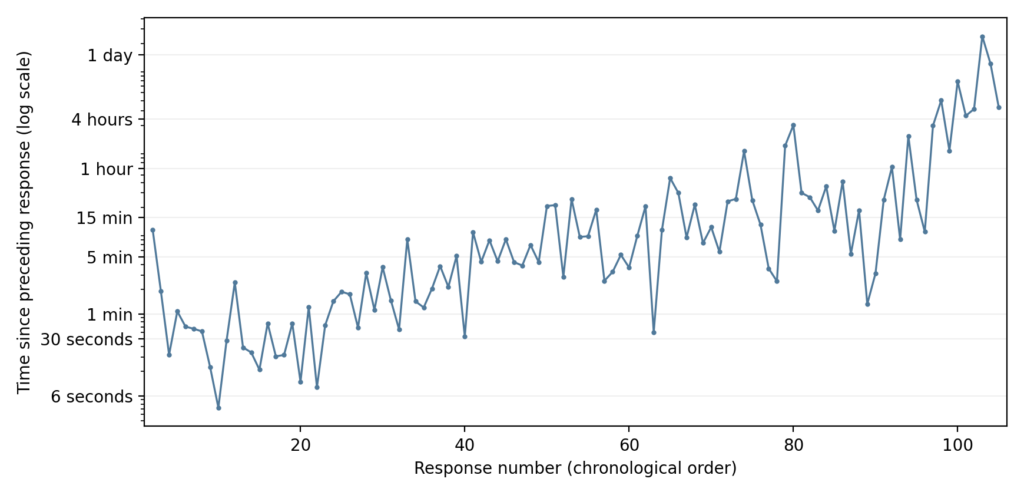
I also examined the elapsed time between consecutive responses (Figure 4). The median interval was 5.3 minutes, and the shortest was four seconds. Responses arrived rapidly after the initial invitation and became less frequent over subsequent days, with the longest interval reaching 40.7 hours. This pattern is consistent with a burst of replies after an email invitation and does not by itself establish that anyone submitted more than one response.
Conclusion
Six Nobel Prize-winning economists have endorsed Proposition 40. Among the respondents to this survey, however, economists and accountants who study taxes in their everyday work overwhelmingly oppose it, while lawyers are divided, marginally supporting it. Overall, surveyed tax experts would not vote for Prop 40.
Some of the relevant questions for assessing this piece of legislation are empirical. How many wealthy individuals will leave California? How much revenue will the tax actually raise? These are questions on which academic research can shed light. But whether the tax is desirable also depends on values, including how big government should be, who should pay for it, and how many economic resources we are willing to use up in the process of collecting revenue. Academic tax experts have expertise that can help answer the empirical questions, but their values are no more important than anyone else’s, even if they have likely thought about these tax issues more. However, in the end, considering both the empirical evidence they are aware of and their values, the tax scholars responding to this survey do not support Proposition 40 by a substantial margin.
AI Disclosure: AI was used to produce this piece. I take full responsibility for the contents.
References
Ball, R., & Sutherland, A. (2026, April 8). Biases, inequities, and adverse incentives from basing wealth taxes on accounting measures. Tax Policy Network. https://taxpolicynetwork.org/biases-inequities-and-adverse-incentives-from-basing-wealth-taxes-on-accounting-measures/
Belnap, A. (2026, October 8). California’s billionaire tax: Liquidity issues and questionable fiscal rationale. Tax Policy Network. https://taxpolicynetwork.org/californias-billionaire-tax-liquidity-issues-and-questionable-fiscal-rationale/
Financial Times. (2026, September). Nobel economists throw support behind California billionaire tax. https://www.ft.com/content/94ec0fee-53ab-4d7e-9b17-6b05608ad974
Galle, B. D., Gamage, D., Saez, E., & Shanske, D. (2026). Expert report on the California 2026 billionaire tax: Revenue, economic, and constitutional analysis (University of Missouri School of Law Legal Studies Research Paper No. 2026-01). https://papers.ssrn.com/sol3/papers.cfm?abstract_id=5996554
Hoopes, J. L. (2026). Galle v. Rauh: Comparing two revenue estimates for California billionaire taxation. Working paper. https://papers.ssrn.com/sol3/papers.cfm?abstract_id=6428578
Jacob, M. (2026, March 20). The one time billionaire tax: A one-time fix for a permanent problem? Tax Policy Network. https://taxpolicynetwork.org/the-one-time-billionaire-tax-a-one-time-fix-for-a-permanent-problem/
Jaros, B., Rauh, J. D., Kearney, G., Doran, J., & Cosso, M. (2026). The net present value of the Billionaire Tax Act: An assessment of the fiscal effects of California’s proposed wealth tax Working paper. SSRN. https://doi.org/10.2139/ssrn.6340778
Stark, K. J. (2026, April 6). California’s proposed billionaire wealth tax and the question of state residency. Tax Policy Network. https://taxpolicynetwork.org/californias-proposed-billionaire-wealth-tax-and-the-question-of-state-residency/
State of California. (2025). The 2026 Billionaire Tax Act (Initiative No. 25-0024A1). Office of the Attorney General. https://oag.ca.gov/system/files/initiatives/pdfs/25-0024A1%20%28Billionaire%20Tax%20%29.pdf
[1] I surveyed members of the National Tax Association (NTA) in early October, 2026, using the membership directory as of late 2024, when their membership directory was available to all members. This survey is not sponsored by or approved by the NTA. The NTA has since made their membership directory private, making updating the survey mailing list impossible.