The Last Mile of Tax Transparency: From Data Collection to Revenue Collection
The recent revolution in tax transparency
Two decades ago, one of the biggest blind spots in tax enforcement was cross-border income and wealth. A wealthy individual could hold assets in an offshore account largely beyond the reach of tax administrations, while a multinational enterprise could shift profits across dozens of jurisdictions without providing any administration with a comprehensive view of its global operations. Over the past two decades, governments have sought to close this information gap through an unprecedented wave of transparency initiatives. The Foreign Account Tax Compliance Act (FATCA), the Common Reporting Standard (CRS), country-by-country reporting, the automatic exchange of tax rulings, and more recently platform and crypto-asset reporting have dramatically expanded what tax administrations can see. Under FATCA and the CRS, financial institutions report the identity and tax residence of foreign account holders, together with account balances and income such as interest and dividends. This information is shared with the taxpayer’s home-country tax authority, which can compare it with domestic tax declarations. Country-by-country reporting similarly requires large multinational groups to report where they generate revenues and profits, pay taxes, and employ workers. As a result, governments have access to unprecedented volumes of information on offshore wealth, multinational profit allocation, tax planning arrangements, and ownership structures. The challenge today is no longer a lack of information. It is whether tax administrations can turn that information into effective enforcement. This challenge arises at a pivotal moment: just as the first decade of global tax transparency is revealing the difficulties of using the information collected, advances in artificial intelligence are creating new possibilities for analyzing it more quickly and effectively.
Table 1 – Recent Key Tax Transparency Initiatives to Counter Tax Evasion and Avoidance
| Transparency initiative | Main objective | Information |
| OECD Model for AEOI – CRS / US Model – FATCA | Offshore tax evasion by individuals | Foreign financial accounts held by non-residents |
| Directive on Administrative Cooperation 7 (DAC7) – Platform Reporting Rules | Underreporting in the platform and gig economy | Income earned through digital platforms |
| OECD Model for Crypto-Asset Reporting Framework (CARF) | Offshore tax evasion using crypto-assets | Crypto-asset transactions and account information |
| Automatic Exchange of Tax Rulings (BEPS Action 5) | Aggressive corporate tax planning | Advance tax rulings and advance pricing agreements |
| Country-by-Country Reporting (BEPS Action 13) | Aggressive corporate tax planning | Revenues, profits, taxes paid, employees, assets by jurisdiction |
| Mandatory Disclosure Rules (OECD BEPS Action 12) | Aggressive tax planning arrangements | Reportable cross-border tax arrangements disclosed by intermediaries and taxpayers |
The evidence so far suggests that transparency changes behavior, often before a tax authority even launches an audit. FATCA and the CRS reduced offshore tax evasion and encouraged taxpayers to disclose previously hidden assets. Multinational firms also adjusted their behavior in response to greater transparency, changing both reporting practices and real business decisions.[1] More recently, mandatory disclosure rules targeting tax advisers and intermediaries have shown similar deterrent effects where enforcement is perceived as credible. Yet transparency initiatives were never intended merely to influence behavior through the threat of detection. Their primary purpose was to provide tax administrations with better information for risk assessment, audit selection, and enforcement. The key question now is therefore whether tax administrations can process, analyze, and act on the vast quantities of information they receive. For many years, evidence on this “last mile” remained scarce because how tax administrations use information was largely hidden from researchers. That is beginning to change. As tax administrations increasingly collaborate with researchers and release new evidence, a clearer picture is emerging of when information is transformed into enforcement.
From information to knowledge, and from knowledge to enforcement: The most immediate achievement of the transparency revolution has been informational. FATCA and CRS have given tax administrations a far more complete picture of where residents hold financial assets abroad and what income those assets generate. Through collaborations between researchers and tax administrations, these new data have also transformed our understanding of offshore wealth itself. Today, tax administrations around the world can link CRS and FATCA reports directly to tax records, providing an unprecedented view of the size, location and ownership of offshore assets. The emerging evidence from the United States, France, Denmark, Colombia and South Africa points to a remarkably consistent picture: offshore wealth is substantial, typically amounting to between 4 and 20 percent of GDP depending on the country, and is highly concentrated among the wealthiest households. If CRS opened the black box of offshore wealth, CbCR opened the black box of multinational corporations. For decades, governments could see pieces of a multinational group’s activities but rarely the full picture. Country-by-country reporting changed that. Tax administrations now receive information on revenues, profits, taxes paid, employees and assets for every jurisdiction where a large multinational operates. Country-by-country data have made it possible to identify profit-shifting patterns that were previously difficult to observe and have significantly improved our understanding of how multinational firms organize their global operations and tax affairs.
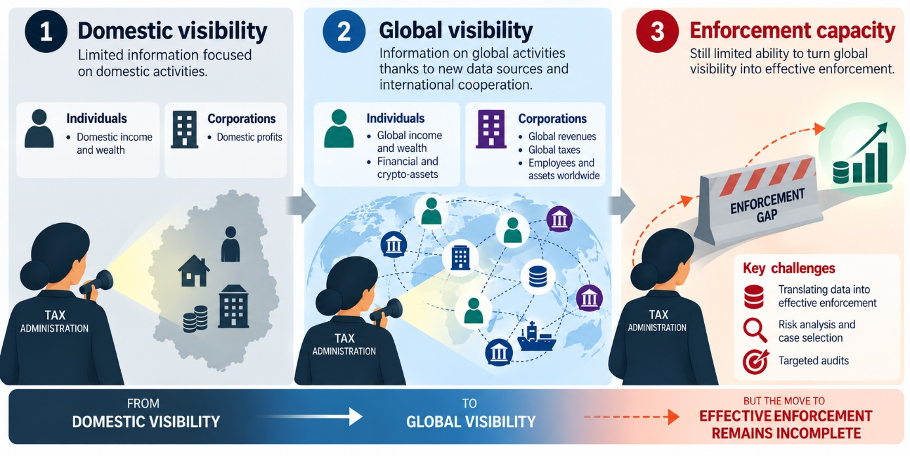
Has greater transparency translated into better enforcement? The answer is increasingly yes, but much less uniformly than policymakers originally hoped. The strongest evidence comes from the taxation of individuals. In Denmark, estimates suggested that post-CRS the offshore gap has been reduced by around 70 percent through a combination of asset repatriation, improved reporting, and targeted enforcement. Much of the response came from wealthy taxpayers repatriating previously hidden offshore assets, while additional gains resulted from improved self-reporting and audits supported by the new information. In Colombia, access to CRS data allowed the tax administration to compare taxpayer declarations with information received from foreign financial institutions and launch targeted compliance campaigns. The results were substantial: Colombia’s entry into the CRS is estimated to explain around 38 percent of the increase in reported offshore wealth, while subsequent enforcement campaigns based on CRS information explain a further 22-28 percent.
The picture is less clear for multinational corporations. Country-by-country reporting and the automatic exchange of tax rulings were introduced to strengthen tax administrations’ ability to identify cross-border tax risks. Evaluations conducted for the European Commission suggest that these instruments have become part of tax administration’s risk-assessment toolkit.[2] Yet the available evidence also points to an important limitation. While tax administrations use the information, there is remarkably little systematic evidence tracing that use through to specific enforcement outcomes. The European Court of Auditors found limited use advance tax rulings disclosure and country-by-country reports in in the EU, while the more recent Commission evaluation notes that Member States still do not effectively monitor or publish the outcomes resulting from the use of exchanged data.[3] We know tax administrations receive and consult the information. We know much less about how often it changes audit decisions, leads to adjustments, or ultimately increases tax revenues.
This gap is not necessarily surprising. European Commission evaluations, OECD assessments, and reports from tax administrations repeatedly identify three challenges.[4] First, data quality and consistency remain a concern. Country-by-country reports were designed primarily as a high-level risk assessment tool rather than a detailed accounting dataset, and differences in reporting practices, the treatment of dividends and profits, and other technical issues can complicate their interpretation. Researchers comparing country-by-country reporting data with other sources have documented important data and comparability limitations that complicate their use for detailed tax-risk analysis and subsequent enforcement. Second, matching international information to domestic taxpayers remains challenging. This problem is especially visible for CRS data, where tax administrations struggle to identify the beneficial owners behind trusts, holding companies, and other intermediary entities. Matching rates vary considerably across countries, but a common challenge emerges when accounts are held through companies, partnerships, or other complex ownership structures, where identifying the underlying taxpayer becomes substantially more difficult. Third, tax administrations face a capacity challenge. Transparency initiatives have produced enormous volumes of information, but transforming these data into practical enforcement actions requires substantial investment in IT infrastructure, data integration, analytical systems, and human resources. These challenges are not confined to lower-capacity administrations. Even highly digitalised tax administrations in countries such as Norway, Denmark, and Sweden continue to face difficulties in matching, processing, and effectively using exchanged information for tax control.[5]
What lessons can be drawn from the first decade of tax transparency? Perhaps the most important is that collecting information is only the beginning. Building the infrastructure, analytical tools, and administrative expertise needed to turn transparency into enforcement inevitably takes time. The experience with CRS and FATCA suggests that tax administrations are gradually learning how to use these data more effectively, and the same process is likely underway for country-by-country reporting and other corporate transparency initiatives. Yet there are also reasons for urgency.
First, transparency regimes rely heavily on deterrence. Taxpayers and firms adjust their behavior not only because information exists, but because they believe it will eventually be used. If enforcement remains limited for too long, the credibility of the system may weaken and the behavioral responses observed in the early years may fade. Evidence from earlier information-exchange initiatives suggests precisely this risk: the response to information-sharing agreements weakened over time as taxpayers adapted and the perceived threat of detection diminished.[6] More recent evidence from the CRS reinforces this point: taxpayers respond much more strongly where information exchange is backed by credible enforcement and greater tax-administration capacity.
Second, transparency comes at a cost. By 2017, EU Member States had spent around €112 million implementing automatic exchange systems: stakeholder estimates for Austria, France, Germany, Luxembourg and the UK put one-off investments at around €340 million and recurring annual costs at roughly €120 million.[7] As the transparency architecture matures, governments will increasingly need to demonstrate that these investments generate measurable compliance, enforcement, and revenue gains. Artificial intelligence may help accelerate this process by allowing tax administrations to match records, detect unusual patterns, and direct scarce enforcement resources towards the cases posing the greatest compliance risks. But technology alone will not complete the last mile: its effectiveness will still depend on data quality, administrative expertise, and appropriate safeguards. Ultimately, the success of tax transparency will depend not on the volume of information collected, but on how effectively it is turned into compliance, enforcement, and public trust.
Further Academic Reference
Bratta, B., Santomartino, V. and Acciari, P., 2024. Assessing profit shifting using country-by-country reports: A nonlinear response to tax rate differentials. National Tax Journal, 77(2), pp.349-380.
Davoine, E., Herry, S.L.G., Le Pouhaër, E. and Leenders, W., 2026. Global Transparency and Tax Enforcement on Foreign Capital. Working paper.
De Simone, L. and Stomberg, B., 2023. Has FATCA succeeded in reducing tax evasion through foreign accounts?. Oxford Review of Economic Policy, 39(3), pp.550-564.
Fuest, C., Greil, S., Hugger, F. and Neumeier, F., 2025. Global profit shifting of multinational companies: Evidence from country-by-country reporting micro data. Journal of the European Economic Association, 23(5), pp.1773-1808.
Godar, S., Aliprandi, G., Faccio, T., Janský, P. and Toledo Ruiz, K. 2024. The long way to tax transparency: lessons from the early publishers of country-by-country reports’, International Tax and Public Finance, 31,
Hoopes, J.L., Robinson, L. and Slemrod, J., 2024. Corporate tax disclosure. The Journal of the American Taxation Association, 46(2), pp.31-61.
Johannesen, N., Reck, D., Risch, M., Slemrod, J., Guyton, J. and Langetieg, P., 2024. The offshore world according to FATCA: New evidence on the foreign wealth of US households. Tax Policy and the Economy, 38(1), pp.61-99.
Johannesen, N., Larsen, L. and Riedel, N., 2026. Does global financial transparency improve tax compliance in developing countries?.
[1] See De Simone, L. and Olbert, M., 2022. Real effects of private country-by-country disclosure. The Accounting Review, 97(6), pp.201-232; Joshi, P., 2020. Does private country‐by‐country reporting deter tax avoidance and income shifting? Evidence from BEPS Action Item 13. Journal of Accounting Research, 58(2), pp.333-381; Bilicka, K., Casi, E., Seregni, C. and Stage, B.M., 2025. Tax strategy disclosure: A greenwashing mandate?. Journal of Accounting Research, 63(5), pp.1857-1915.
[2] For more details, see Ramboll Management Consulting, Syntesia Policy and Economics and London Economics (2024) Evaluation of the Directive 2011/16 and its Amendments: Final Report, Volume 1 – Main Text. Report prepared for the European Commission, Directorate-General for Taxation and Customs Union. 11 January 2024.
[3] For more details, see European Court of Auditors (2021) Exchanging tax information in the EU: solid foundation, cracks in the implementation. Special Report No. 03/2021. Luxembourg: Publications Office of the European Union and European Commission (2025) Report from the Commission to the European Parliament and the Council on the evaluation of Council Directive 2011/16/EU on administrative cooperation in the field of taxation. COM(2025) 695 final. Brussels: European Commission.
[4] See for example OECD (2024). Important disclaimer regarding the limitations of the Country-by-Country report statistics. Paris: OECD.
[5] Riksrevisjonen (2023) Skatteetatens arbeid med å avdekke norske skattepliktiges inntekter og formuer i utlandet samt kryptovaluta. Dokument 3:3 (2023–2024). Oslo: Riksrevisjonen.
[6] See Menkhoff, L. and Miethe, J., 2019. Tax evasion in new disguise? Examining tax havens’ international bank deposits. Journal of Public Economics, 176, pp.53-78.
[7] More statistics on the costs are provided here European Commission (2018). Report from the Commission to the European Parliament and the Council on overview and assessment of the statistics and information on the automatic exchanges in the field of direct taxation. COM(2018) 844 final, Brussels, 17 December 2018.