
A smaller fix for buy, borrow, die might be a good starting point
“Buy, borrow, die” has become a familiar indictment of how wealthy Americans are taxed. Senator Ron Wyden warns that assets pass to children “often entirely tax-free.” Morris Pearl, chair of Patriotic Millionaires, describes wealth reaching the next generation “completely free of income tax.” For these reasons, many people advocate taxation of wealthy Americans, although the exact extent of this issue for tax revenues is heavily debated as discussed by Edward Fox and Zachary Liscow. Still, many people including Pearl endorse wealth taxes alongside taxes on unrealized gains. But before choosing how to fix this issue, we should identify precisely what allows these gains to escape taxation.
The strategy starts with appreciating assets, such as shares. Their owner borrows against them to finance consumption instead of selling and realizing taxable gains. Borrowing creates a repayment obligation, so loan proceeds are not income. The decisive additional benefit comes at death: under the American step-up in basis, inherited shares generally receive a new tax cost equal to their market value. The appreciation accumulated during the deceased’s lifetime disappears from the capital gains tax base, making the “buy, borrow, die” strategy valuable. The same goes for a strategy, where the owner does not borrow against the increased value, also called “buy, save, die”. Also, this strategy benefits from the step-up at death.
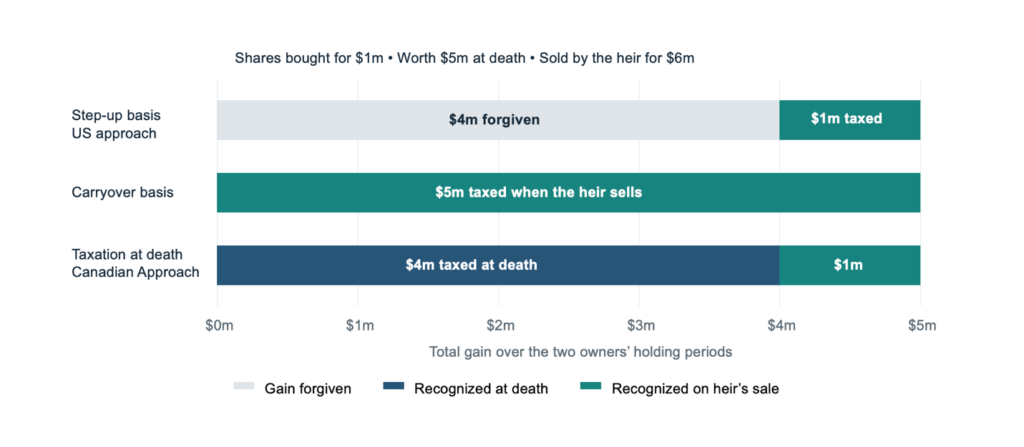
Consider shares purchased for $1 million and worth $5 million at death. If the heirs immediately sell for $5 million, the $4 million gain generally escapes capital gains tax. Estate tax is a separate question; forgiveness of the gain does not mean that every wealthy estate avoids every tax. Nevertheless, the capital gains advantage is substantial. Holding an appreciated investment until death can turn tax deferral into permanent exemption.
That prospect distorts decisions long before anyone dies. Investors may retain shares they would otherwise sell to diversify or finance better opportunities. This lock-in effect reflects the tax advantage of waiting. Simply raising the capital gains tax rate can increase the reward for avoiding realization while leaving the eventual exemption intact. A higher statutory rate need not repair a hole in the tax base.
Broader remedies also have costs. Wealth taxes create a host of other challenges including valuation issues and economic distortions. Higher dividend and capital gains taxes can impede the movement of equity capital toward firms that need external financing such as start-ups and growing firms. These effects depend on design and circumstances, but they belong in the policy calculation. If the identified problem is forgiveness at death, a reform directed at that provision deserves consideration before adding another layer of taxation.
There are two distinct approaches. Instead of a step-up at death, a carryover basis lets heirs inherit the original tax cost, preserving the capital gain for taxation when they sell. Alternatively, death can trigger a deemed sale, taxing accrued gains immediately and then resetting the heirs’ basis. Both end forgiveness, but only the second ends deferral at death. This distinction matters for both incentives and liquidity.
Unlike annual wealth taxation, neither approach itself requires a yearly assessment of every covered asset merely because it is owned. Carryover basis generally waits for an actual sale to generate cash. Taxation at death requires valuation at that point, rather than annual valuations throughout the owner’s life.
Sobia Jafry’s working paper examines Canada, where unrealized gains are generally taxed at death. Studying the 2000 capital gains tax cut, she compares living taxpayers, who choose their realizations, with deceased taxpayers, whose accrued gains become taxable. She finds an initial increase in realizations but no lasting medium- or long-run response. The findings are consistent with weaker lock-in when death does not erase the tax.
More direct evidence comes from Lucy Msall and Ole-Andreas Næss. Their working paper studies Norway’s 2006 replacement of stepped-up basis with carryover basis for shares. Removing forgiveness increased taxable realizations, particularly among older investors and owners of highly appreciated portfolios. The authors estimate that annual capital gains tax revenue rose by 26%. Revenue increased through a broader realized tax base without raising the capital gains tax rate.
These results support a targeted reform. Yet, even a carryover basis permits lengthy deferral, potentially across generations. Indeed, the Norwegian study finds that the stock of unrealized gains continued growing. Taxation at death addresses that problem more directly, but can create liquidity pressures for heirs inheriting private businesses.
Implementation therefore matters. Historical purchase costs must be documented, illiquid businesses need workable payment arrangements, and any new rules should be coordinated with estate taxation. These are substantial design questions. Ending forgiveness is a narrower but potentially effective reform. If policymakers want to address buy, borrow, die, they should start with the provision that turns waiting into permanent tax forgiveness. Broader redistribution objectives via wealth taxes or higher capital gains taxes require their own arguments. For the particular problem of “buy, borrow, die” and “buy, save, die”, respectively, a targeted repair deserves priority over a much larger tax overhaul with many potentially detrimental economic effects.
