The Jock Tax: Origins, Calculation, and Effects on Players, Teams, and Championship Sites
In February 2026, Seattle Seahawks quarterback Sam Darnold led his team to a dominant 29–13 win over the New England Patriots in Super Bowl LX. Every player on the winning team earned a $178,000 bonus. However, because of the jock tax, Darnold’s $178,000 in incremental income led him to have about $198,000 more in California income taxes. He won the Super Bowl, but he lost money after taxes due to the jock tax.
The culprit is the “jock tax,” the phrase for how states and cities tax the income nonresident athletes earn while working inside their jurisdiction. The modern jock tax dates to the early 1990s and applies to athletes across professional leagues like the NFL, NBA, NHL, MLB, and WNBA. It also impacts team decisions, such as where a team holds training camp, where a championship is played, and how much a payroll is worth on an after-tax basis.
In this article, I explain what the jock tax is, how it began, and how it is calculated. I then show what it means for players and teams, and how it will affect players depending on where the Super Bowl and golf’s major championships are played over the rest of the decade.
What is the jock tax?
The jock tax is not a separate tax and, it does not explicitly appear in the Internal Revenue Code. Instead, it is the ordinary state and local income tax on nonresidents, applied to people whose work is mobile. Most taxpayers live, work, and file in one state. Professional athletes differ in that they often work in different states (and sometimes different countries) throughout the year.
All U.S. professional athletes are subject to the U.S. federal income tax (with a top rate of 37% in 2026) regardless of the state or city in which their games are played. However, these athletes face different state (and sometimes local) income taxes. Each state where the athlete has duty days (the term used to identify a day worked) can tax the share of income earned there. The athlete’s home state taxes everything but generally credits taxes paid to other states.
Athletes are among the most visible targets of the jock tax because their salaries are public and their work schedules are published months in advance. However, the same rules would theoretically apply to any highly mobile taxpayer.
How did the jock tax begin?
The jock tax began with Michael Jordan. While states were permitted to tax nonresidents on income earned in their jurisdiction, they typically did not. This changed after the Chicago Bulls beat the Los Angeles Lakers in the 1991 NBA Finals, when California assessed tax on the Bulls players for the games they played in Los Angeles.
Illinois answered with a retaliatory law (nicknamed “Michael Jordan’s Revenge”) that taxed visiting players from states that taxed Illinois-based players. Other states and several cities followed. Today nearly every state with both an income tax and a major professional team taxes visiting athletes, and the rule now spans every league and international events played on U.S. soil. Courts have also begun to set limits. For instance, in recent years we have seen the Pennsylvania Supreme Court strike down Pittsburgh’s 3% tax on visiting athletes because the city’s residents paid only 1%.
How is the jock tax calculated?
For team sports, states apportion a player’s annual pay using duty days. A duty day is any day the player practices, travels, trains, or plays. A state’s share of the player’s income is its share of those days using the following formula:

A clean example of how this formula works is the case of Sam Darnold. Darnold’s contract with the Seattle Seahawks averages $33.5 million a year. If we assume that Darnold worked 180 duty days in the season, with eight of them spent in California for Super Bowl week, those eight days make up 4.44% of his duty days. That share pulls about $1.49 million of his salary into the jurisdiction of California, which levies taxes at a top rate of 13.3%. That is why roughly $198,000 of added California tax exceeded his $178,000 bonus for winning the Super Bowl.
States do not claim days spent abroad, so an NFL game in London or an NBA game in Paris shifts those days back to the team’s home state. Because federal tax is the same for U.S. athletes, the variation in after-tax pay between two identically compensated athletes comes from the jock tax.
The mechanics differ by sport because athletes have many different revenue streams. Below is a summary of the main types of compensation and how states typically tax each:
| Setting | What is taxed | How the state’s share is set | Illustration |
| Team sports (NFL, NBA, NHL, MLB) | Salary and bonuses | Duty days in the state ÷ total duty days | An NBA season runs about 195 duty days, from training camp to the last regular-season game |
| Playoffs and championships | The game check, plus a larger share of salary | Extra duty days at the host site | Eight Super Bowl days pulled about $1.49M of Darnold’s pay into California |
| Individual sports (golf, tennis) | Prize money | Sourced in full to the state where the event is played | A $4.5M major win is taxed by the host state alone |
| Endorsements | Fees for appearances and shoots | Where the work is done; otherwise the home state | A commercial shot in Los Angeles is California income |
| International events | U.S.-source income of foreign players | Federal tax plus state duty-day apportionment; treaties can lower withholding | Mbappé’s one World Cup match in New Jersey: about $94,000 of state tax |
What does the jock tax mean for players?
As discussed above, two identically compensated athletes can have different after-tax income because of the jock tax. A player has most of their duty days where their team is based. However, the jock tax also varies with the location of road games, practices, and other duty days. Figure 1 compares pre-tax salary, estimated jock tax, and after-tax salary for two highly-compensated athletes in football (Josh Allen vs. Trevor Lawrence) and basketball (Stephen Curry vs. Giannis Anteokounmpo).
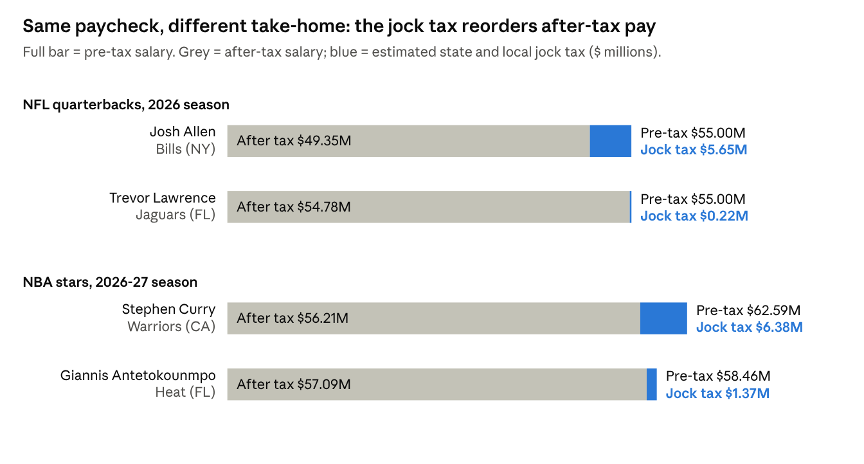
Josh Allen and Trevor Lawrence are both paid about $55 million a year. However, their after-tax outcomes differ significantly. Most of Allen’s duty days are in New York, whereas most of Lawrence’s are in Florida. As a result, Allen’s estimated jock tax is about $5.65 million, far larger than Lawrence’s $0.22 million.
In the NBA, the jock tax flips the league’s pay ranking on an after-tax basis. Giannis Antetokounmpo earns about $4 million less than Stephen Curry before tax but takes home more after it, because the estimated jock tax rate for Miami Heat players is 2.34%, compared with 10.20% for the Golden State Warriors.
Player movement can also significantly affect a player’s after-tax earnings. For instance, Myles Garrett’s 2026 trade from Cleveland to the Los Angeles Rams moves him from Ohio’s 2.75% rate to California’s 13.3%, so the same contract costs him up to $4.2 million more a year in state tax. The same logic applies to the draft order. Heisman Trophy winner Fernando Mendoza gained millions in after-tax earnings by going to the Las Vegas Raiders (Nevada, no income tax) rather than the New York Giants (New Jersey, 10.75%).
What does the jock tax mean for teams?
Every team in a league spends under the same salary cap, but a dollar of payroll is worth less to a player in a high-tax state. My estimates put the combined state and city jock tax rate at 10.20% of salary for California’s four NBA teams in 2026-27, compared with 2.34% for Florida’s two. Cities can add their own layer: Portland’s county and regional taxes push a game at the Moda Center to 13.9%, above California’s top rate.
The differences in the jock tax imposed on athletes can also affect competition. Prior research by Alm, Kaempfer, and Sennoga (2012) finds that Major League Baseball teams in high-tax rate jurisdictions must pay free agents more to compete. Also, Kopkin (2012) finds that NBA teams that are subject to higher tax rates sign lower-skilled free agents on average. As shown in research by Goldman and Jacob (2026), these differences in tax rates can impact performance outcomes.
Teams also make choices that move their players’ tax bills. The Dallas Cowboys hold training camp in California. This team choice increases the number of duty days that Cowboys players have in California. For a player like Cowboys quarterback Dak Prescott, this locational decision means that Prescott has to pay an estimated $940,000 a year more than if the team held training camp in Texas.
How does the jock tax affect events that change locations each year?
The Super Bowl is an event where the jock tax is highly visible because the NFL moves its championship every year. Meanwhile, the NFL pays every player the same flat check regardless of where the Super Bowl is played. The extra week of duty days at the host site pulls a slice of each player’s full-season salary into that state. Figure 2 applies the same eight-day assumption to the NFL’s highest-paid player, Patrick Mahomes, at each host site from 2025 through 2030.
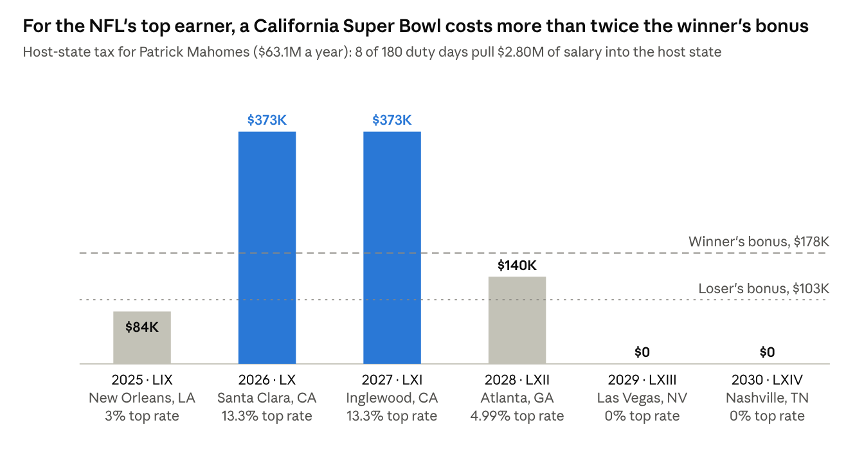
The schedule ahead varies substantially. As in 2026, Super Bowl LXI in 2027 will be played in California. Atlanta follows in 2028, then Las Vegas in 2029 and Nashville’s new stadium in 2030, both in states with no income tax. For Mahomes, at about $63.1 million a year, a 2027 Super Bowl appearance would pull about $2.8 million of salary into California, resulting in about $373,000 of California state tax. That tax would be more than twice the winner’s bonus and more than three times the loser’s $103,000. The same week of work in Las Vegas in 2029 or Nashville in 2030 would trigger no host-state tax at all.
Golf shows the jock tax in its purest form. A tournament’s prize money is sourced entirely to the state where the event is played, so the winner’s state tax is simply the host state’s rate times the winnings. Many tour players live in Florida, Texas, or Nevada, meaning that host-state tax is usually their only state tax on the win.
Like the Super Bowl, golf’s majors rotate locations, and the varying locations affect players’ jock taxes. Figure 3 applies each upcoming venue’s top rate to a $4.5 million winner’s check.
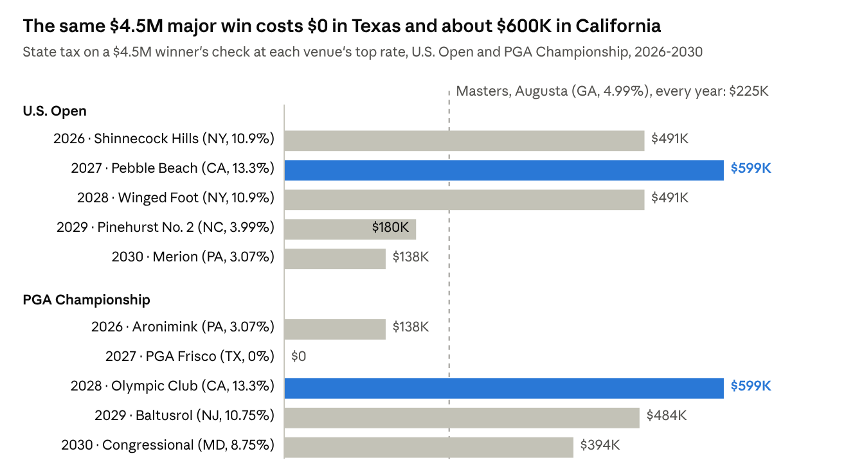
The 2026 season already illustrates the gap. The 2026 Masters and the 2026 U.S. Open paid identical $4.5 million first prizes, but Georgia’s 4.99% rate took about $225,000 while New York’s top rate took about $490,000. J.J. Spaun’s 2025 U.S. Open win at Oakmont, in Pennsylvania at 3.07%, cost about $132,000 on a $4.3 million check.
The rotation through 2030 shows an even larger gap. The 2027 U.S. Open will be played at Pebble Beach in California, while the 2027 PGA Championship will be played in Frisco, Texas. If both tournaments paid the same $4.5 million first prize, a winner whose home state has no income tax would keep about $600,000 more by winning the PGA Championship rather than the U.S. Open.
What could leagues and lawmakers do about the jock tax?
Players will still participate in the Super Bowl and golf majors even if the taxes are not ideal. But the jock tax creates differences in pay, and leagues control several of the levers that produce them.
- Weigh tax costs in site selection. Leagues and governing bodies could place more championships in low- or no-tax states. This would be a relatively obvious path as there are plenty of great locations in low or no income tax rate jurisdictions. However, it would also pull marquee events out of major markets such as Los Angeles, New York, and San Francisco.
- Make championship pay location-aware. The NFL could adjust the size of playoff and Super Bowl payouts based on the host state’s tax rate in a way that players receive the same amounts after-tax regardless of the location. Similarly, the USGA and PGA of America could adjust purses for the host state’s income tax rate.
- Adjust salary cap rules for tax differences. A uniform salary cap buys less after-tax talent in high-tax states. A league could allow a cap adjustment for teams whose players face higher home-state rates.
- Simplify and constrain the state rules. States could adopt uniform duty-day definitions, filing thresholds, and composite returns to cutdown on the compliance costs that athletes and teams face.
The bottom line is that the jock tax turns geography into compensation. A team’s home state, a training camp site, a trade, a draft pick, an international game, and a championship venue all move millions of dollars of after-tax pay. As the Super Bowl heads to California again in 2027 and golf’s majors rotate through New York, California, and New Jersey, those choices will keep showing up on the players’ tax returns.
A note on estimates
All player and team figures are illustrative estimates, not tax returns. They use top statutory rates, simplified duty-day schedules, and public salary data, and they ignore deductions, agent fees, residency credits, and timing. Real liabilities depend on facts only the player and team know. New York’s 10.9% bracket applies above $25 million of total income, so many golfers would face 10.3% there. Georgia’s rate is the 4.99% enacted for 2026 and is scheduled to keep falling if revenue targets are met.
Sources
My Forbes analyses drawn on in this piece:
- Sam Darnold Won The Super Bowl — But Lost Money Due To The Jock Tax (Feb. 10, 2026)
- The NFL Draft Order Will Save Fernando Mendoza Millions In State Taxes (Apr. 20, 2026)
- NFL Blockbuster Trades Send Players’ Tax Bills Soaring By Millions (June 1, 2026)
- Ronaldo, Mbappé, And The World Cup’s Hidden Tax Costs (June 12, 2026)
- Which NFL Players Will Owe The Most Jock Tax In 2026 (Aug. 6, 2026)
- Which NBA Players Will Owe The Most Jock Tax In 2026-27 (Oct. 19, 2026)
- The Tax Benefit Of J.J. Spaun’s U.S. Open Win At Oakmont Country Club (June 13, 2025)
Other sources:
- Alm, J., W. H. Kaempfer, and E. B. Sennoga. 2012. “Baseball Salaries and Income Taxes: The ‘Home Field Advantage’ of Income Taxes on Free Agent Salaries.” Journal of Sports Economics 13 (6): 619–634.
- Kopkin, N. 2012. “Tax Avoidance: How Income Tax Rates Affect the Labor Migration Decisions of NBA Free Agents.” Journal of Sports Economics.
- CBS News Pittsburgh. 2025. “Pittsburgh’s ‘jock tax’ is unconstitutional, Pennsylvania Supreme Court rules.”
- NBC New York. “Future Super Bowl locations for 2027, 2028 and beyond.”
- Comptroller of Maryland. 2026. “2026 Maryland State and Local Income Tax Withholding Information.”
- Fantasy Nerds. 2026. “NFL’s Highest-Paid Players by Position for 2026 Revealed.” (Mahomes’s contract value)
Use of AI
This essay was drafted with the assistance of Claude, an AI model developed by Anthropic. The analysis and estimates come from my prior Forbes articles and public data. Claude helped with preparing the writing and the figures. I reviewed, edited, and verified all content and am responsible for any errors.