What Are States Buying with Data Center Subsidy Deals?
Louisiana may forgo up to $10 billion in state and local taxes to host a single data center, Meta’s Hyperion project in Richland Parish. Meta promises around 1,000 permanent jobs at the site, and will also fund infrastructure upgrades and job training programs via a local community college. The deal is a prominent example of a fairly common practice: state and local business tax subsidies have roughly tripled over the past three decades, and at least 36 states now offer subsidies specifically targeting data centers.[1] And state and local incentives are only part of the public financial support for these projects: Meta also claims the federal R&D tax credit on chips for its AI data centers, potentially saving it billions of dollars in taxes annually.
Deals like this are usually sold, and judged, on their headline numbers: dollars invested and jobs promised. But those numbers say little about what a state actually gets in return, and states rarely disclose enough for an outsider to work that out. Louisiana is no exception. In this piece, I draw on academic research, including my own, to lay out how policymakers and the public can evaluate such deals from a state’s perspective. I use Hyperion as a running example and return to the federal credit at the end. There are three key questions to ask. First, how many of the promised jobs are incremental to what a company would have otherwise created? Second, how much is the state spending per additional job? And third, how enforceable are the commitments the company makes to the state in exchange for the subsidy, and how does the state monitor the company? The answers point to concrete steps states can take before signing their next deal.
It’s difficult to assess the first question directly, because we can’t observe the counterfactual. Several studies do get at this indirectly, with results that range from virtually no additional jobs (e.g., Jensen 2017) to a moderate number (Criscuolo et al. 2019). And when incentives do succeed, incremental job creation is often concentrated within a specific industry (Slattery and Zidar 2020). Incrementality also depends on the geographic unit we’re interested in; a subsidy designed to lure jobs from one state to another might increase job figures in the subsidizing state while having no impact on employment in the country as a whole. But even if we assume that all of the jobs being created are incremental, as Louisiana officials suggest in the Meta/Hyperion case, answers to the other two questions are critical for understanding what a state ultimately gets from using incentives to lure a company to town.
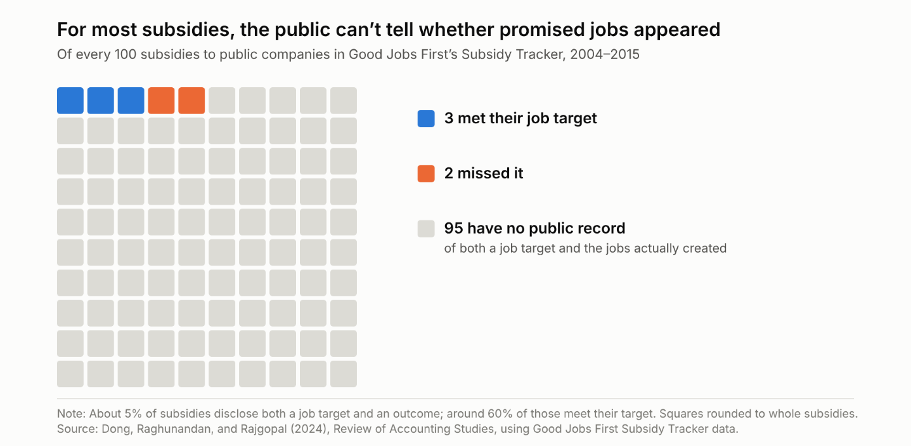
On the second question, while it’s hard to come up with a single ‘right’ answer for the cost per job figure, even calculating how much a single job is costing the state can be surprisingly difficult. Many subsidies come with up-front promised or expected job creation totals (e.g., 1000 in Meta’s case). Far fewer actually disclose, ex-post, how many jobs were actually created. The distinction matters: my own work, with Qingkai Dong and Shiva Rajgopal, suggests that around 40% of the job targets firms promise in exchange for state subsidies are not met. And this figure comes from a sample of subsidies with clear ex-ante promised and ex-post actual job creation disclosures. Subsidies that come with these disclosures represent only around 5% of subsidies to public firms recorded in Good Jobs First’s Subsidy Tracker database during our study’s sample period. The true share of missed targets is probably higher when we consider subsidies awarded in less transparent environments.
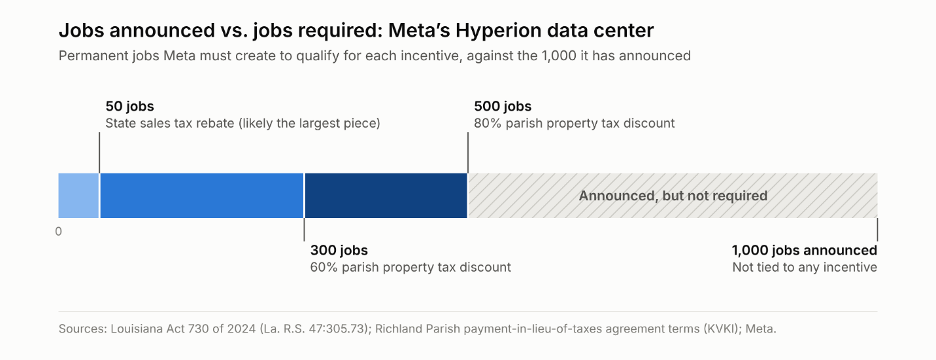
There’s another way in which promised totals can be misleading: the number a company announces is not always the number it is obligated to deliver to qualify for the subsidy. To come back to the Hyperion example, Meta says it will create 1,000 jobs. This is the number found in press releases and public coverage of the deal. But the parish’s property tax agreement requires Meta to create only 300 jobs to unlock a 60% discount on its property taxes, and 500 jobs if it wants an 80% discount. If the full package is unlocked, it could cost Louisiana nearly $20 million per job (i.e., $10 billion for 500 jobs). And that might still be too generous of an estimate. The state’s sales tax rebate – likely the largest piece of the package, which one outside estimate puts at more than $3.3 billion – is tied to a much lower bar: to qualify, Louisiana law requires that a mere 50 jobs to be created.
These cost per job figures are much higher than estimates found in many other settings. For example, Slattery (2025) finds cost-per-promised-job figures of around $107,000 in subsidies given to large new plants. Even using Meta’s own 1,000-job promise, the corresponding figure is $10 million per job for Hyperion. These figures are over the life of the deal, but even for a typical 10-year commitment (Slattery 2025) that would amount to $1 million per job per year for Hyperion.
Data centers have long been more expensive because they need a lot of capital but have fewer permanent employees who remain once construction is complete. Earlier data center deals averaged around $2 million per job. This isn’t to say that deals like the Hyperion one are necessarily bad, but the high costs per promised job – and even higher costs per legally required job – mean that the case for deals like this relies on expansions in the tax base. States should be able to show that the gains exceed what they’ve given up. Richland Parish collected about $19 million in sales taxes in the fiscal year before construction began; in the first quarter of 2026 alone, it collected $39 million. But much of that will go away once construction is complete, and to assess the overall deal from Louisiana’s perspective we need to know how much the state and parish expect in long-term, recurring tax revenues.
The third question I raised earlier, on monitoring and enforcement, is where states have the most control but often exercise the least. Part of this is political: officials are often rewarded for landing deals (Slattery 2026), and being able to tout a promised number of jobs to be created seems to matter more for short-run electoral purposes than how well those deals actually fare. Yet the firms most likely to fall short are precisely those most likely to have received subsidies for political reasons; in our data, we find that election-year subsidies to politically connected recipient firms are 13-15 percentage points less likely to succeed in creating their promised number of jobs.
The usual safeguard against missed targets is a clawback, which lets a state recover a subsidy when a company falls short of a promised job target. Most major programs have one on paper: Good Jobs First found that 75% of 238 state programs it examined carried some penalty for noncompliance. But nearly half of those penalties could be waived at the state’s discretion, and only 9% of programs published any data on enforcement. Clawbacks also require knowing that a target was missed, and it’s not clear how well states keep track of this: at the time of Good Jobs First’s study, about three-quarters of major programs did not even report the jobs actually created internally (to say nothing of posting that data externally), and a subsequent series of Pew studies suggested that the issue remains widespread. Pew’s broader advice is simple: pay incentives only after companies meet their commitments.
In spite of the above, monitoring does help. But form matters here. In work with Lisa De Simone and Rebecca Lester we examine smaller, routine subsidies, averaging around $330,000 each. In the states we study, these awards account for 99.9 percent of subsidies and about two-thirds of aggregate subsidy dollars. Yet these kinds of subsidies rarely make headlines, which makes disclosure and monitoring especially important. We find a link between these subsidies and local employment when states require granting agencies to report them to the legislature or governor. Laws requiring only public disclosure seem to do less, largely because of how they are written: they cover only some types of subsidies, so governments shift to ones the laws do not cover, and they often don’t require timely reporting, which leads to information being posted years out of date. Firms respond the same way. In newer work with Dian Jiao, Shiva Rajgopal, and Min Jun Song examining a new subsidy disclosure rule, we find that firms shift the types of subsidies they seek toward those not covered by the rule.
Monitoring and enforcement also matter for costs that never appear directly on financial statements: externalities. In work that began as my dissertation, I find that subsidized firms engage in operational misconduct in subsidizing states (but not in other locations) more frequently, because those states seem to be enforcing the rules for subsidy recipients less strictly. Sometimes that leniency is even written into the deal itself. For example, to land a Foxconn plant in 2017, Wisconsin exempted the project from several environmental laws in tandem with a $3 billion subsidy package. When hiring fell far short of the promised 13,000 jobs, the state was able to renegotiate the dollar value of the subsidy package down to $80 million. But environmental laws waived in advance can’t be retroactively applied, and the full cost of a subsidy can include weaker protections for the very workers and communities it is meant to benefit.
Hyperion involved no waiver of that kind (that we know of, anyway), but on enforcement and monitoring it’s still a mixed bag. Richland Parish’s property tax discount is earned, growing as Meta reaches investment and employment thresholds. But the massive sales tax rebate requires only 50 jobs, Meta self-certifies its investment figures, and clawbacks can be waived at the state’s discretion. And state officials signed NDAs before the deal was announced, leaving little room for oversight by either the legislature or the public. State leadership doesn’t seem troubled by this: Governor Jeff Landry has made clear that he sees transparency as more hindrance than safeguard, telling the New York Times that opponents use it to kill deals like this one.
The federal R&D credit that Meta controversially claims for its AI data centers works on a different logic: it pays for research investment, not jobs, and so the relevant question is how much additional research it buys. On transparency, though, the federal credit actually fares better. Because the IRS may challenge Meta’s claim, accounting rules require the company to disclose how much of its tax savings might not survive an audit: $18.74 billion, with its research credits listed first among the reasons. Louisiana publishes nothing comparable.
What does all this mean for policymakers? Each of the three questions points to something states can do before a deal is signed, all of which involve transparency in some way. States should publish how much revenue they expect to forgo, and how many of the promised jobs they think would have come anyway, and the additional tax revenue they expect to earn (with justifications). The largest pieces of a package should be paid out only as the announced jobs materialize, as Richland Parish’s property tax agreement does, which also makes the role of clawback provisions less important. Granting agencies should report promised and realized jobs promptly, and pay attention to externalities that might impact employees or the broader communities that subsidies are meant to help. Communities can get real benefits from deals like Hyperion, but they need to pay a defensible price for promises they can enforce.
[1] https://fortune.com/2026/05/14/meta-data-center-tax-break-hyperion-louisiana/