The Global Minimum Tax Is Live. How Are U.S. Multinationals Responding?
In December 2024, a UBS analyst asked Mastercard about its tax rate guidance, noting that the company had “added about 400 basis points … Essentially the full impact associated with Singapore adopting Pillar Two.” Mastercard’s head of investor relations confirmed that Singapore’s adoption of the Pillar Two minimum tax had undone previous tax rate benefits and then elaborated: “When you think about offsets or incentives, given there’s minimum tax, it’s harder to do, but it doesn’t mean we aren’t trying.” He acknowledged, “our tax team is always working to optimize our overall tax structure” and “we also work with governments around incentives.” New incentives, he said, “could be through refundable credits,” through co-investment, or in forms that “may not be in a tax rate” at all.[i]
The implications of Pillar Two, the OECD’s global minimum tax, extend beyond Mastercard and Singapore. It sets a 15% tax rate floor on the profits of large multinationals in every country where they operate. As of 2025, 58 jurisdictions had Pillar Two rules in place.[ii] The United States is not one of them, yet the rules were built to reach U.S. multinationals, through the countries where they hold subsidiaries. That mismatch raises an obvious question: what are U.S. firms doing about it?
The early evidence points in a consistent direction. Even though few U.S. firms publicly talk about the tax like Mastercard, many have quietly reorganized to limit their exposure, and on average, avoid increased tax payments. Much of that evidence comes from my recent work with Martin Jacob, Jaron Wilde, and Ryan Wilson (Jacob et al. 2026).[iii]
How much do firms say it matters?
When the OECD deal was announced, investors expected it to matter. Research by Roberto Gómez-Cram and Marcel Olbert finds that firms likely to be exposed saw negative stock returns around the initial announcement.[iv] Fast-forward a few years and listen to what companies now tell investors, though, and the minimum tax barely comes up. Among U.S. multinationals with at least $750 million in revenue (a proxy for Pillar Two’s €750 million threshold) and some foreign profits or taxes, only about 6 in 100 mentioned the minimum tax on any earnings call in 2024 or 2025.
Like Mastercard, firms that do raise it mostly expect a cost. In 2025, 80% describe a negative expected impact. Put those two numbers together, and fewer than 5 in 100 in-scope U.S. multinationals have told investors to expect a hit. That silence has two readings. Either the tax does not bind for most firms, or firms have arranged their affairs to ensure it does not. Ownership and tax data help separate the two.
Why are U.S. firms in a unique position?
Pillar Two applies to multinational groups with annual revenue above €750 million. Companies compute an effective tax rate for each country where they operate, and if a country’s rate falls below 15%, someone collects the difference. Suppose a subsidiary’s effective rate is 7%. The 8-point gap can be collected in one of three ways:
- The low-tax country itself collects it through a qualified domestic minimum top-up tax (QDMTT).
- The ultimate parent’s home country, or another country that hosts an intermediate parent in the ownership chain, collects it through the income inclusion rule (IIR).
- As a backstop, other countries where the group operates can collect it through the undertaxed profits rule (UTPR).
Notably, the United States has not enacted any of these rules. On January 20, 2025, a presidential memorandum declared that commitments to the OECD made by the prior administration have “no force or effect within the United States absent an act by the Congress.”[v] The EU went the other way. Directive 2022/2523, adopted in December 2022, required member states to write the rules into national law by December 31, 2023.[vi]
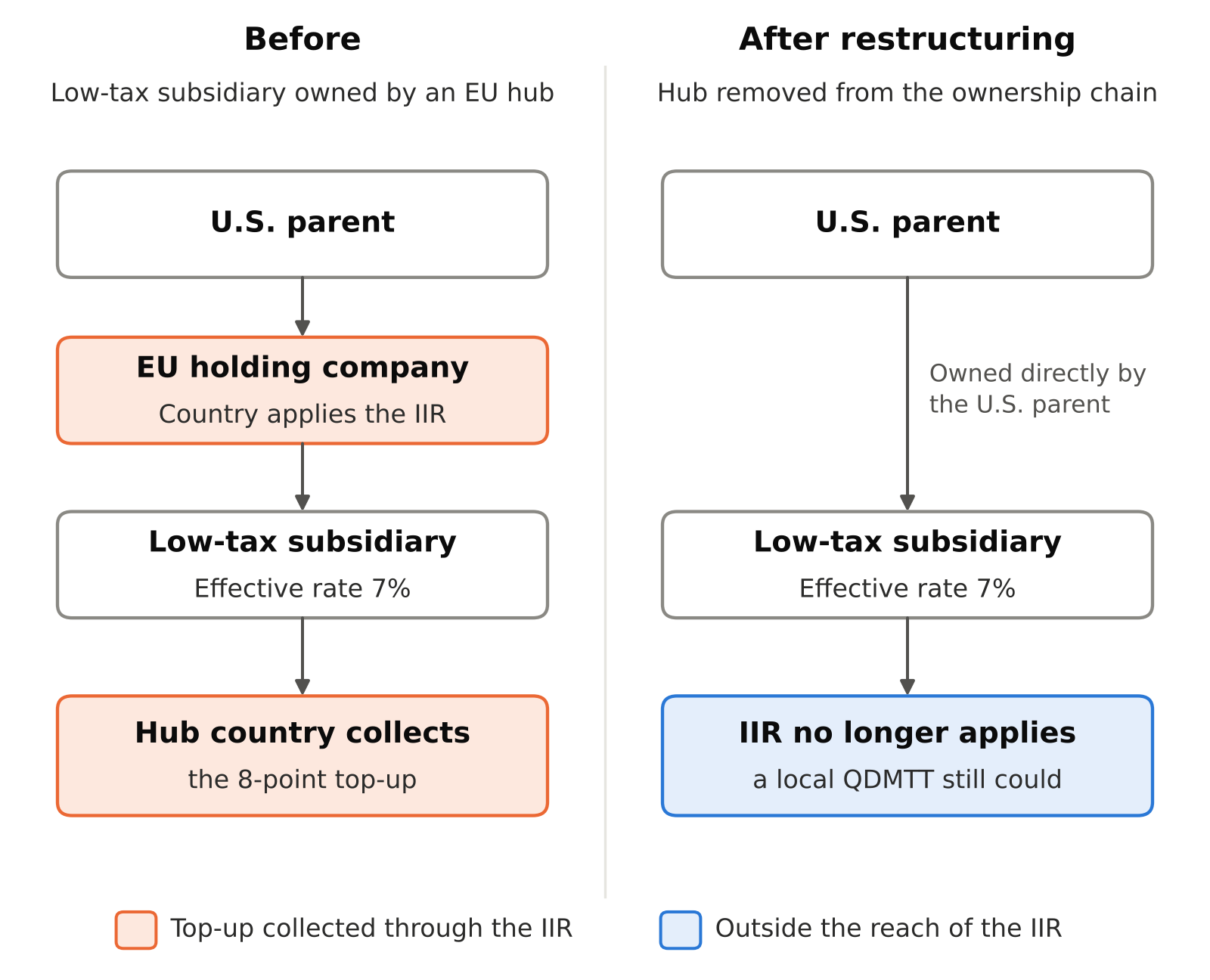
This divergence creates an opening for U.S. multinationals. No U.S. parent applies the IIR, but many own low-tax subsidiaries through holding companies in Europe. These hubs were often set up before the 2017 Tax Cuts and Jobs Act for treaty access and to defer U.S. tax on dividends. If the hub sits in a country that applies the IIR, that country can collect the top-up tax (Figure 1, left). However, remove the hub (or any other “exposed” intermediary), and you remove the IIR’s reach (Figure 1, right). Unless the low-tax country adopts its own QDMTT, it is not clear any other country can collect the top-up tax.[vii]
Are firms restructuring around it?
For a U.S. firm, the most direct way to step outside Pillar Two is to change who owns its low-tax subsidiaries. Suppose an exposed subsidiary sits under a holding company in a country that applies the IIR. Moving it directly under the U.S. parent, or under an entity in a non-adopting country, takes it out of the IIR’s reach (Figure 1). Ownership records show this happening at scale. In Jacob et al. (2026), we trace the ownership chains of large multinationals’ subsidiaries in 143 countries from 2015 to 2024.[viii] We compare U.S. groups with EU/UK groups, which cannot avoid the IIR as it has been adopted by their global owner’s home country.
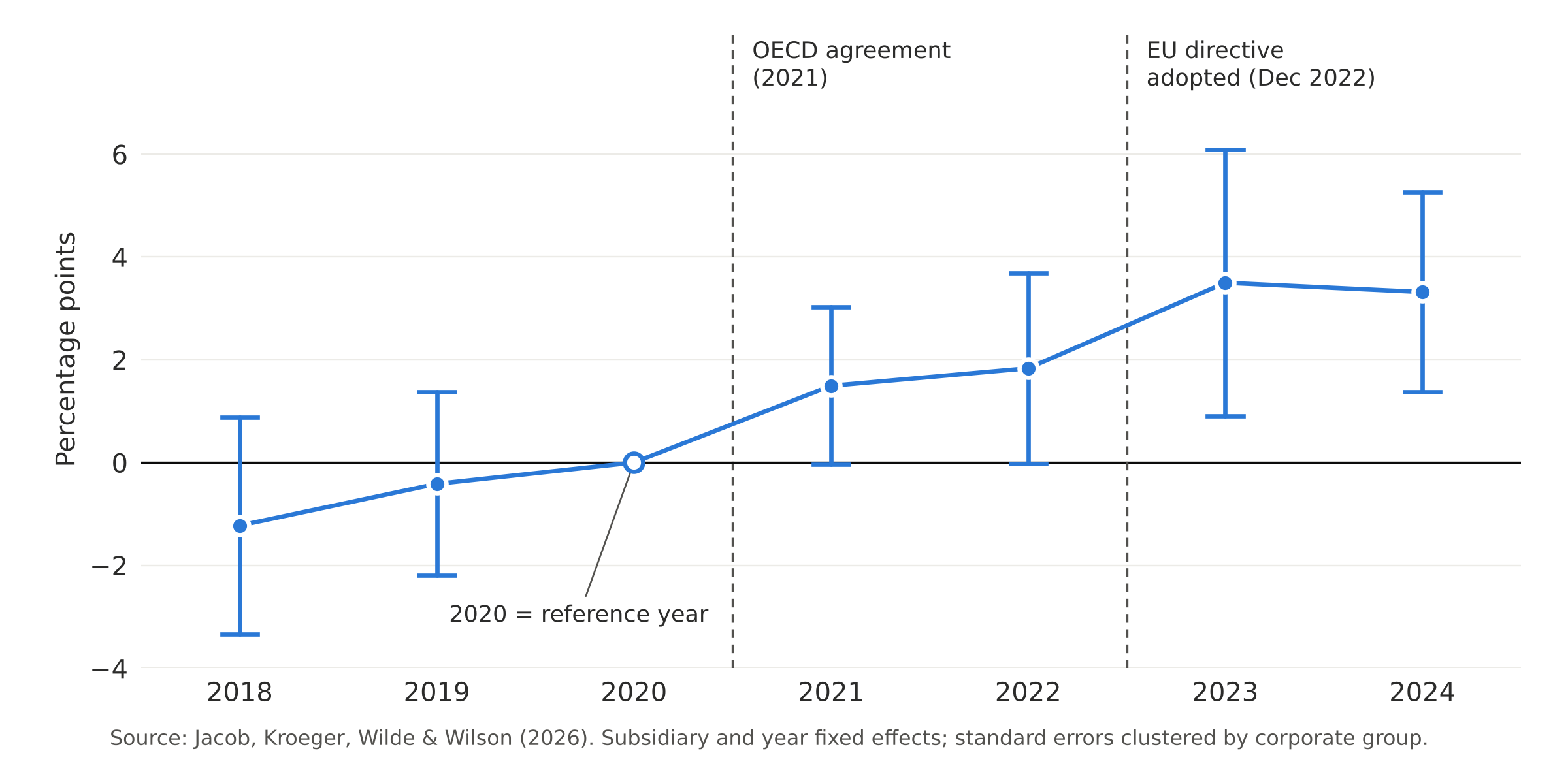
On average, about 1.9% of exposed subsidiaries have their intermediate parent in an adopting country removed. After 2021, U.S. groups became 2.4 to 3.2 percentage points more likely than EU/UK groups to make that change (more than double the baseline rate).
The timing points to anticipation (Figure 2). Before 2021, there is no statistically significant difference between U.S. and EU/UK groups. The gap opens after the 2021 agreement and roughly doubles in 2023 and 2024, after the EU adopted its directive in December 2022. Importantly, the response began before the rules took effect in 2024.
The ownership changes look deliberate rather than incidental:
- Targeted. Over the same period, U.S. groups with exposed subsidiaries became less likely to make other ownership changes. The increase is specific to removing exposed intermediate parents.
- Complete. In 92.7% of these changes, no entity in a Pillar Two adopting country remained between the subsidiary and the global parent. In 73.6%, the subsidiary moved directly under the U.S. parent.
- Cheap. More than 90% of the removed parents stayed active in the group, and more than 88% of those still owned other subsidiaries. Firms moved the exposed subsidiaries out from under the hub but left the hub in place.
Tax directors describe the same playbook. In our study we also survey 201 tax directors at U.S. multinationals, and the mitigation strategies mentioned most often were relocation (17%) and restructuring (16%), followed by transfer pricing and investment location (13% each). Of those surveyed, 84% said their company had adopted or would adopt such strategies.[ix]
Are firms paying more?
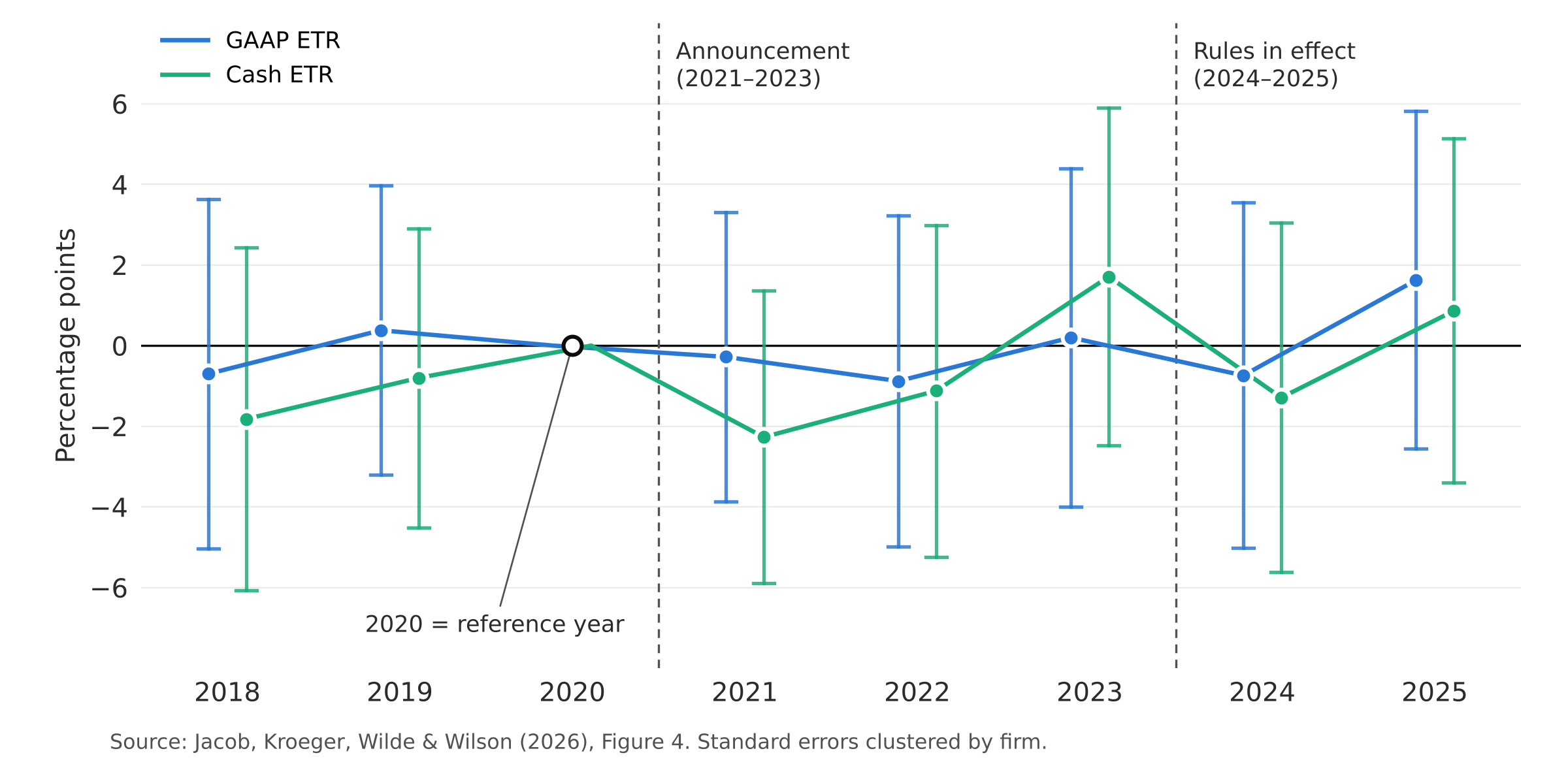
Restructuring matters only if it keeps tax bills down. So far, effective tax rates show no visible effect. U.S. firms with substantial tax haven operations have the most to lose from a 15% floor. Yet those firms have tracked other U.S. multinationals closely on both GAAP and cash effective tax rates. That holds through the 2021–2023 announcement period and the first two years the rules were in force, 2024–2025 (Figure 3).[x]
Restructuring is one reason rates have held steady. The other is that the rules still leave countries room to compete. The key tool is the qualified refundable tax credit, which Pillar Two treats as income rather than as a reduction in tax. Take a firm with $10 million of income and $2 million of tax. A $2 million qualified refundable credit cuts its cash taxes to zero. Yet its Pillar Two effective rate stays at 16.7% ($2 million divided by $12 million), above the floor, so no top-up tax is due.
Ireland is a clear example. In its Finance (No. 2) Act 2023, the same law that adopted the minimum tax, Ireland raised its R&D tax credit from 25% to 30%. The Minister for Finance said the increase would “maintain the current net benefit of the credit for companies subject to Pillar Two.”[xi] Firms also seek these incentives directly. For example, in August 2024, FMC’s CFO said the company had moved intangible assets “to our Swiss subsidiaries, where we recently were awarded OECD Pillar 2 compliant tax incentives.”[xii] Asked how countries were offsetting the tax, surveyed tax directors most often named refundable tax credits (18%), non-tax subsidies (15%), and accelerated deductions or tax deferral (12%).
That is not to say the minimum tax has no bite. The firms that warned investors seem to have borne a cost. Among 45 U.S. multinationals that flagged a negative impact on earnings calls, cash effective tax rates rose by about 3.6 percentage points in 2024–2025 relative to comparable firms.[xiii] These firms are a small slice of exposed U.S. multinationals. The evidence also covers only fiscal 2024 and 2025, before the Side-by-Side package took effect.
What happens now?
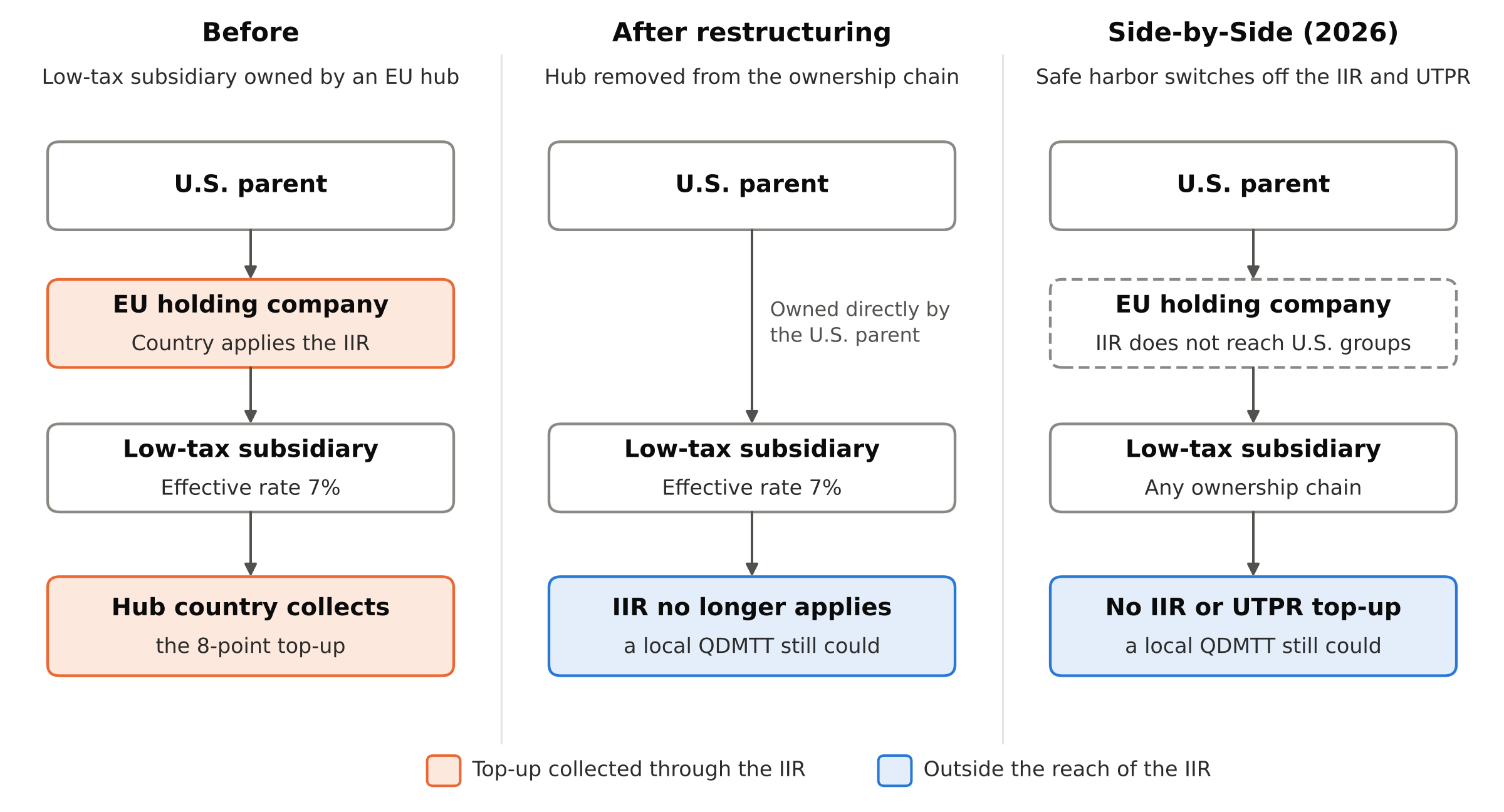
The rules have changed again. In June 2025, the G7 agreed to advance a “side-by-side” system.[xiv] On January 5, 2026, the OECD Inclusive Framework agreed on a package to implement it.[xv] Under its safe harbor, U.S.-parented groups can elect to be exempt from both the IIR and the UTPR, retroactive to January 1, 2026. They remain subject to QDMTTs (Figure 4).[xvi]
- The restructuring margin has largely done its job. The ownership changes described above removed exposure to the IIR, and that rule no longer reaches U.S. parents that elect the safe harbor. This may lead to fewer new restructurings, but it is unclear whether firms will unwind earlier ones.
- The live channel is now the domestic minimum tax. QDMTTs are collected by low-tax countries themselves, so whatever exposure U.S. firms still have depends on host-country choices and less on ownership chains.
- Incentives become the margin of competition. Low-tax countries that adopt a QDMTT can still compete through qualified refundable credits, subsidies, and other support. As Mastercard put it, new incentives “may not be in a tax rate. It could be above the line.” Support delivered that way is harder to see, and effective tax rates may understate it.
When the agreement was struck in 2021, Treasury Secretary Janet Yellen said the global minimum tax “will end the damaging race to the bottom on corporate taxation.”[xvii] For U.S. multinationals, the early evidence points to something more modest. When implementation is uneven and policy design leaves discretion to both countries and firms, coordinated reforms invite strategic responses that blunt them. So far, those responses have run through ownership structures. Going forward, they are likely to run through the design of incentives.
A note on sources
Unless noted otherwise, research findings are from our study, Jacob et al. (2026).
Use of AI
This essay was drafted with the assistance of Claude, an AI model developed by Anthropic. The analysis and findings come from my original research with coauthors Martin Jacob, Jaron Wilde, and Ryan Wilson (Jacob et al. 2026). Claude helped outline and draft the text, prepare the figures from our estimates, and proofread and format references. I reviewed, edited, and verified all content and am responsible for any errors.
[i] Mastercard Inc. at UBS Global Technology and AI Conference. December 4, 2024. Accessed via Refinitiv StreetEvents Event Transcripts.
[ii] PwC. 2025. “Pillar Two Country Tracker.” https://www.pwc.com/gx/en/services/tax/pillar-two-readiness/country-tracker.html
[iii] Jacob, M., K. Kroeger, J. Wilde, and R. Wilson. 2026. “How Do U.S. Multinationals Navigate the Global Minimum Tax?” Working paper. https://papers.ssrn.com/sol3/papers.cfm?abstract_id=7172762
[iv] Gómez-Cram, R. and M. Olbert. 2023. “Measuring the Expected Effects of the Global Tax Reform.” The Review of Financial Studies 36 (12): 4965–5011.
[v] The Organization for Economic Co-operation and Development (OECD) Global Tax Deal (Global Tax Deal). Presidential memorandum, January 20, 2025.
[vi] Council of the European Union. 2022. Council Directive (EU) 2022/2523 of 14 December 2022 on ensuring a global minimum level of taxation for multinational enterprise groups and large-scale domestic groups in the Union.
[vii] In principle, the UTPR could reach such a structure. To my knowledge, no jurisdiction has publicly reported assessing UTPR top-up tax in practice. The rule’s legality is also contested: in July 2025, Belgium’s Constitutional Court asked the Court of Justice of the European Union whether the UTPR is compatible with EU law. KPMG. “Infringement Procedures and CJEU Referrals”. E-News from KPMG’s EU Tax Centre. July 31, 2025.
[viii] Jacob et al. (2026), Section 3.2 and Tables 2–6.
[ix] Jacob et al. (2026), Section 4.
[x] Jacob et al. (2026), Section 3.3, Figure 4, and Table 7.
[xi] Government of Ireland, Department of Finance. 2023. “Minister McGrath publishes Finance (No. 2) Bill 2023.” Press release. https://www.gov.ie/en/department-of-finance/press-releases/minister-mcgrath-publishes-finance-no-2-bill-2023/
[xii] Q2 2024 FMC Corp Earnings Call. August 1, 2024. Accessed via Refinitiv StreetEvents Event Transcripts.
[xiii] Jacob et al. (2026), Table 8, column 4 (entropy-balanced sample).
[xiv] G7. 2025. “G7 Statement on Global Minimum Tax.” June 28, 2025.
[xv] OECD. 2026. “International community agrees way forward on global minimum tax package.” January 5, 2026. Side-by-Side package: https://www.oecd.org/content/dam/oecd/en/topics/policy-sub-issues/global-minimum-tax/side-by-side-package.pdf
[xvi] Fenwick. 2026. “What the OECD’s Pillar Two Side-by-Side Safe Harbor Means for US Multinationals.” January 23, 2026. https://whatstrending.fenwick.com/post/what-oecds-pillar-two-side-side-safe-harbor-means-us-multinationals
[xvii] U.S. Department of the Treasury. 2021. “Statement from Secretary of the Treasury Janet L. Yellen on the Global Minimum Tax Agreement.” https://home.treasury.gov/news/press-releases/jy0447