Public Tax Transparency Arrives — Will It Matter?
Large U.S. multinationals operating in the European Union (EU) are, for the first time, publicly providing a country-by-country breakdown of where they book profits, pay taxes, and employ people. The EU’s public country-by-country reporting (CbCR) directive requires in-scope multinational groups to break out key financial information for each EU member state, with an aggregated figure for operations outside the bloc (along with separate disclosures for any country on the EU’s list of tax havens).
The new EU public CbCR requirement (“public CbCR”) precedes a similar soon-to-be-in-effect Australian regime. With these reporting requirements in effect, most large U.S. multinationals with meaningful international footprints will have no jurisdiction left to hide behind. Public disclosure of where firms operate is becoming a global standard, not the exception.
The policy’s purpose is to produce greater transparency to expose aggressive tax avoidance and encourage firms to change behavior through public scrutiny. However, whether these public disclosures will move the needle on tax enforcement, proposed tax law, or even consumer sentiment toward global tax avoiders remains an open question. Global tax authorities already possess this information through confidential tax reporting, and academic research suggests consumers rarely punish firms for tax avoidance. Public CbCR represents an important transparency milestone but is unlikely to alter corporate behavior or even lead to a change in tax policy.
Tax authorities already have detailed CbCR
U.S. firms have filed confidential country-by-country reports (“private CbCR”) with the U.S. IRS since 2016 as part of the OECD’s BEPS Action 13 framework – suggesting the public versions of these reports will do nothing to alter tax enforcement. Prior to public reporting, U.S. firms already disclosed considerable information regarding their international footprint and activity through various confidential tax filing requirements. Even to the IRS, little of the private CbCR data was genuinely new information given the IRS’s existing filing requirements. Empirical evidence in Nessa, Persson, Song, Towery, and Vernon (2025) find that private CbCR does little to change the underlying tax behavior of U.S. multinationals due to the pre-existing disclosure infrastructure.
Further, the IRS has exchange of information agreements to exchange tax filings, including these reports specifically, with dozens of foreign tax administrations. Therefore, even a foreign revenue agency (for example in France or Germany), could access many of the previous IRS filings as well as the private CbCR filings through the information sharing agreements. Thus, foreign revenue agencies auditing a U.S. multinational’s local subsidiary, in many cases, already had access to the same information now being made public.
So, while the public CbCR reports provides potentially insightful information to public stakeholders, tax authorities will find no new information.
Public backlash on the horizon?
If tax authorities find no new information from public CbCR, the directive’s purpose rests on increasing transparency and inviting greater public scrutiny of multinationals’ tax positions and strategies (Deloitte, 2026). In short, the point is public and reputational pressure – either enough to spur a change in consumer behavior at the register or to create a wave of voter opinion that can change policy.
The “public shaming” model of tax enforcement has become an increasingly favorable tool. Although this theory is intuitively appealing – academic studies find limited support of any negative consumer repercussions to tax avoidance (e.g., Hoopes, Robinson, and Slemrod 2018; Hardeck, Harden, and Upton 2021). Even the most strenuous set of tests in Asay, Hoopes, Thornock, and Wilde (2024) fail to find an economically impactful effect. Despite the policy hopes that the public will punish tax-avoiding companies, the research suggests the punishment does not materialize.
A public shaming model depends on a crucial chain of events that require considerable actions from busy consumers. A consumer must (1) know the disclosures exist and when they are available, (2) find them (particular to the public CbCR disclosures, there is no public repository, requiring consumers go to individual company websites) and (3) correctly interpret what a lower effective tax rate, low headcount, or high profits in any of the listed countries actually implies about corporate tax avoidance.
Absent that chain of consumer-active events, the alternative to generating a public backlash is heavy media coverage doing the gathering and interpretation for the public. Media coverage is plausible for a few marquee names but is unlikely scale to the likely hundreds of firms in scope of the EU reporting requirements.
Beyond changing consumer purchasing behavior, the media could potentially spur enough outrage to shift outcomes in the court of public opinion with the goal of creating actual tax policy changes. This would take a considerable shift in the public dynamic, particularly considering if lawmakers were to change tax policy, the sway of voters would need to outpace the lobbying efforts of the firms directly impacted by such policy – while plausible, an improbably series of events from a set of disclosures that largely repeat what we already know.
Is this time different?
Even with ample media coverage, the “tax avoiders” message can get drowned out in the constant news cycle or simple desensitization. Companies like Starbucks, Google, Apple, and Microsoft have been the subject of tax-avoidance coverage for years — congressional hearings, EU state-aid cases, investigative journalism — well before CbCR (private or public) existed.
Microsoft illustrates the central question facing public CbCR. Microsoft has recently been the focus of the public CbCR story given it is one of the earlier reporters, disclosing on June 30, 2026, but has also been the subject of considerable public coverage on its global tax avoidance activities for years from congressional investigations to IRS disputes. The company’s public CbCR disclosure raises the question as to whether the disclosure will change what the public already knows.
- September 20, 2012: Microsoft faced a Senate hearing from the Permanent Subcommittee on Investigations covering the firm’s use of a Puerto Rican subsidiary along with a “check-the-box” strategy, a common tax planning strategy available under the U.S. tax code. Considerable media coverage followed the hearing with various estimates of the total taxes avoided through such strategies.
- December 12, 2015: the Seattle Times releases an investigative coverage of the firm’s profit shifting structures, again adding estimates of the billions of dollars Microsoft held outside of the U.S. (Seattle Times, 2015).
- October 11, 2023: Microsoft publicly disclosed that the IRS had issued Notices of Proposed Adjustments of $28.9 billion in additional tax due for tax years 2004-2013 regarding various intercompany transfer pricing transactions discussed in the 2012 Senate hearing. Microsoft disputes the assessment, asserting they “acted in accordance with IRS rules and regulations and that our position is supported by case law.”
- June 30, 2026: Microsoft publicly released its CbCR reports on its website (Microsoft, 2026).
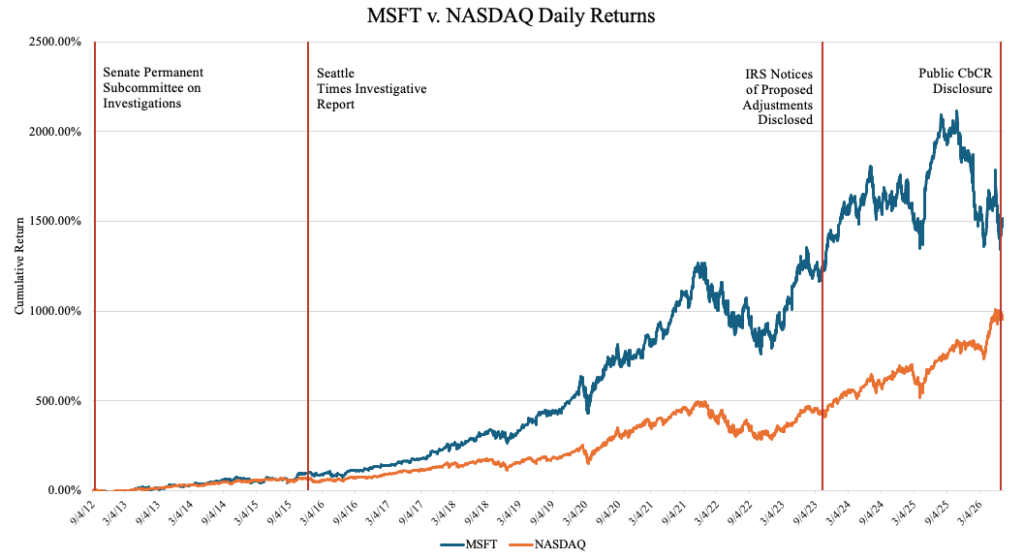
While Microsoft’s CbCR reporting adds detail to the documented tax avoidance, as for many firms, it simply tells the same story that not only the public, but more importantly the tax authorities, have known for a long time. And time after time, Microsoft continues to produce returns outpacing its NASDAQ counterparts, seemingly unhindered by the continued revelations of considerable tax avoidance – as shown in the above figure with the key dates indicated.
Will adding even more disaggregated dollar amounts and percentages to the general understanding that firms avoid taxes (through legal tax systems and arbitrage opportunities generated by global tax regimes) lead to a public backlash or even policy change under the public CbCR regime? It’s hard to believe that this time is different. The coverage is unlikely to tell consumers anything they didn’t already know or at least assume or pressure policymakers to implement new policy. Articles by the FACT Coalition and ITEP (and others) consistently point to Microsoft’s outsized profits reported in Ireland despite relatively few employees as reported in the public CbCR disclosures. However, looking at Microsoft’s public financial statements from 2011 compared to 2025, their significant Irish subsidiaries have appeared in public SEC filings since at least the initial Senate hearing in 2012.
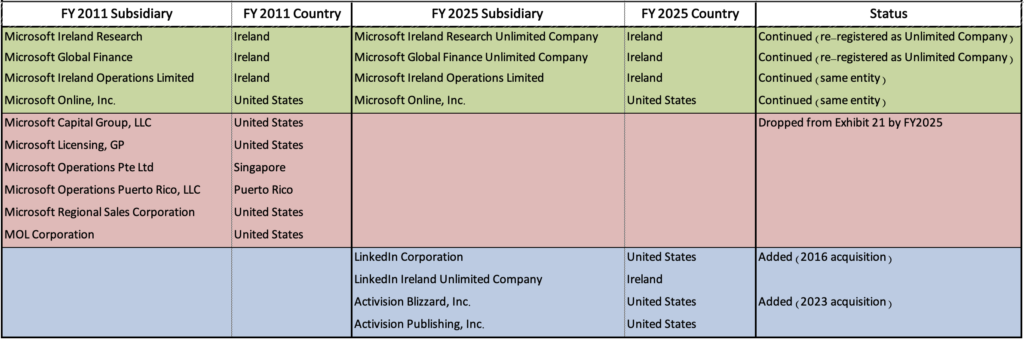
If the public has operated for over a decade on the working assumption that large U.S. multinationals engage in aggressive international tax planning, whether a spreadsheet confirming the mechanics materially changes that perception or spurs sufficient political backlash is unclear.
Conclusion
Public CbCR is less of a behavioral intervention and more of a civic transparency exercise. Tax authorities have the same information through existing filings and confidential exchanges. Consumers, per the academic research, are unlikely to meaningfully punish tax-avoiding firms at the register – and given the scale of lobbying expenditures around tax policy, generating enough political pressure to change tax policy may be even more of a longshot. The handful of companies most likely to draw headlines are the same ones that have already absorbed years of similar coverage without a demonstrated impact on their brands or change in policy.
To be clear, the disclosures are not pointless — transparency has value for many stakeholders, independent of whether it generates public backlash. But watchdogs (or even the firms themselves) bracing for a wave of consumer-driven reputational damage from their first public CbCR filings should calibrate expectations against institutional realities and empirical evidence.
Academic references:
- Asay, H. S., Hoopes, J. L., Thornock, J. R., & Wilde, J. H. (2024). Tax boycotts. The Accounting Review 99(1), 1–29. https://doi.org/10.2308/TAR-2021-0213
- Gallemore, J., Maydew, E. L., & Thornock, J. R. (2014). The reputational costs of tax avoidance. Contemporary Accounting Research.31 (4), 1103–1133.
- Hoopes, J.L., Robinson, L., Slemrod, J., 2018. Public tax-return disclosure. Journal of Accounting & Economics 66 (1), 142–162. https://doi.org/10.1016/j.jacceco.2018.04.001.
- Hardeck, I., Harden, J. W., & Upton, D. R. (2021). Consumer reactions to tax avoidance: Evidence from the United States and Germany. Journal of Business Ethics 170(1): 75-96.
- Nessa, H., Persson, A., Song, J., Towery, E., & Vernon, M. (2025). Public country-by-country reporting and the tax behavior of U.S. multinationals. Journal of Accounting Research 63 (2): 951-988. https://doi.org/10.1111/1475-679X.12594
Non-academic references:
- Deloitte. EU Public CbCR (Country-by-Country Reporting), January 19, 2026
- Microsoft Corporation, FY2025 EU Directive 2021/2101 Country-by-Country Report
- Microsoft Corporation, SEC Form 10-K, Exhibit 21, FY2011 and Exhibit 21, FY2025
- Microsoft Corporation, Form 8-K disclosing IRS Notices of Proposed Adjustment, October 11, 2023
- Microsoft On the Issues, “Update on IRS audit”, October 11, 2023
- Microsoft On the Issues, “Context on our country-by-country tax footprint”, June 30, 2026
- Seattle Times. “How Microsoft moves profits offshore to cut its tax bill”, December 2015