Is a 4% wealth tax the same as a 120% income tax?
There have been many recent proposals to tax the wealth of the very wealthy. For example, in California there is a proposed ballot measure, sometimes called a billionaire tax, that would impose a one-time 5 percent tax on residents with net worths exceeding 1 billion dollars in an effort to tax revenue. Meanwhile, in New York, Zohran Mamdani has argued for substantially higher taxes on the wealthiest residents and highest income earners to fund public spending priorities. These proposals differ in structure, but they share a common feature: they focus on taxing accumulated wealth rather than just annual income.
These discussions illustrate a broader challenge. Our tax system generally taxes income, not wealth itself, so it can be difficult to think clearly about what it means to impose a tax on wealth rather than on the income it generates. For example, a 4 percent wealth tax sounds modest compared to a 37 percent income tax. Four percent is much less than 37 percent. But how do these numbers actually compare in economic terms?
Fortunately, there is a straightforward way to translate a wealth tax rate into an equivalent income tax rate. All you need to know is the rate of return earned on the wealth being taxed. Wealth generates income over time, and the relationship between those two numbers allows us to convert one tax base into the other.
Consider an example. Theresa Heinz Kerry is one wealthy individual whose tax return became public when her husband, John Kerry, ran for president. In one year, her tax return showed approximately 5 million dollars in total income. Based on reasonable assumptions about the rate of return on her tax-exempt bonds and the dividend yield on her stock holdings, suppose her total wealth at the time was roughly 145 million dollars.
A 4 percent wealth tax, ignoring any exemption thresholds for simplicity, would amount to about 6 million dollars per year. That means she would owe 6 million dollars in wealth taxes on 5 million dollars of income generated from that wealth. If we convert that wealth tax into an income tax rate, we divide 6 million by 5 million, which yields 120 percent. In other words, the wealth tax alone would be equivalent to a 120 percent tax on her income, before accounting for the ordinary income taxes she may already be paying. That is extraordinarily high when expressed as an income tax rate.
More generally, the formula is simple. To convert a wealth tax rate into an equivalent income tax rate, divide the wealth tax rate by the rate of return on the wealth.
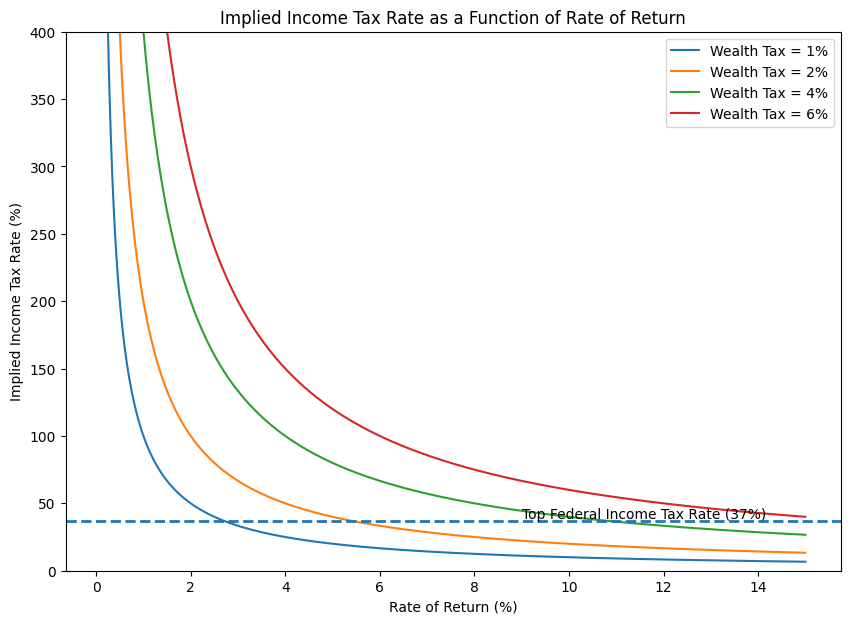
In Ms. Heinz Kerry’s case, her implied rate of return was relatively modest. This may be partly due to her potentially higher-returning assets, such as ownership in a corporation, does not show up on her tax return until she sells a portion of it. Suppose instead that a wealthy individual earns a 10 percent annual return. In that case, a 4 percent wealth tax would be equivalent to a 40 percent income tax. If the top statutory income tax rate is 37 percent, the combined effective tax rate on the income generated by that wealth would be roughly 77 percent (40% + 37%).
The rate of return matters enormously. If someone has a bad year and earns a 0 percent return, the equivalent income tax rate becomes mathematically infinite, because you are dividing by zero. Of course, someone who consistently earns zero returns will not remain wealthy for long, but the example highlights how sensitive the conversion is to investment performance.
Abigail Disney, a wealthy heiress and public supporter of a wealth tax, has stated that her wealth grows by roughly 6 to 8 percent per year. If we assume a 7 percent return, then a 4 percent wealth tax translates into approximately a 57 percent income tax rate. Adding the existing 37 percent top income tax rate would imply a total tax burden on income of roughly 94 percent. That’s high!
Some people in this country might be comfortable with a 94 percent tax rate on the income of the very wealthy. Others would find that level confiscatory. The key point is not to settle the debate, but to clarify it. Once you understand how to convert a wealth tax rate into its income tax equivalent, you can better evaluate what a proposal actually implies in terms that are more familiar to those who live in countries who generally finance their government with income taxes. A wealth tax may sound small when expressed as a percentage of assets, but its economic effect depends crucially on the rate of return those assets generate.