Can Wealth Taxes Substantially Tax Power Away from Billionaires?
Wealth taxes are costly to administer, inefficient, distortionary, invite avoidance, capital flight, valuation games, and endless litigation. They would require the IRS to appraise illiquid assets such as private businesses, art collections, and real estate partnerships every single year. And they have a long track record of failure in Europe, where country after country repealed them after discovering that they raised less revenue than promised and cost more to enforce than expected.
That debate has been had many times before. But the latest wealth tax proposal from Senator Bernie Sanders and Representative Ro Khanna, out on March 2, makes clear that this is not just about revenue, but rather, it is about power. The proposal notes: “Never before in our nation’s history have so few people held so much wealth and so much power.” The concern is not simply that billionaires are rich. It is that their wealth translates into political influence, and that taxing that wealth annually would diminish that influence.
I don’t disagree that the wealthy wield too much political power. But, a wealth tax is a horrible way to solve that problem.
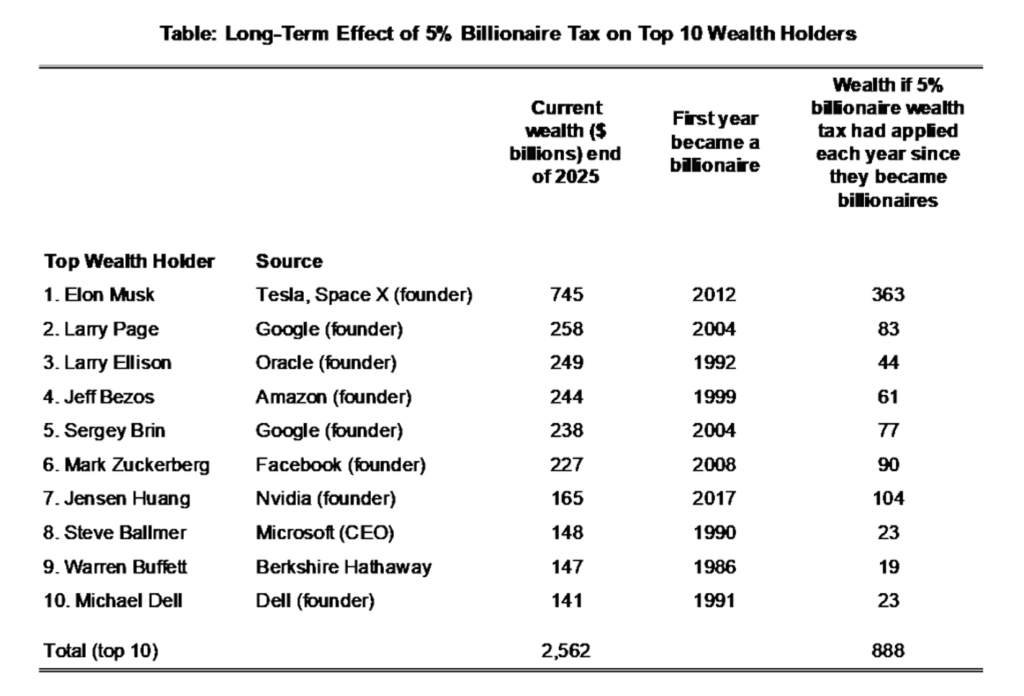
The analysis of the Sander bill makes that clear. Professors Saez and Zucman provide some analysis which shows what today’s billionaire wealth would look like had a wealth tax been in place for decades. The figure is intended to demonstrate how much less concentrated wealth would be under such a regime. But if we look more closely, we see that even under that counterfactual, every single billionaire in the figure remains staggeringly wealthy. Tens of billions of dollars, and in some cases, well over 100 billion. The least wealthy person still has 19 billion. You can buy a lot of things with 19 billion dollars!
If the objective is to eliminate or meaningfully reduce political power, shaving a few dozen billion off someone who still holds 30 or 80 billion is not going to do it.
As Larry Summers argued in his debate with Emmanuel Saez, vast fortunes are not required to secure political influence. Summers claimed that “The reality is that with either the Democratic Party or the Republican Party, a wealthy person can get a lot of clout by spending $4 to $5 million a year. No substantial wealth tax is going to prevent the wealthiest people from spending that amount or even a multiple of that amount.” That is a vanishingly small fraction of the wealth levels depicted in the Saez/Zucman paper, even under decades of wealth taxation. Modern campaigns are costly, but not remotely costly enough to exhaust even a dramatically trimmed billionaire fortune.
Consider Sam Bankman-Fried. At his peak, he was estimated only a few dozen billion. Yet during the 2022 election cycle, he became one of the largest political donors in the country, second only to George Soros in donations to the democrats (Soros, the biggest donor, currently has wealthy pegged at under a paltry $10 billion). He did it by personally donating a mere $40 million. He did not need $200 billion. He did not need $100 billion. He needed a fraction of his wealth to exert enormous influence.
That is the uncomfortable reality for those who believe wealth taxes will take political power away from billionaires. Elections are, in relative terms, remarkably cheap. The amount of money required to meaningfully influence a Senate race, fund ballot initiatives, or bankroll issue advocacy is tiny compared to the fortunes depicted in the Sanders figure, even after decades of wealth taxation. And even if enacted, there would not be decades of wealth taxes—starting from today, even with a 5% tax, the incredibly wealthy will remain incredibly wealthy.
If the goal is to reduce political influence, then the figure in the paper inadvertently undermines the case. It shows a world in which billionaires are somewhat less wealthy but still more than wealthy enough to dominate the political landscape. Wealth taxes are a poor way to meaningfully diminish the political influence of the very-wealthy.