When Tax Returns Go Public, Investors Read Them
Should publicly traded companies’ tax returns be available to the public? The question has been debated for decades (Lenter, Slemrod, and Shackelford 2003; Morris 2015), and has recently led to new requirements that multinational companies in the United States and Europe disclose more about their tax positions.
Supporters of disclosure argue that the tax return gives outsiders a new way to hold managers accountable. As stated by Prof. Shiva Rajgopal (2020), “Making [tax returns] public would immediately empower hundreds of market participants, including short sellers, analysts, and activists. These parties would suddenly have access to a new tool to ensure greater discipline in how the firm manages capital and its tax affairs.”
Companies tend to oppose tax disclosure requirements, and no firm voluntarily publishes its own tax return. One common justification is that the information would not be useful to investors. Commenting on the FASB’s proposed tax disclosure rules, Louis Sanford, CFO of 1859 Historic Hotels, Ltd., wrote that “investors claim that they need more information and detail, yet history has shown that they either ignore the information, don’t understand[it], or are unable to connect the dots.” (Sanford 2023).
In a recently published paper in the Journal of Accounting Research, written with our late co-author Aydin Uysal, we test whether investors use the information in companies’ disclosed tax returns in a setting where firms have been required to post their tax returns for more than a decade. We find that investors do connect the dots, and that what they do with the information changes how managers report.
What a tax return can tell investors, and how that affects reporting incentives
In most countries, investors see only one report of annual performance, the book financial statements. Managers also prepare a second report, the tax return, which is provided to the tax authority, i.e., the IRS in the U.S. Although the tax return relies on tax rules, it measures the same underlying business that book income captures under financial reporting rules or GAAP (Lev and Nissim 2004; Blackburne and Blouin 2016). Additionally, the tax return shows the firm’s tax position and the taxes it will actually pay, which are important for understanding tax-related cash flows.
If investors had access to the tax return, we would expect them to use it in valuing the firm. Investors can use information from tax returns to better understand underlying fundamentals given the potential for the GAAP-based story to be incomplete due to measurement errors or opportunistic reporting. This type of optimistic reporting is tied to managerial discretion over corporate disclosures, and the discretion extends, to some degree, to tax reporting as well. Furthermore, managers’ pay and careers generally depend on firm performance as reflected in the stock price. As a result, managers have incentives to bias reported numbers in ways that raise investors’ valuations. This creates a basic trade-off in which the more investors rely on a report, the more a manager gains from biasing it.
Tax disclosures in Turkey
Testing whether investors would use disclosed tax returns, and the feedback effects of such use on reporting choices, has been difficult because tax returns are almost never public. Most research relies on tax numbers backed out of financial statement footnotes, private access by a few sophisticated investors (Demere 2022), or one specific tax item (Cussatt and Demere 2022). In two settings where governments have released limited corporate tax data, Japan and Australia, prior research finds that firms act as if disclosure is costly but change their tax reporting little (Hasegawa et al. 2013; Hoopes, Robinson, and Slemrod 2018). However, neither setting provides investors with a timely and complete tax return, which limits what these studies can tell us about how investors use the information. Turkey provides a setting that overcomes these limitations.
Beginning with fiscal year 2009, publicly traded firms in Turkey were required to post on a public website any financial statement they submit to a government agency before releasing their book financials. That includes the income statement from the company’s estimated annual tax return, roughly comparable to page one of a U.S. Form 1120. The estimated return is due about 45 days after year-end, and the book financials follow at day 60 or 70. Investors therefore see the tax income statement first, on its own date, and the book financials a few weeks later.
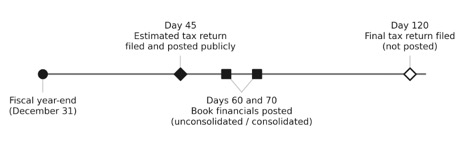
This is a much richer disclosure than those studied elsewhere. Japan published only taxable income, and Australia publishes three line items, both with long lags and only for large firms. Turkish investors, by contrast, see a full tax-basis income statement within weeks of year-end. The firms also post the statement they file with the tax authority rather than a new report written for investors. Investors therefore see the same information the government sees. Together, these features make it possible to test how investors react to the tax return itself.
Our sample covers firms in the BIST 100 index, which accounts for more than 95 percent of Turkish market capitalization, from 2005 to 2019, and includes 133 firms and 750 firm-years.
Estimating managers’ use of reporting discretion
Even with the right data, there is a limit to what standard regression analysis can show. It can tell us whether investors respond when a tax return comes out, but it cannot directly estimate two things that matter most for evaluating disclosure:
- how much managers bias the book and tax numbers they report; and
- how much investors learn about a firm’s underlying performance.
As such, we estimate bias and investor learning with a structural model. In our model, managers bias reported numbers to support the stock price; biasing is costly, and investors know this and discount for it (building on Dye and Sridhar 2004). Each piece of the model can be linked to observable data, including how prices respond to each report and how book income, taxable income, and cash flow move together. Working backward from those links, we estimate the key model parameters, which allow us to back out how much bias is in each report and how much investors learn from them.
For these reasons, structural estimation is increasingly used in accounting research (Bertomeu et al. 2021; Bertomeu, Liang, and Marinovic 2023; McClure 2023). The approach does come with a cost, since the conclusions are only as good as the model’s assumptions. Ours include, for example, that free cash flow is an unbiased, if noisy, signal of performance. The benefit is that the model lets us ask not just whether investors react to disclosure, but whether disclosure changes how managers report.
What investors learn, and how managers respond
We start by examining whether stock returns respond to the tax disclosure , which does not require the model. We find that growth in taxable income is associated with positive abnormal returns on the day the tax statement is posted, suggesting that it carries new information about performance. On the later book earnings date, abnormal returns are positively associated with book income but negatively associated with taxable income. Once both reports are out, investors appear to read them together, using book income to learn about performance and taxable income relative to book income to learn about the firm’s tax bill. Having both gives investors a better picture of the firm’s underlying economics and of how much tax it is paying.
The model then shows how this affects reporting, and three findings stand out.
Book bias falls. With a second measure of performance available, investors rely less on book earnings, and the estimated price response to book income falls by nearly half. Because managers gain less from inflating a number investors rely on less, estimated upward bias in book income roughly halves after tax disclosure begins.
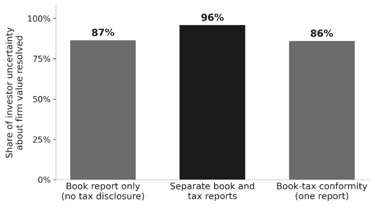
Investors learn more. Holding everything else fixed, disclosure of the tax return resolves about 96 percent of investors’ uncertainty over firm value, compared to only 86 percent when only book earnings are disclosed. Put differently, the uncertainty left over after all disclosures shrinks by roughly two-thirds.
The effect on tax bias is ambiguous. Our estimate of upward bias in taxable income rises after disclosure, which would imply higher tax payments, but it is too imprecise to draw firm conclusions. This ambiguity is consistent with the trade-off managers face when reporting taxable income. Once investors can see the tax return, reporting higher taxable income signals strong performance, but it also means paying more tax (see, e.g., Erickson, Hanlon, and Maydew 2004). Different firms are likely to resolve that tension differently, so the average change can be small even when the incentives on both sides are strong.
Taken together, these results show that when investors can check book earnings against another measure of the same business, any one number matters less, so the payoff to biasing book earnings falls and investors end up better informed. Separate disclosure of the tax return reduced book bias and improved investors’ information at the same time.
The book-tax conformity trade-off
Because the model captures how managers and investors interact, we can also use it to study an alternative regime, book-tax conformity (BTC), in which firms report a single income number for both financial reporting and tax purposes. In structural estimation, this is referred to as a counterfactual.
BTC is often proposed as a way to eliminate tax bias and increase the taxes firms pay. If book and tax income must match, inflating earnings raises the tax bill and shrinking taxable income lowers reported profits, so the opposing incentives offset (Hanlon and Shevlin 2005). Many countries have tied book and tax income together to varying degrees (Atwood, Drake, and Myers 2010), and the U.S. corporate alternative minimum tax enacted in 2022 now taxes large corporations on their adjusted book earnings, with the express purpose of increasing tax collections. However, comparisons across countries mix conformity with many other differences. Using the model, we can hold the Turkish firms and investors fixed and change only the reporting rule.
Our estimates suggest that conformity would achieve some of what its supporters hope for, while leaving investors no worse off, informationally, than under book-only reporting. The conforming number is less upwardly biased than book income was before tax disclosure, but more upwardly biased than taxable income, which suggests that the tax and market incentives offset each other. With BTC, investors resolve about 86 percent of their uncertainty about firm value, only slightly less than the 87 percent resolved with book-only. Both are substantially less than the 96 percent resolved when book and tax reports are disclosed separately.
Takeaways for policy
Investors use the information in tax returns. Debates over tax return disclosure often turn on whether the public will punish tax avoiders (e.g., Asay et al. 2024). While sidestepping the issue of tax avoidance per se, our evidence points to an audience that clearly does respond. Investors price tax information, and they use it together with book earnings.
Managers adjust their reporting in response to mandatory disclosure. Earlier studies of limited government releases found little change in how firms report. With a full, timely tax return, we find a meaningful improvement in investors’ information and a significant reduction in upward bias in book earnings.
Separate reports provide more information than conformity. Proposals to link tax to book income, from conformity to book-based minimum taxes, should weigh what investors lose along with any reduction in bias.
Because these estimates come from a single country, how far they generalize remains an open question. Turkey’s IFRS-based reporting and worldwide tax system resemble those of many developed economies, but evidence from additional settings would be valuable. Nonetheless, our results provide clear evidence that investors who are given access to tax returns do connect the dots.
References
Allen, E. J., H. L. Friedman, and A. Uysal. 2026. “The Effect of the Mandatory Disclosure of Corporate Tax Returns on Reporting Bias.” Journal of Accounting Research.
Asay, H. S., J. L. Hoopes, J. R. Thornock, and J. H. Wilde. 2024. “Tax Boycotts.” The Accounting Review 99 (1): 1–29.
Atwood, T. J., M. S. Drake, and L. A. Myers. 2010. “Book–Tax Conformity, Earnings Persistence, and the Association between Earnings and Future Cash Flows.” Journal of Accounting and Economics 50: 111–125.
Bertomeu, J., E. Cheynel, E. X. Li, and Y. Liang. 2021. “How Pervasive Is Earnings Management? Evidence from a Structural Model.” Management Science 67 (8): 5145–5162.
Bertomeu, J., Y. Liang, and I. Marinovic. 2023. “A Primer on Structural Estimation in Accounting Research.” Foundations and Trends in Accounting 18 (1–2): 1–137.
Blackburne, T., and J. Blouin. 2016. “Understanding the Informativeness of Book–Tax Differences.” Working paper.
Cussatt, M., and P. Demere. 2022. “The Usefulness of Corporate Income Tax Accounting: Evidence from Pension Returns.” The Accounting Review.
Demere, P. 2022. “Is Tax Return Information Useful to Equity Investors?” Review of Accounting Studies.
Dye, R., and S. Sridhar. 2004. “Reliability–Relevance Trade-offs and the Efficiency of Aggregations.” Journal of Accounting Research 42 (1): 51–88.
Erickson, M., M. Hanlon, and E. L. Maydew. 2004. “How Much Will Firms Pay for Earnings That Do Not Exist? Evidence of Taxes Paid on Allegedly Fraudulent Earnings.” The Accounting Review 79 (2): 387–408.
Hanlon, M., and T. Shevlin. 2005. “Book–Tax Conformity for Corporate Income: An Introduction to the Issues.” Tax Policy and the Economy 19: 101–134.
Hasegawa, M., J. L. Hoopes, R. Ishida, and J. B. Slemrod. 2013. “The Effect of Public Disclosure on Reported Taxable Income: Evidence from Individuals and Corporations in Japan.” National Tax Journal.
Hoopes, J. L., L. Robinson, and J. Slemrod. 2018. “Public Tax-Return Disclosure.” Journal of Accounting and Economics 66 (1): 142–162.
Lenter, D., J. Slemrod, and D. Shackelford. 2003. “Public Disclosure of Corporate Tax Return Information: Accounting, Economics, and Legal Perspectives.” National Tax Journal 56 (4): 803–830.
Lev, B., and D. Nissim. 2004. “Taxable Income, Future Earnings, and Equity Values.” The Accounting Review.
McClure, C. G. 2023. “How Costly Is Tax Avoidance? Evidence from Structural Estimation.” The Accounting Review 98 (6): 353–380.
Morris, D. 2015. “A Case for Company-Specific Public Disclosure of Corporate Tax Returns.” Accounting and the Public Interest 15: 1–21.
Rajgopal, S. 2020. “Why Don’t ESG Investors Ask for a Public Firm’s Tax Return?” Forbes, April 24.
Sanford, L. W. 2023. Comment Letter No. 1, FASB Proposed Accounting Standards Update, Income Taxes (Topic 740).