What Can Norway Teach Us About California Billionaire Taxation?
California voters are considering Proposition 40, a one-time 5 percent tax on the wealth of people who were California residents on January 1, 2026. The central fiscal question is not whether billionaires will move in response to taxes—some clearly will, and the economists supporting the bill understand that some will. Rather than if any will move, the question is how many will move, which billionaires they will be, and how much of the tax base goes with them.
A timely new working paper provides useful evidence. The University of Texas at Austin’s Marius A. K. Ring’s “Taxing Entrepreneurial Wealth: Evidence from Norway, 2021–2025”, examines Norway’s recent increases in wealth and dividend taxation.
Between 2021 and 2023, the effective top marginal wealth-tax rate on business wealth almost doubled, from about 0.47 percent to 0.88 percent, while dividend taxes also increased. In percentage terms, this is large, but, relative to the percentages being considered in California, it is small (recall Prop 40 suggests 5% tax, more than 5 times as large as the total tax in Norway).
Ring finds that most taxed people did not leave. But some did. And, the bad news for those with large estimates of Prop 40 revenue is that the migration response is concentrated at the extreme top. These effects echo what a recent AER paper, Taxing Top Wealth: Migration Responses and Their Aggregate Economic Implications, found: “We find significant migration responses among the wealthy…”
Surprisingly, those with the most to lose from wealth taxation were the most likely to respond. There is essentially no deviation from the pre-reform migration trend for people between the 99th and 99.9th percentiles. But among the top 0.01 percent, migration jumps sharply. Overall, Ring estimates that the reforms induced only about 74–98 additional people to leave Norway.
That sounds reassuring for a wealth tax. Its only a few dozen people in the entire country. In Norway, this meant that there was not a ton of revenue loss. However, when you consider how concentrated wealth is in California, this turns out to be a big deal.
California’s tax base is much more dependent on a handful of people. Jaros, Rauh, Kearney, Doran, and Cosso (2026)construct a person-by-person estimate of California’s billionaire tax base. They identify just six publicly reported departures before the January 1 residency date. However, just those 6 people representing about $536 billion—nearly 30 percent of the potential tax base. The tax base in California is incredibly concentrated, and if only a few people from the very top of the income distribution, that can still be a large amount of revenue. Another estimate shows extraordinary concentration of wealth in California: four California billionaires alone hold close to $1 trillion, roughly 40 percent of total California billionaire wealth.
This is why saying that “only a few billionaires move” can be misleading. With a distribution this skewed, which few matters enormously. The Norwegian evidence suggests it is those at the top.
There is another reason Norway may understate the mobility problem for California. Leaving Norway means leaving one’s country: language, national institutions, social networks and much else. Leaving California can mean moving from Palo Alto to Reno, or Los Angeles to Las Vegas, while remaining in the same country, using the same currency, legal system and language.
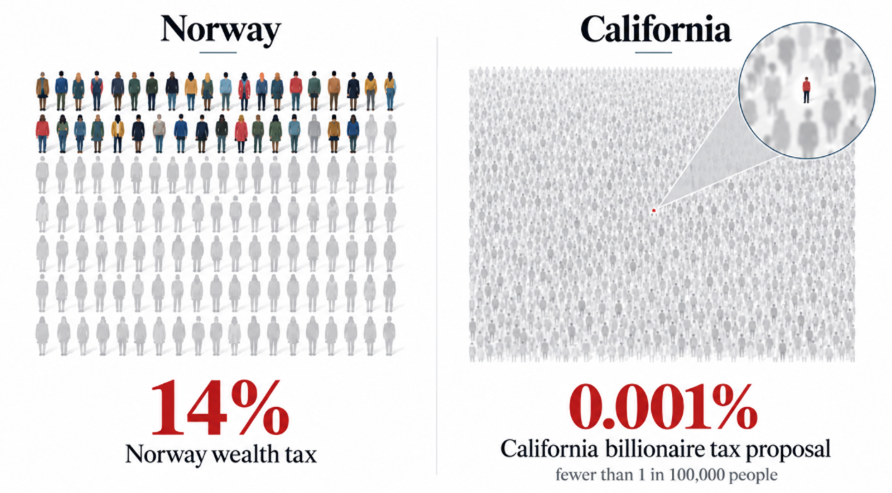
Another important difference between Norway and California is who actually pays the tax. Norway’s wealth tax is broad: roughly 14 percent of adult residents pay it. In California, on the other hand, fewer than 0.001% of Californians will pay the tax. The base is incredibly concentrated. Ring finds that essentially all of the migration response is concentrated at the extreme top of the wealth distribution, while the vast majority of wealth-tax payers do not move. That helps explain why migration only modestly reduced Norway’s revenue gains. California’s proposal is fundamentally different. It would apply only to billionaires—a few hundred people, roughly the top 0.001 percent of California households. In other words, California is proposing to build its entire wealth-tax base out of approximately the same extreme upper tail in which Norway finds the migration response. Evidence that the bottom 99.9 percent of Norway’s wealth-tax payers did not move therefore tells us considerably less about California than the headline results might suggest. Who moved in Norway is exactly the targeted tax base in California.
The California proposal attempts to blunt that problem by fixing liability based on residence on January 1, 2026—the wealthy can’t move, the bill architects say. But residence is not simply whatever someone writes on a form. As UCLA tax professor Kirk Stark explains, California residency is a fact-intensive “closest connections” inquiry involving homes, family, business relationships, physical presence, voter registration and many other facts. Someone can claim to have moved while California claims that, legally, they did not. Further, even if they can’t move in response to the first installment of the tax, they will move in response to the anticipated second installment of the tax.
That means California may have designed a tax intended to make last-minute escape difficult, while simultaneously setting up potentially enormous disputes over whether some of the richest people in the world actually left.
Norway’s lesson is that wealth taxes don’t make everyone leave—only those at the very, very top of the income distribution. And, those are exactly who California is proposing to tax. Further, in a place like California, even just a few of those people at the very, very top can mean a lot of revenue. Finally, with California’s rate being much higher, and moving much, much less costly, we may well expect revenue to be disappointing from Prop 40.