
Lower Gas Taxes Won’t Necessarily Mean Lower Gas Prices
Americans are once again confronting a familiar economic shock: soaring gasoline prices.
Since the outbreak of war involving Iran, prices at the pump have climbed sharply, from roughly $3 a gallon to well above $4 in many parts of the country, and even higher in some states. For households already squeezed by inflation, every extra dollar spent filling the tank matters. Commuters feel it immediately. Businesses do too.
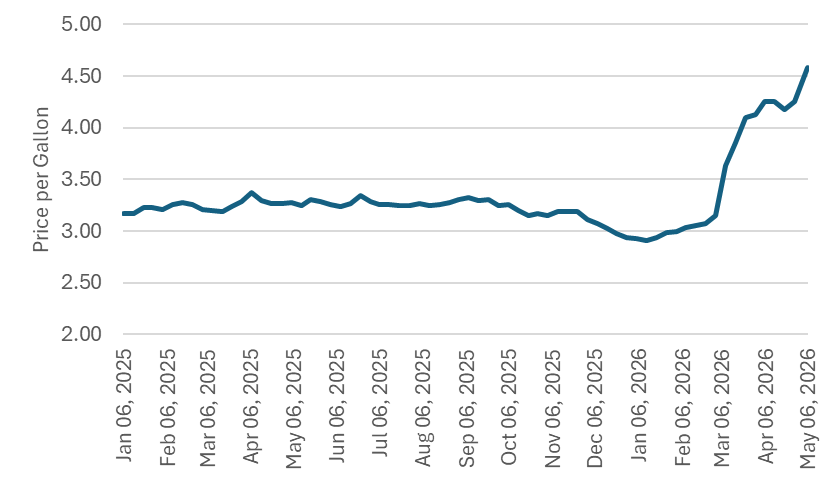
Washington’s response to gas prices came this week when President Trump proposed suspending the federal gasoline tax: 18.4 cents per gallon on gasoline and 24.4 cents on diesel. Politically, the idea is easy to understand. If government removes a tax, consumers should pay less.
But markets do not always work that neatly.
Economic research has long shown that reductions in fuel taxes are not necessarily passed through fully to consumers. Much depends on competition among gasoline retailers. In highly competitive markets, stations may cut prices almost penny for penny. In less competitive markets, however, retailers often absorb part of the tax reduction themselves.
In other words, a tax cut at the federal level does not automatically translate into an equal drop at the pump.
The experience abroad offers a useful warning. Following the recent gas price shock, several European governments temporarily cut fuel taxes. Germany introduced one of the largest reductions of 17 cents a liter (or 4.5 cents a gallon). Yet recent studies found that pump prices fell by less than the tax cut itself, particularly for diesel.
This is not corporate misconduct. It is economics.
Prices are determined in markets, not dictated in Washington. And markets differ. In areas with fewer competitors, companies possess greater pricing power and consumers receive less of the benefit. That is why Americans should temper expectations. A suspension of the federal gasoline tax may provide some relief, but drivers should not expect prices everywhere to fall by the full 18.4 cents for gasoline or 24.4 cents for diesel.
There is another complication: fiscal cost.
The federal gasoline tax raises substantial revenue for infrastructure and transportation spending. Suspending it would cost the government an estimated $2 billion per month at a time when budget deficits are already elevated and interest payments on federal debt are rising rapidly.
That raises a broader policy question. If the goal is to help households struggling with higher energy costs, is a broad gasoline tax holiday the most efficient tool? Or would more targeted relief for lower-income workers and small businesses achieve more at lower fiscal cost?
Fuel tax suspensions are politically attractive because they are visible and immediate. But economics suggests the benefits are likely to be smaller and more uneven than many consumers expect.
