Fixing the QSBS Stacking Problem
I. Introduction
As nearly every sentient U.S. tax adviser knows by now, section 1202, which shelters certain gains from the sale of qualified small business stock (QSBS) from tax, is manna from heaven for the venture capital industry. While originally billed in 1993 as targeted tax relief for small business investors, the QSBS tax break has evolved over the years into a gargantuan windfall captured almost entirely by venture capital fund general partners, wealthy angel investors, and founders of successful start-up companies. As a result, we have previously argued that Congress should repeal section 1202 or at least substantially redesign it to better achieve its original purpose of subsidizing small businesses.[1]
In this article, however, we focus on one well-known QSBS problem, colloquially known as “stacking,” and potential responses to stacking short of a legislative fix. In general, excluded QSBS gain is limited to the greater of 10 times the basis of QSBS sold during the year (the 10x basis cap) or $15 million, reduced by any prior excluded gain on stock issued by the same issuer (the $15 million per-issuer cap). (For QSBS acquired before July 4, 2025, the per-issuer cap is $10 million.) Founders, angel investors, and venture capital carried-interest holders typically have little if any basis in their QSBS stock, so the $15 million per-issuer cap is the key constraint. Stacking involves gifting QSBS to family members and to nongrantor trusts that benefit family members, thereby effectively multiplying the $15 million per-issuer cap. A recent Wall Street Journal article described a proposed stacking strategy in which two co-founders who are unmarried, childless brothers would gift QSBS to 18 different trusts.[2] If effective, the total excluded gain would equal $300 million, as each of the two brothers and 18 trusts would claim their own $15 million per-issuer cap.
Congress has thus far shown no appetite for specifically targeting stacking. To the contrary, the One Big Beautiful Bill Act[3] expanded the section 1202 exclusion in several significant respects — raising the per-issuer cap to $15 million (indexed for inflation), increasing the qualifying asset threshold from $50 million to $75 million, and introducing tiered exclusions for stock held three to four years — without including any anti-stacking provision, even though stacking was at the time a fairly well-known strategy.
The absence of any legislative response makes administrative action even more important. Treasury officials have signaled that guidance is imminent. Kenneth Kies, Treasury assistant secretary for tax policy, warned tax planners at a May 2026 conference, “Let me just warn you: We don’t like stacking, OK?” and indicated that guidance is coming.[4] Treasury attorney-adviser Evan Adams made similar remarks the same month.[5] Section 1202 guidance appears on the Treasury/IRS 2026 priority guidance plan.
II. The Scope of the Problem
A recent Treasury Office of Tax Analysis (OTA) report provides useful empirical context for the magnitude and trajectory of the QSBS exclusion. According to the January 2025 OTA working paper, taxpayers excluded more than $152 billion of gains under section 1202 between 2012 and 2022, with annual exclusions peaking at over $50 billion in tax year 2021 before declining in 2022.[6] Approximately 217,000 individual taxpayers and 25,000 trusts and estates claimed at least one exclusion over that period. The distribution is heavily skewed: The median annual exclusion among individual claimants was $2,810, while the 90th percentile reached $590,940. Taxpayers with total positive income over $1 million account for just 26 percent of returns claiming an exclusion, but nearly 75 percent of excluded gains — a concentration ratio underscoring that section 1202 overwhelmingly benefits the wealthiest investors.
Most significant for present purposes is the growth in trust-based exclusions. Trust and estate claims were negligible in 2012–2014 but climbed to $6.65 billion in 2021, representing 13 percent of that year’s total. The aggregate trajectory is striking: Individuals claimed $1.18 billion in exclusions in 2012 versus $0.14 billion for all nonindividual filers; by 2021, complex trusts alone claimed $6.65 billion. As the OTA authors observe, the growth in trust exclusions “coincided with an increasing share of 1202 exclusions being claimed by trusts and estates,” a pattern consistent with accelerating adoption of stacking strategies.[7] (These figures almost certainly understate the scope of exclusions claimed by trusts: The OTA data captures only e-filed returns and depends on taxpayers self-reporting QSBS exclusions using the correct code on Form 8949, “Sales and Other Dispositions of Capital Assets”)
III. The Mechanics of Stacking
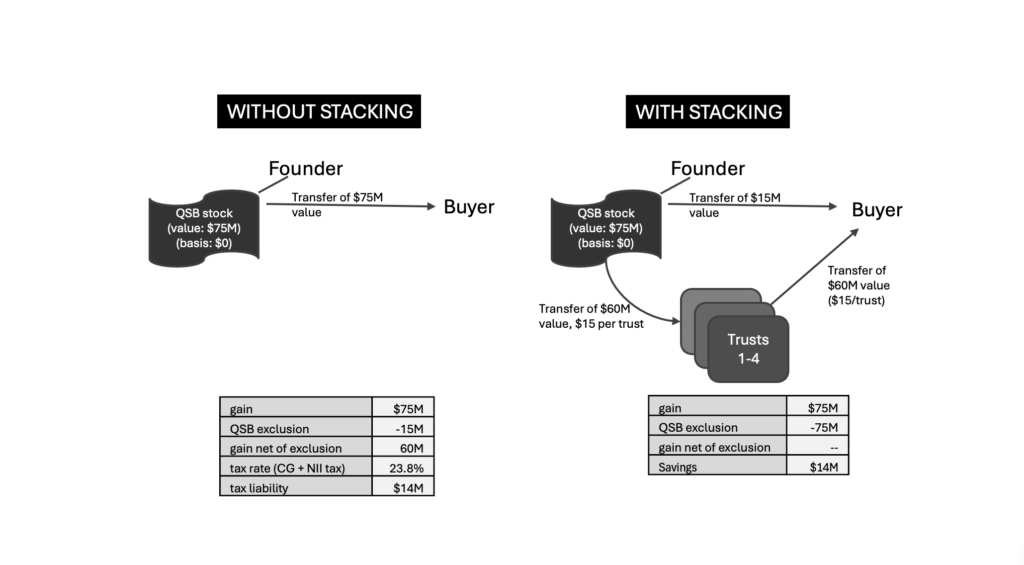
To appreciate the appeal of stacking for taxpayers and the difficulty of the strategy for the IRS, it is worth pausing to understand how a typical structure is assembled. Assume a co-founder holds QSBS in a qualifying corporation with minimal tax basis — common for founders who received stock for services or at a nominal purchase price at formation. After the requisite five-year holding period under section 1202(a), she anticipates a sale generating $75 million in gain. Under section 1202(b)(1), she can exclude the greater of $15 million or 10 times her adjusted basis. With near-zero basis, the 10x cap provides virtually no shelter, and her exclusion is capped at $15 million. The remaining $60 million is subject to tax at the 23.8 percent top federal rate on long-term capital gains, producing a federal income tax liability of approximately $14 million.
Stacking dramatically changes this calculus. Assume that prior to the sale, the founder makes gifts of QSBS to a series of irrevocable nongrantor trusts established for the benefit of family members. Under section 1202(h)(2)(B), a donee of gifted QSBS steps into the donor’s shoes for all purposes relevant to the exclusion — including the holding period and the original-issuance requirement. Each donee trust starts with a fresh $15 million per-issuer cap, unconstrained by any exclusion the donor has claimed or will claim from the same issuer. With four trusts to shelter the remaining $60 million of gain, the structure eliminates the $14 million tax bill entirely.
IV. Current Law: The Government’s Options
Under current law, well-structured stacking strategies appear safe. The statute explicitly provides that donees of gifted QSBS step into the donor’s shoes and may claim their own per-issuer cap. In the absence of new regulations, the government’s options fall into two categories: common-law doctrines developed outside the QSBS context, and the existing rule on multiple trusts under reg. section 1.643(f)-1. Neither is adequate.
A. Assignment of Income
The assignment of income doctrine prevents a taxpayer from deflecting income to another after the right to receive it has ripened.[8] If QSBS is gifted after a legally binding commitment to sell has been made — for example, a signed purchase agreement or letter — the IRS should assign the gain back to the donor. But a founder who gifts QSBS before then has no ripened income to assign.
B. Step Transaction
The step transaction doctrine collapses formally separate steps into a single integrated transaction when those steps are interdependent or prearranged. When planned properly, a transfer to a nongrantor trust creates a separate taxpayer in form and substance. If the trust owns the stock, receives the sale proceeds, and makes distributions on its own, a court would likely be reluctant to collapse the transactions, given that the transactions have real consequences beyond tax savings.
C. Economic Substance
The economic substance doctrine, codified in section 7701(o), is the government’s weakest theory. A trust established for family members can be supported by a litany of nontax rationales — asset protection, estate planning, or management of distributions for minor or spendthrift beneficiaries. The IRS would be hard-pressed to establish that a well-planned trust lacks economic substance.
D. The Multiple Trust Rule
Section 643(f) andreg. section 1.643(f)-1 authorize the IRS to aggregate multiple trusts sharing substantially the same grantors and primary beneficiaries if there exists a principal income-tax-avoidance purpose. If this rule applies in the QSBS context, the IRS would treat multiple trusts as a single trust with a single per-issuer cap. This is the government’s best weapon in theory. Yet as far as we are aware, the government hasn’t removed this saber from its sheath. No court has ever applied section 643(f) to disallow a claimed tax benefit. Indeed, we haven’t been able to find any cases giving any serious attention to this rule.
The IRS has placed section 643(f) questions on its no-rule list.[9] So far as we are aware, neither taxpayers nor the government have litigation experience regarding the provision. To invoke the rule, the IRS must affirmatively prove all three elements on a transaction-by-transaction basis against counsel who will have structured trusts with distinct primary beneficiaries, independent trustees, and staggered creation dates.
The present rule’s weakness is not accidental: The 2018 proposed regulations had included a presumption of avoidance purpose whenever multiple trusts produce a “significant income tax benefit” — a mechanism that would have meaningfully shifted the proof burden. Treasury dropped the presumption from the 2019 final regulations after opponents of the presumption argued it exceeded Treasury’s authority by effectively diluting the statutory “principal purpose” standard through regulation. The preamble noted only that the matter remained “under advisement.”
E. Overall Assessment
No QSBS stacking case has been litigated. The common-law doctrines available to the government — assignment of income, step transaction, economic substance — are inapplicable to any well-planned and executed stacking arrangement. The rule on multiple trusts requires the government to prove subjective purpose without a presumption, on a case-by-case basis, with no favorable case law precedent. The IRS may win individual battles where the planning or execution of the transfers is lacking — such as a gift made after a purchase agreement is signed, or multiple identical or near-identical trusts. But it will lose the war if confined to the tools now at its disposal. If the government is seeking a meaningful solution, new regulations are the best bet.
V. Regulatory Approaches: An Antiavoidance Presumption
Treasury should promulgate new regulations that would allow the IRS to more effectively attack abusive stacking strategies that use nongrantor trusts. While the Loper Bright case reduced the deference that courts give regulations,[10] section 1202(k) specifically commands that Treasury “shall prescribe such regulations as may be appropriate to carry out the purposes of this section, including regulations to prevent the avoidance of the purposes of this section through split-ups, shell corporations, partnerships, or otherwise.” Congress imposed the $15 million per-issuer cap presumably for a good reason. Trust-stacking strategies circumvent the purpose of the $15 million per-issuer cap by effectively multiplying it. The only limitations are the tax planner’s ingenuity and the constraints imposed by the existing weak rule on multiple trusts. For these reasons, it seems clear that Treasury is authorized to address abusive stacking strategies by issuing new regulations.
One approach would be along the lines of the presumption of tax avoidance that was included in the proposed regulations on multiple trusts but removed prior to finalization. For example, the presumption could apply to any two or more trusts that both (1) claim excluded QSBS gain from the same issuer by virtue of the $15 million per-issuer cap and (2) have overlapping beneficiaries. These trusts would be treated as a single trust for purposes of section 1202 with only a single $15 million per-issuer cap unless the trusts can establish by clear and convincing evidence that QSBS cap manipulation was not a principal purpose of the establishment or funding of any of the trusts.
In our view, it would be wise to leave the concept of “overlapping beneficiaries” to be developed by the IRS and the courts based on facts and circumstances. If the rule is crafted with exacting precision, planners will, given the stakes, toe the line. If the line is left fuzzy, there is a zone of uncertainty, and knowledgeable and responsible practitioners will police themselves (and their clients).
VI. An Anti-Conduit Alternative
Another regulatory approach would be to attack stacking as an anti-conduit problem. Regs could be modeled on the Treasury regulations addressing conduit financing arrangements: reg. section 1.881-3. Those regulations address a different problem (the use of intermediate entities to reduce withholding taxes on payments to foreign persons), but the analytical framework translates naturally to QSBS stacking.
Under reg. section 1.881-3, a “conduit financing arrangement” exists when (1) a series of transactions involves one or more intermediate entities, (2) the arrangement is structured with a principal purpose of reducing withholding taxes, and (3) the intermediate entity would not have participated in the arrangement on substantially the same terms absent the expected tax benefit. When these conditions are satisfied, the intermediate entity is disregarded for withholding tax purposes, and the relevant tax consequences are determined as if the payment flowed directly between the ultimate payor and the ultimate recipient. The regulations include both a facts and circumstances test and a presumption of conduit status in certain cases — particularly when the tax benefit from using the intermediate entity is large relative to any nontax differences in routing the payment through it.
Translated to the QSBS context, an analogous anti-conduit framework could operate as follows. A nongrantor trust would be treated as a conduit for purposes of the section 1202 per-issuer cap if: (1) QSBS is transferred to the trust by gift or otherwise, (2) the trust claims the $15 million per-issuer exclusion on gain from the QSBS, and (3) a principal purpose of establishing or funding the trust was to claim a per-issuer exclusion that would not otherwise be available — that is, the grantor or a related person has already used or would use a per-issuer exclusion on the same issuer’s QSBS. When the conduit rules apply, the trust’s separate $15 million per-issuer cap is disallowed, and the trust’s gain is attributed to the grantor for purposes of applying the exclusion limit.
The focus would be on whether the trust’s claim to a separate $15 million cap represents tax relief the statute was designed to provide, or instead an arbitrage of the cap through trust multiplication. A presumption of a bad purpose should arise if multiple trusts were formed by the same settlor for the benefit of related persons and funded with stock of the same issuer shortly before sale. On the other hand, one or more trusts established long before any stacking plan was contemplated — for bona fide estate planning reasons, funded with cash or non-QSBS assets — would not be a conduit even if such a trust ultimately holds QSBS, because its principal purpose was not the section 1202 benefit. The framework could be made self-executing once the operative terms are defined: There is no need to aggregate multiple trusts and then determine how a single cap applies across them. Instead, the conduit trust’s exclusion claim is simply reallocated to the grantor, where it counts against the grantor’s own cap.
The architect of this approach must resolve important design questions. For example, how close in time must the trust’s establishment and funding be to the anticipated QSBS sale before conduit status is presumed? A safe harbor could protect trusts established and funded before the earliest realistic expectation of a qualifying sale — for example, before any initial public offering or acquisition discussions commence, or before any letter of intent is signed. We recognize that taxpayers will respond to such a rule by planning further in advance, which counsels in favor of combining the anti-conduit approach with a strengthened version of the regulation on multiple trusts, described above.
VII. Conclusion
The stacking problem is just one example of the poor design of the QSBS exclusion, though it might be the most egregious. Ideally, this flaw and the many others would be resolved by wholesale legislative amendments to section 1202, if not outright repeal. We are not holding our breath. Therefore, it is incumbent on Treasury to promulgate regulations to mitigate the pernicious effects of the current statute where it can. The anti-stacking proposals discussed herein would be a good start.
[1]See Gregg Polsky and Ethan Yale, “A Critical Evaluation of the Qualified Small Business Stock Exclusion,” 42 Va. Tax Rev. 353 (2023).
[2]Ashlea Ebeling, Richard Rubin, and Peter Santilli, “Silicon Valley Is Obsessed With ‘Trust Stacking,’ and the IRS Doesn’t Like It,” The Wall Street Journal, June 29, 2026.
[3]H.R. 1, P.L. 119-21, signed July 4, 2025.
[4]Edward Beeby, “Kies Says Anti-Stacking Regulations Are Likely,” Tax Notes Federal, May 25, 2026, p. 1388.
[5]See id.
[6]See Zahrah Abdulrauf et al., “Quantifying the 100 Percent Exclusion of Capital Gains on Small Business Stock,” OTA Working Paper 127 (Jan. 2025).
[7]Id. at 6.
[8]See generally Lucas v. Earl, 281 U.S. 111 (1930).
[9]Rev. Proc. 2023-3, 2023-1 IRB 144.
[10]See generally Loper Bright Enterprises Inc. v. Raimondo, 603 U.S. 369 (2024).