Does Tax Complexity Hinder Innovation?
Governments around the world rely heavily on the tax system to encourage businesses to invest in research and development (R&D). With the United States among the early adopters in 1981, the R&D tax credit has become a staple of innovation policy around the world. The basic idea is simple: lowering the cost of R&D gives firms a stronger incentive to invest in innovation. But while the economic logic is straightforward, the tax rules governing these incentives often are not.
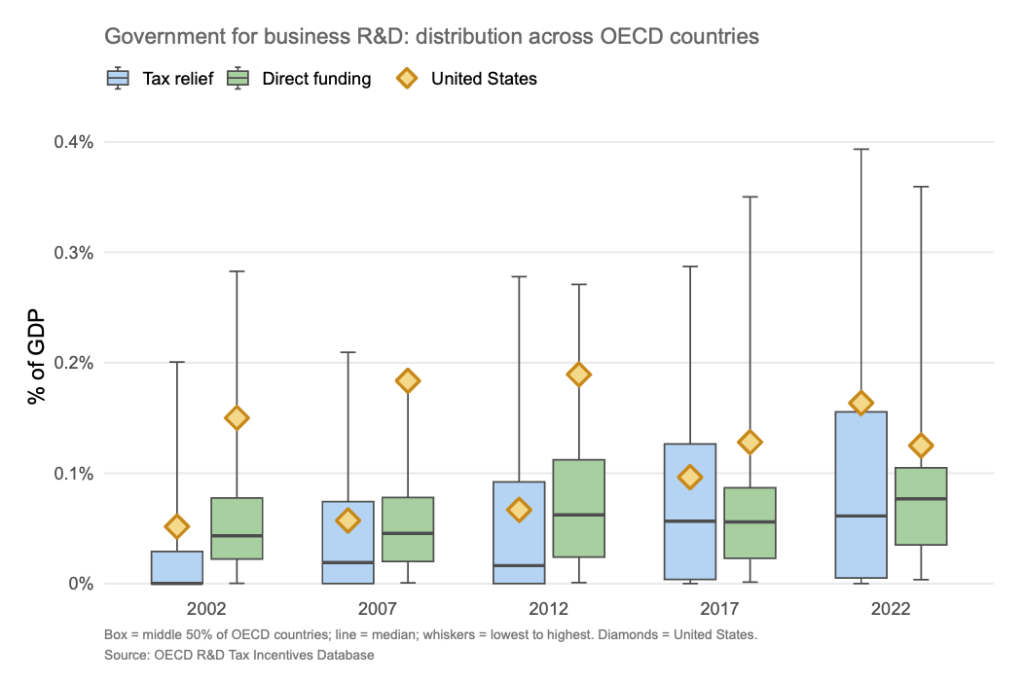
Claiming an R&D tax credit can require firms to determine which activities and expenditures qualify, work through tax-specific calculations, maintain detailed records, and navigate filing and approval requirements. These demands can extend beyond the tax department, requiring firms to collect information from employees involved in R&D and reconcile tax rules with records created for other business purposes. These rules can therefore impose substantial compliance costs and create uncertainty over whether, and to what extent, firms will ultimately receive the tax benefit.
Policymakers have long worried that these burdens may undermine the credit itself.[1] The issue is more than paperwork. An R&D tax credit is intended to change firms’ decisions at the time they decide how much to invest in R&D. If obtaining the credit is costly or its benefits are difficult to anticipate, the incentive to undertake additional R&D may be weaker than policymakers intended.
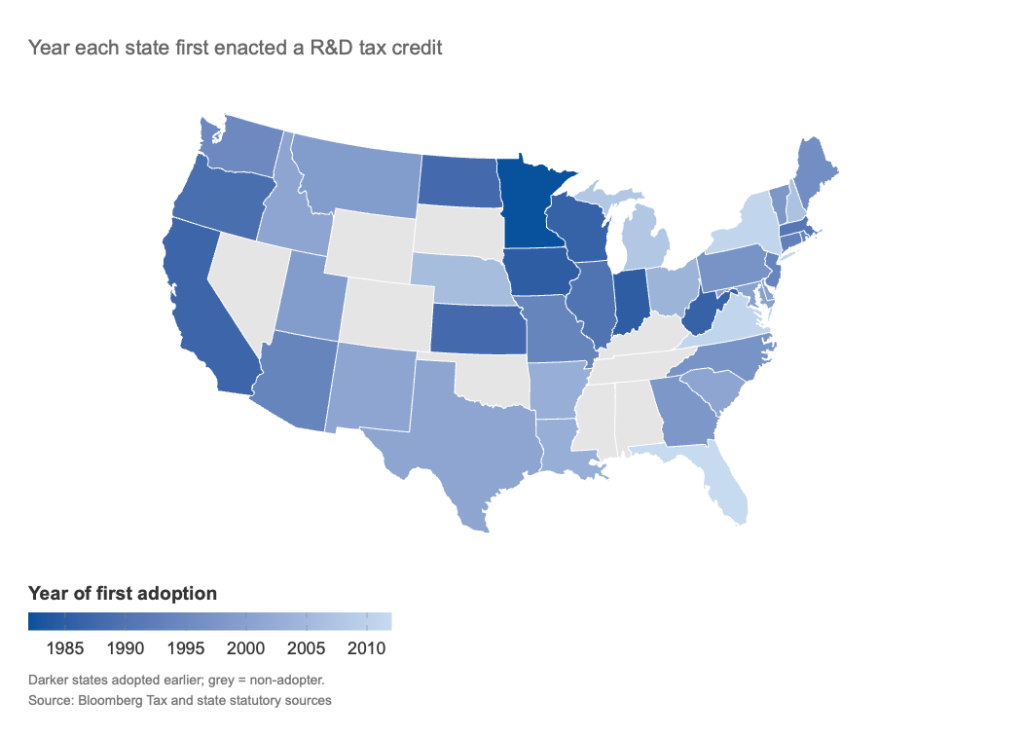
In recent research that I conducted with John Gallemore and Ed Maydew, we examine whether these concerns are well founded. We assemble four decades of historical R&D tax credit rules across U.S. states, capturing differences in qualification rules, credit calculations, application and filing procedures, and documentation. States vary considerably not only in the statutory generosity of their R&D tax credits, but also in the rules and processes firms must navigate to obtain them. Combining these policy characteristics with firms’ patenting activity, we find that firms respond more strongly to R&D tax incentives when the credits are easier to navigate. As the rules and processes become more complex, the innovation response weakens substantially.
The consequences can extend beyond the firms receiving the tax benefit. One of the main economic rationales for government support of private R&D is the knowledge it generates for others. Other firms and inventors can learn from new discoveries, build on them, and generate further innovation. These knowledge spillovers mean that the social returns to R&D can substantially exceed the private returns. Encouraging investment that generates these broader benefits is therefore an important rationale for R&D tax incentives. By weakening firms’ innovation response, tax complexity can work against that policy objective.
The burden is also not evenly distributed across firms. Navigating an R&D tax credit can require specialized tax expertise, sophisticated accounting systems, and the ability to coordinate information across different parts of an organization. Larger firms are generally better equipped with these resources and can spread the costs of navigating complex rules across a larger base of activity. Consistent with that advantage, we find that complexity has a smaller effect on the innovation response of larger firms and firms with more experience navigating government requirements. Smaller firms, by contrast, appear more susceptible to the frictions created by complex credit rules. Complexity can therefore affect not only how strongly an incentive works, but also which firms are best positioned to respond to it.
That uneven burden matters in an innovation landscape that has increasingly tilted toward large, established firms. Recent research has linked the growing concentration of innovative activity among incumbents to weaker business dynamism, reduced knowledge diffusion, and lower innovative output among inventors moving to incumbent firms.[2] Tax rules that make innovation incentives relatively harder for smaller firms to use could reinforce these broader trends.
Yet the many rules and processes surrounding R&D tax credits do not necessarily serve the same purpose. Some can help governments distinguish genuine R&D from ordinary business spending and prevent firms from simply relabeling expenses to obtain a tax benefit. Effective policy design therefore requires preserving safeguards that help target genuine R&D while reducing administrative hurdles that make the incentive unnecessarily difficult to use. Our evidence reinforces this distinction. Rules that complicate determining what qualifies and calculating the credit tend to weaken firms’ innovation response. Requirements related to reviewing and substantiating claims, however, appear to operate differently and may serve a useful screening role.
Tax complexity is therefore more than an administrative feature of an R&D tax credit. It is part of the incentive itself. Policymakers can set a credit rate intended to encourage additional innovation, but firms respond to the benefit they expect to receive after considering the full costs involved in obtaining it. More broadly, designing effective innovation tax incentives requires attention not only to how much support the tax system provides, but also to how that support is delivered. The details of implementation are not merely administrative. They help determine whether these policies ultimately achieve their intended purpose.
References
Akcigit, U., and S. T. Ates. 2023. What Happened to US Business Dynamism? Journal of Political Economy 131 (8): 2059–2124.
Akcigit, U., and N. Goldschlag. 2023. Where Have All the “Creative Talents” Gone? Employment Dynamics of US Inventors. Working Paper.
Congressional Research Service. 2016. Research Tax Credit: Current Law and Policy Issues for the 114th Congress.
Gallemore, J., E. L. Maydew, and R. X. Yao. 2026. Does Tax Complexity Hinder Innovation? Working Paper.
Joint Committee on Taxation. 2011. Tax Incentives for Research, Experimentation, and Innovation. U.S. Congress Joint Committee on Taxation.
U.S. Government Accountability Office (GAO). 2009. The Research Tax Credit’s Design and Administration Can Be Improved.
[1] For example, in 2009, Senate Finance Committee leaders commissioned a review of the federal R&D tax credit by the U.S. Government Accountability Office (GAO), aimed in part at identifying ways to reduce recordkeeping and compliance costs. Senator Chuck Grassley specifically raised concerns about the credit’s accessibility to small businesses. Similar concerns motivated subsequent reform efforts, including a 2014 House bill to simplify the credit by reducing recordkeeping requirements and complex calculations. GAO (2009), the Joint Committee on Taxation (2011), and the Congressional Research Service (2016) also highlighted compliance burdens and uncertainty surrounding the credit.
[2] Recent research documents that U.S. inventors have become increasingly concentrated at large incumbent firms and less likely to work for young firms or become entrepreneurs. Inventors who move to incumbents also subsequently produce less innovative output than those who move to young firms (Akcigit and Goldschlag 2023). Related work highlights weakening knowledge diffusion between leading and lagging firms as an important force behind the decline in U.S. business dynamism (Akcigit and Ates 2023).